Results for “modern”
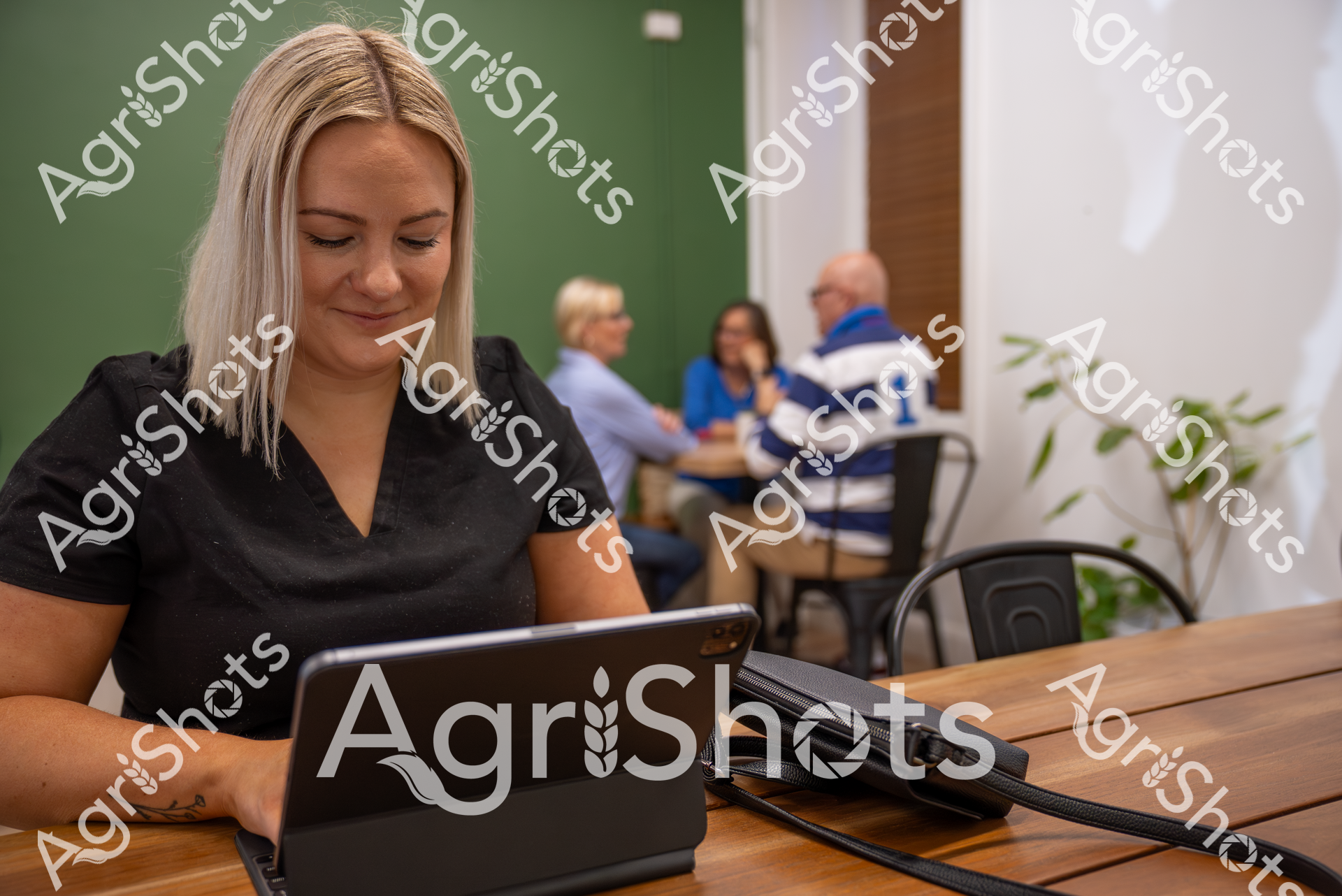
A woman in black attire works intently on an iPad at a wooden table, with blurred colleagues conversing in the background. The setting appears to be a modern office or cafe with green walls, creating a professional yet relaxed atmosphere typical of contemporary workspaces. Image

A woman in black attire works intently on an iPad at a wooden table, with blurred colleagues conversing in the background. The setting appears to be a modern office or cafe with green walls, creating a professional yet relaxed atmosphere typical of contemporary workspaces.

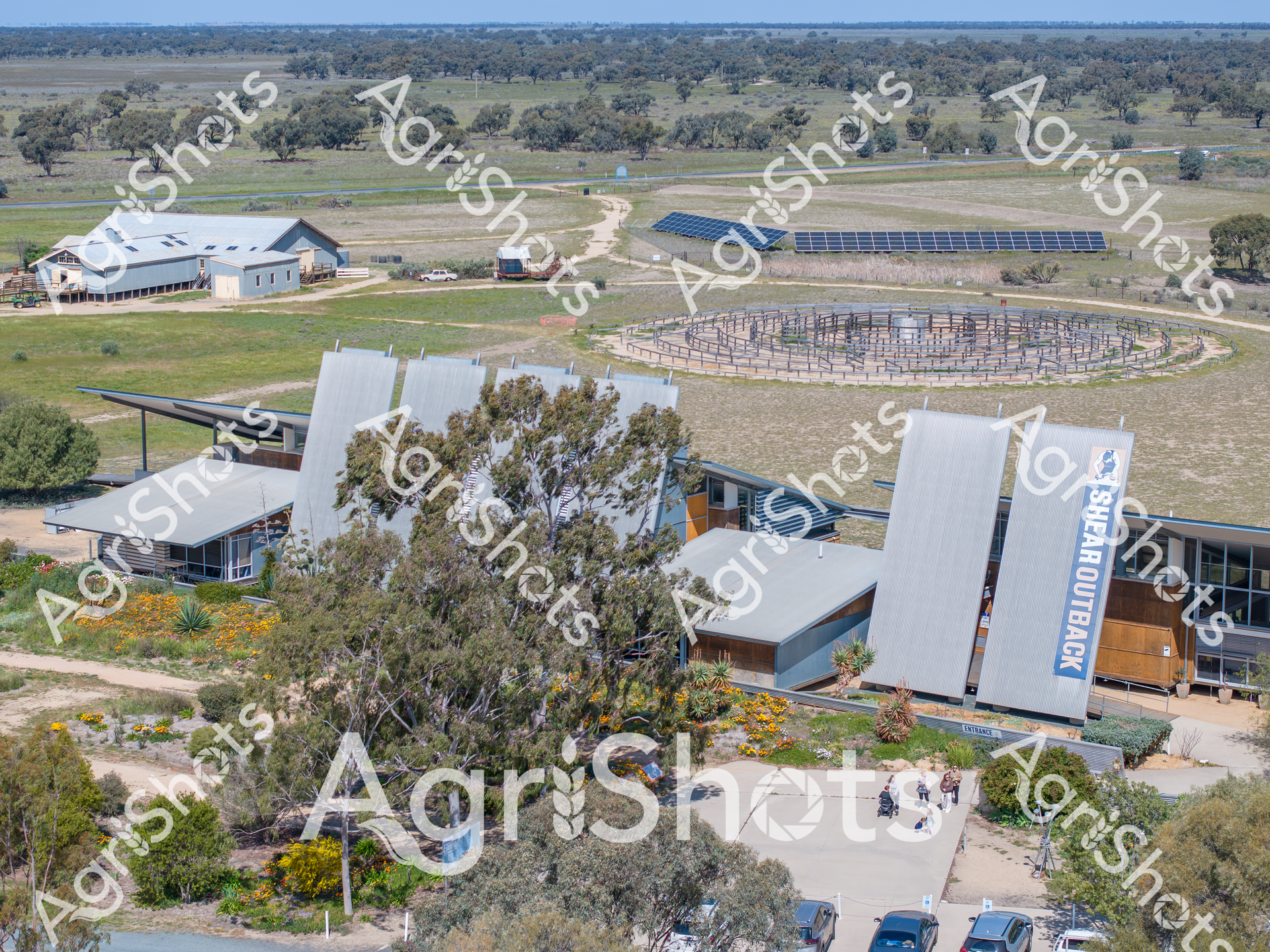
Aerial view of the Shear Outback agricultural tourism site in New South Wales' Riverina region, showcasing modern sustainable buildings, solar panels, and a circular sheep yards. The landscape features native trees, flowering gardens, and a comprehensive sheep shearing facility that highlights Australia's wool industry heritage and agricultural innovation. Image

Aerial view of the Shear Outback agricultural tourism site in New South Wales' Riverina region, showcasing modern sustainable buildings, solar panels, and a circular sheep yards. The landscape features native trees, flowering gardens, and a comprehensive sheep shearing facility that highlights Australia's wool industry heritage and agricultural innovation.
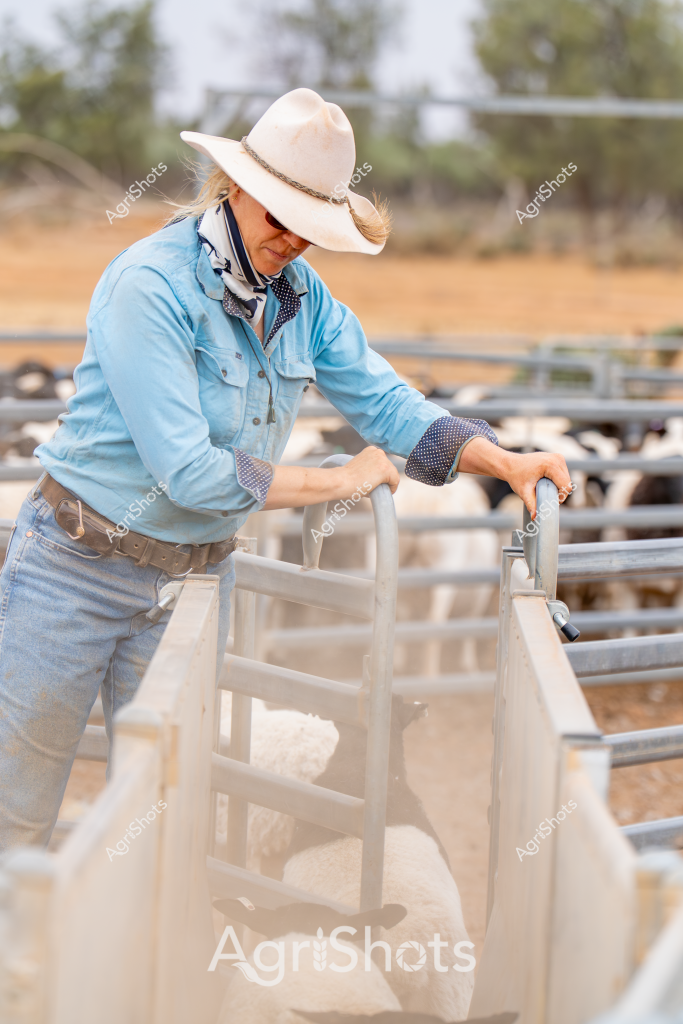
A woman stockman wearing a light blue long-sleeved shirt, pale cowboy hat, and denim jeans leans over a metal livestock gate in a dry, arid paddock setting. Her polka-dotted shirt cuffs and careful posture suggest she is working with livestock, carefully managing the gate in what appears to be a rural Australian cattle or sheep station environment. Dusty golden grasslands and scattered trees stretch into the background, with metal livestock yards creating structured boundaries. Her attentive stance and practical workwear reflect the professional approach of modern rural agricultural workers, demonstrating the hands-on nature of managing livestock in challenging Australian landscapes. The soft lighting and muted color palette capture the quiet concentration required in daily farming operations. Image

A woman stockman wearing a light blue long-sleeved shirt, pale cowboy hat, and denim jeans leans over a metal livestock gate in a dry, arid paddock setting. Her polka-dotted shirt cuffs and careful posture suggest she is working with livestock, carefully managing the gate in what appears to be a rural Australian cattle or sheep station environment. Dusty golden grasslands and scattered trees stretch into the background, with metal livestock yards creating structured boundaries. Her attentive stance and practical workwear reflect the professional approach of modern rural agricultural workers, demonstrating the hands-on nature of managing livestock in challenging Australian landscapes. The soft lighting and muted color palette capture the quiet concentration required in daily farming operations.
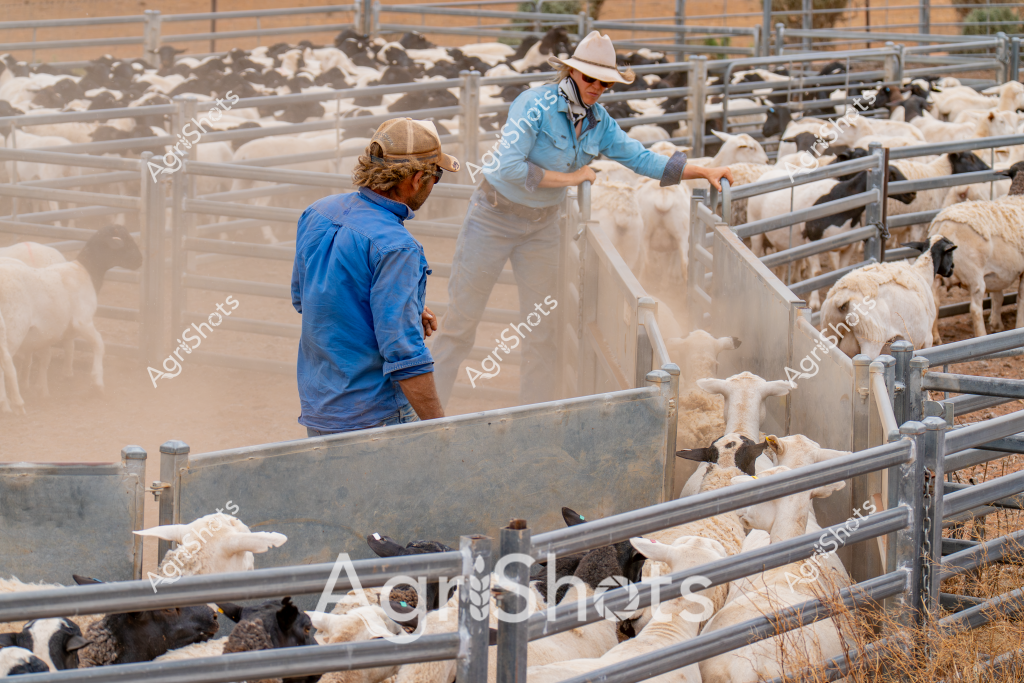
Two workers manage a flock of white and black sheep in a dusty livestock yard, demonstrating professional stock handling techniques. A woman in a light blue long-sleeved shirt and white wide-brimmed hat stands near the metal livestock gates, carefully controlling the sheep's movement, while a man in a blue shirt observes from another section of the pen. The metal livestock yards are filled with sheep of varying white and dark coloration, packed tightly within the galvanized steel fencing. Dry, golden dust rises around the animals, creating a hazy atmosphere that suggests an arid or semi-arid agricultural setting, typical of Australian sheep farming regions. The precise arrangement of the yards and the calm, methodical approach of the workers highlight the efficiency of modern livestock management practices. The scene captures the intricate work of sheep farming, where careful handling and infrastructure are critical to managing large flocks in challenging environmental conditions. Image

Two workers manage a flock of white and black sheep in a dusty livestock yard, demonstrating professional stock handling techniques. A woman in a light blue long-sleeved shirt and white wide-brimmed hat stands near the metal livestock gates, carefully controlling the sheep's movement, while a man in a blue shirt observes from another section of the pen. The metal livestock yards are filled with sheep of varying white and dark coloration, packed tightly within the galvanized steel fencing. Dry, golden dust rises around the animals, creating a hazy atmosphere that suggests an arid or semi-arid agricultural setting, typical of Australian sheep farming regions. The precise arrangement of the yards and the calm, methodical approach of the workers highlight the efficiency of modern livestock management practices. The scene captures the intricate work of sheep farming, where careful handling and infrastructure are critical to managing large flocks in challenging environmental conditions.
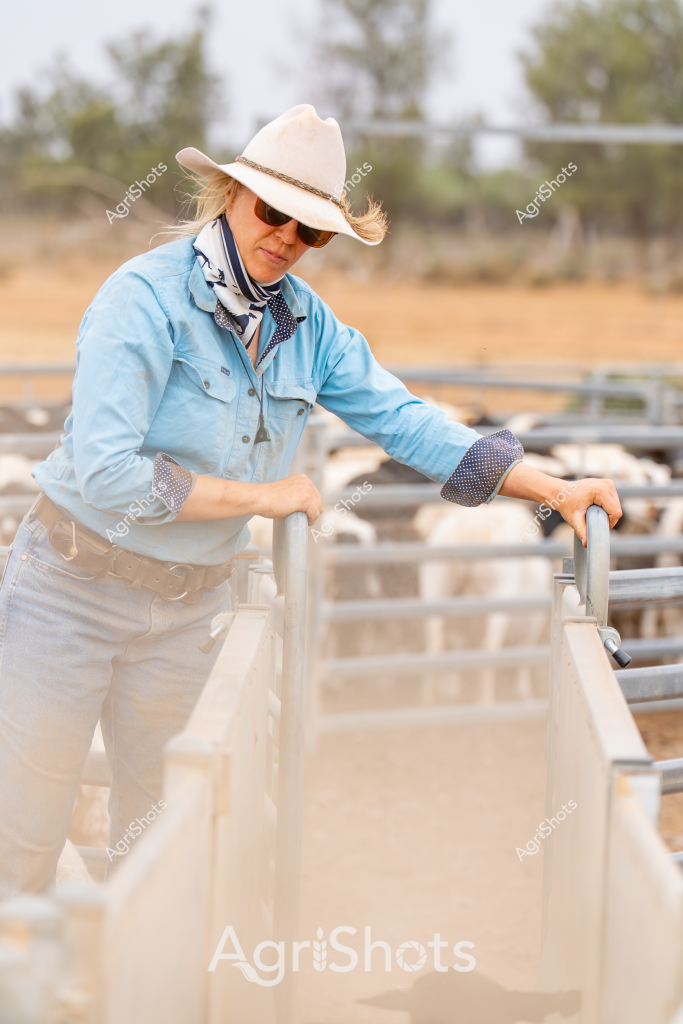
A woman stockman leans over metal livestock yards in an arid Australian pastoral landscape, wearing classic rural work attire. She's dressed in a light blue long-sleeved shirt with polka dot trim, crisp white trousers, a beige belt, and a wide-brimmed cream cowboy hat that shields her sunglasses from the harsh outback light. The surrounding environment appears dry and sparse, with scattered trees and golden-brown grasslands typical of inland Australian farming regions. Her posture suggests focused concentration as she works with the livestock yards, her hands gripping the metal rails with practiced ease. The scene captures the essence of contemporary Australian agricultural work - a professional woman managing livestock in a challenging rural environment, demonstrating the skill and resilience of modern farmers. Image

A woman stockman leans over metal livestock yards in an arid Australian pastoral landscape, wearing classic rural work attire. She's dressed in a light blue long-sleeved shirt with polka dot trim, crisp white trousers, a beige belt, and a wide-brimmed cream cowboy hat that shields her sunglasses from the harsh outback light. The surrounding environment appears dry and sparse, with scattered trees and golden-brown grasslands typical of inland Australian farming regions. Her posture suggests focused concentration as she works with the livestock yards, her hands gripping the metal rails with practiced ease. The scene captures the essence of contemporary Australian agricultural work - a professional woman managing livestock in a challenging rural environment, demonstrating the skill and resilience of modern farmers.
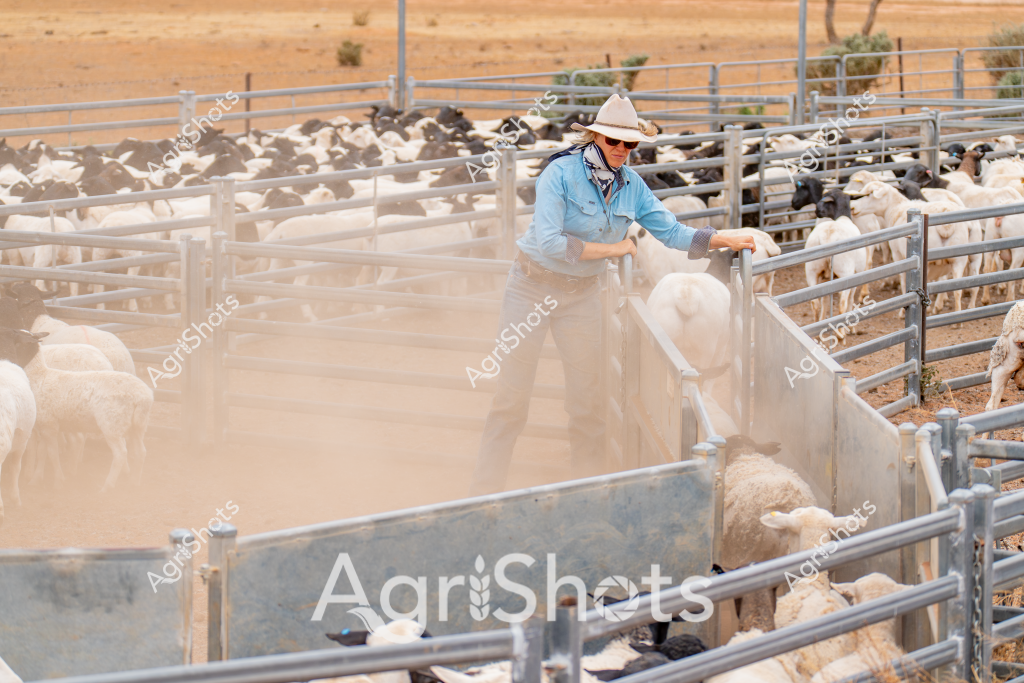
A man stockman wearing a white cowboy hat and blue work shirt manages a large flock of sheep in a dusty livestock yard. The metal cattle yards create a structured environment with multiple pens, surrounded by a dry, arid landscape typical of Australian pastoral regions. Numerous white and black sheep are densely packed within the metal fencing, creating a textured scene of agricultural activity. Dust rises around the working stockman as he carefully moves and directs the sheep, demonstrating the skill and physical demands of livestock management in challenging rural conditions. The harsh, golden-brown background suggests a hot, dry climate characteristic of inland Australian farming regions, highlighting the resilience required in agricultural work.

The scene captures the essential work of livestock management, with the stockman's careful movements and the tightly controlled environment showing the precision of modern sheep farming practices. Sunlight and dust create a golden atmosphere, emphasizing the rugged nature of Australian agricultural landscapes and the ongoing work of managing livestock in challenging environmental conditions. Image

A man stockman wearing a white cowboy hat and blue work shirt manages a large flock of sheep in a dusty livestock yard. The metal cattle yards create a structured environment with multiple pens, surrounded by a dry, arid landscape typical of Australian pastoral regions. Numerous white and black sheep are densely packed within the metal fencing, creating a textured scene of agricultural activity. Dust rises around the working stockman as he carefully moves and directs the sheep, demonstrating the skill and physical demands of livestock management in challenging rural conditions. The harsh, golden-brown background suggests a hot, dry climate characteristic of inland Australian farming regions, highlighting the resilience required in agricultural work. The scene captures the essential work of livestock management, with the stockman's careful movements and the tightly controlled environment showing the precision of modern sheep farming practices. Sunlight and dust create a golden atmosphere, emphasizing the rugged nature of Australian agricultural landscapes and the ongoing work of managing livestock in challenging environmental conditions.
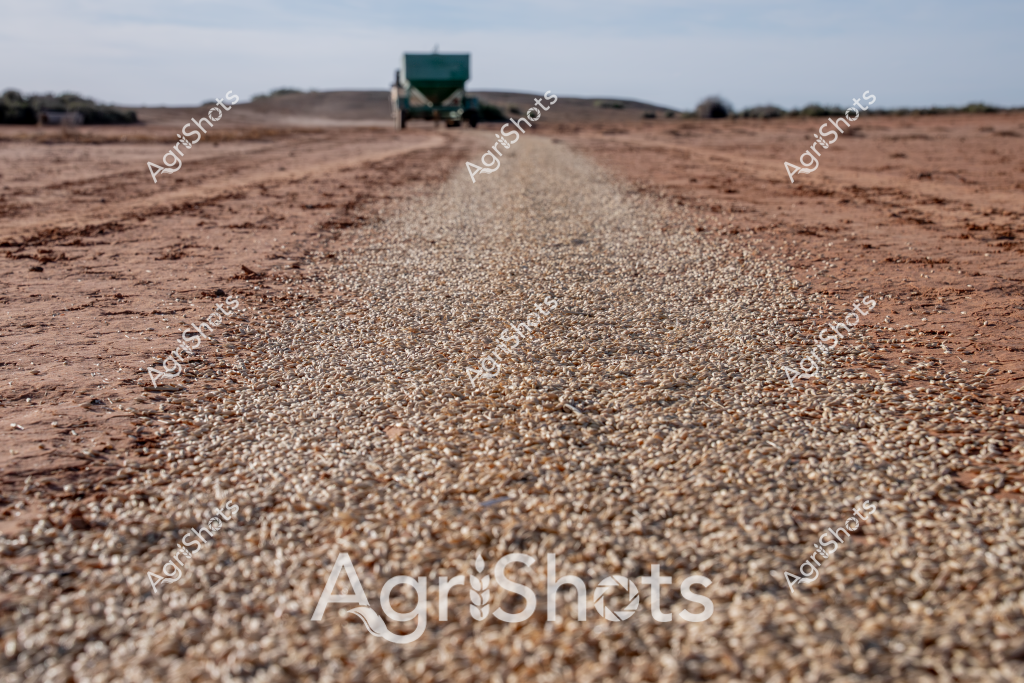
A green agricultural spreader traverses a long, narrow path of uniformly distributed gravel or seed across an arid, reddish-brown paddock landscape. The machine appears to be moving slowly, precisely dispersing its cargo in a controlled line that bisects the dry, textured terrain. The surrounding landscape consists of compacted earth in muted browns and tans, suggesting a drought-affected or semi-arid agricultural region. The horizon is flat and expansive, with a pale, overcast sky creating a sense of vastness and isolation typical of Australian rural environments. The image captures the precision of modern agricultural technology, where even in challenging environmental conditions, farmers use sophisticated equipment to manage crop planting or soil distribution with remarkable accuracy. The close-up perspective of the gravel/seed path provides a textural detail that emphasizes the methodical nature of agricultural practices in harsh landscapes. Image

A green agricultural spreader traverses a long, narrow path of uniformly distributed gravel or seed across an arid, reddish-brown paddock landscape. The machine appears to be moving slowly, precisely dispersing its cargo in a controlled line that bisects the dry, textured terrain. The surrounding landscape consists of compacted earth in muted browns and tans, suggesting a drought-affected or semi-arid agricultural region. The horizon is flat and expansive, with a pale, overcast sky creating a sense of vastness and isolation typical of Australian rural environments. The image captures the precision of modern agricultural technology, where even in challenging environmental conditions, farmers use sophisticated equipment to manage crop planting or soil distribution with remarkable accuracy. The close-up perspective of the gravel/seed path provides a textural detail that emphasizes the methodical nature of agricultural practices in harsh landscapes.
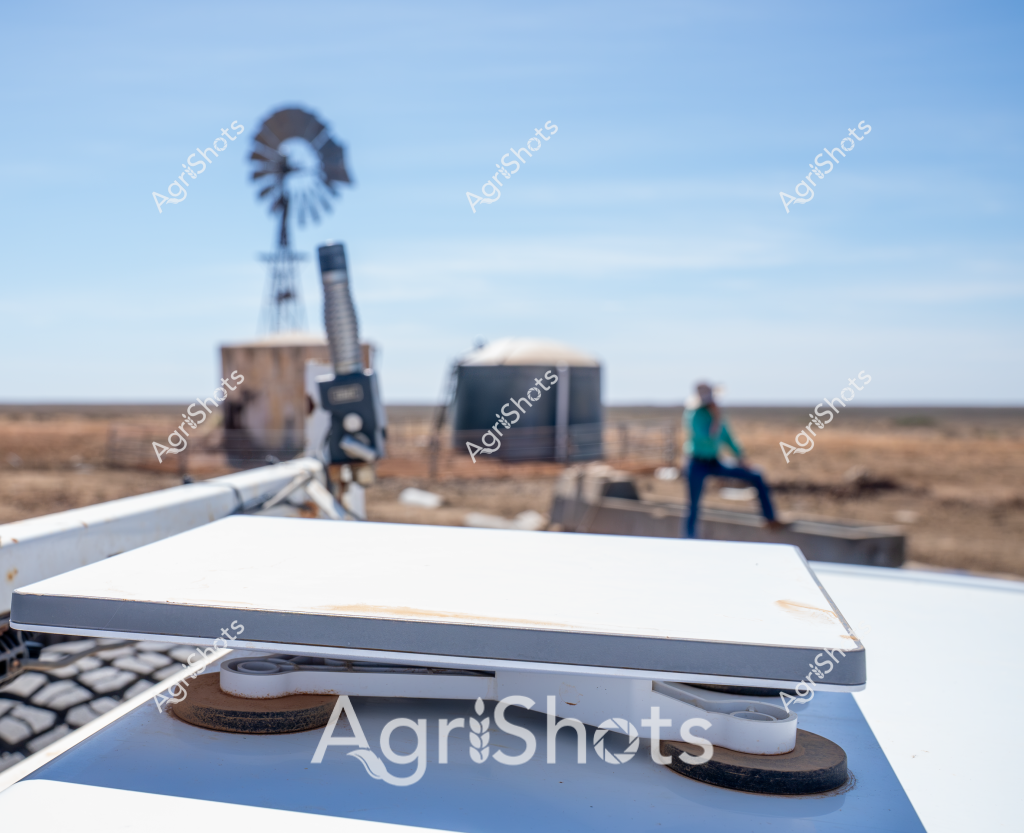
A rural scene captures an agricultural monitoring setup in a dry, expansive landscape, featuring a windmill and technical equipment in the background. In the foreground, a sophisticated white monitoring device with gray trim sits precisely positioned, its sensors and mounting points suggesting advanced data collection capabilities. A person wearing a teal-colored jacket stands near some equipment modules, indicating ongoing field research or environmental monitoring. The stark, arid terrain stretches to the horizon, with a classic Australian windmill standing tall against the clear blue sky, symbolizing traditional water management techniques alongside modern technological approaches. The muted earth tones of the landscape - browns and tans - contrast sharply with the crisp white of the monitoring equipment and the vibrant teal of the worker's clothing, creating a compelling visual narrative of contemporary agricultural science in action.

The scene represents the intersection of traditional farming infrastructure and cutting-edge environmental monitoring technology, typical of agricultural research in Australia's challenging rural environments. The careful placement of equipment suggests precise data collection, potentially related to soil conditions, climate monitoring, or agricultural research. Image

A rural scene captures an agricultural monitoring setup in a dry, expansive landscape, featuring a windmill and technical equipment in the background. In the foreground, a sophisticated white monitoring device with gray trim sits precisely positioned, its sensors and mounting points suggesting advanced data collection capabilities. A person wearing a teal-colored jacket stands near some equipment modules, indicating ongoing field research or environmental monitoring. The stark, arid terrain stretches to the horizon, with a classic Australian windmill standing tall against the clear blue sky, symbolizing traditional water management techniques alongside modern technological approaches. The muted earth tones of the landscape - browns and tans - contrast sharply with the crisp white of the monitoring equipment and the vibrant teal of the worker's clothing, creating a compelling visual narrative of contemporary agricultural science in action. The scene represents the intersection of traditional farming infrastructure and cutting-edge environmental monitoring technology, typical of agricultural research in Australia's challenging rural environments. The careful placement of equipment suggests precise data collection, potentially related to soil conditions, climate monitoring, or agricultural research.
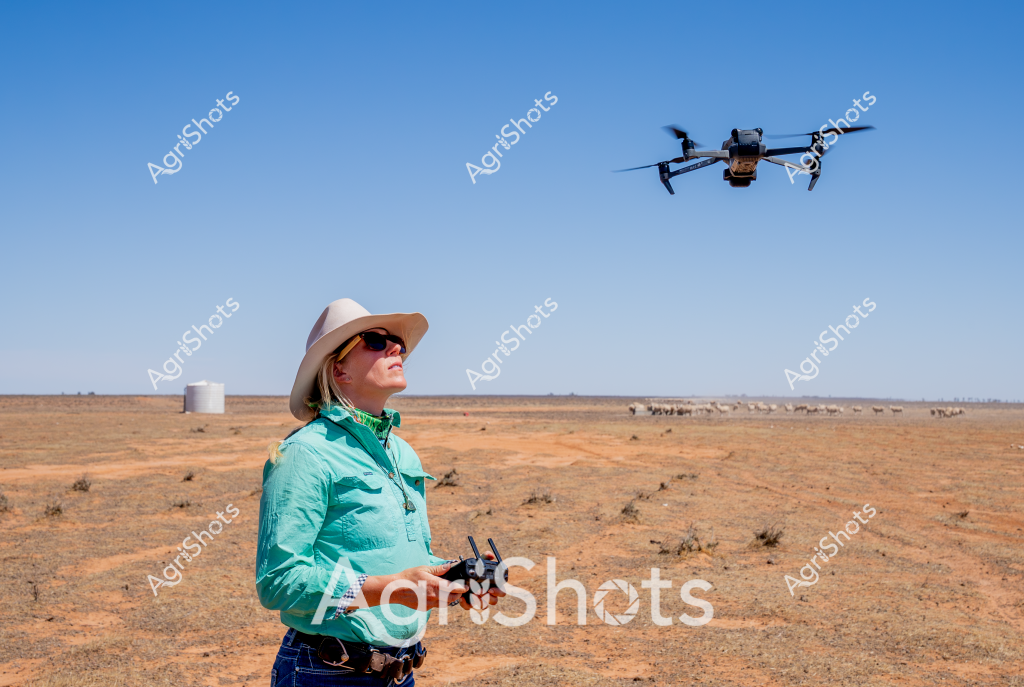
A woman in a turquoise shirt and wide-brimmed hat operates a drone in an arid, expansive Australian outback landscape. Standing confidently with a drone controller in her hands, she pilots an unmanned aerial vehicle (UAV) above a dry, reddish-brown paddock with scattered sparse vegetation. In the background, a distant water tank and a small herd of cattle can be seen, highlighting the remote agricultural setting. The clear blue sky and open terrain suggest this is a typical drone reconnaissance mission for modern farm management, likely used for monitoring livestock, assessing land conditions, or surveying crop and pasture health. Her protective clothing - including sunglasses and a wide-brimmed hat - demonstrates the harsh environmental conditions of rural Australian rangelands. Image

A woman in a turquoise shirt and wide-brimmed hat operates a drone in an arid, expansive Australian outback landscape. Standing confidently with a drone controller in her hands, she pilots an unmanned aerial vehicle (UAV) above a dry, reddish-brown paddock with scattered sparse vegetation. In the background, a distant water tank and a small herd of cattle can be seen, highlighting the remote agricultural setting. The clear blue sky and open terrain suggest this is a typical drone reconnaissance mission for modern farm management, likely used for monitoring livestock, assessing land conditions, or surveying crop and pasture health. Her protective clothing - including sunglasses and a wide-brimmed hat - demonstrates the harsh environmental conditions of rural Australian rangelands.
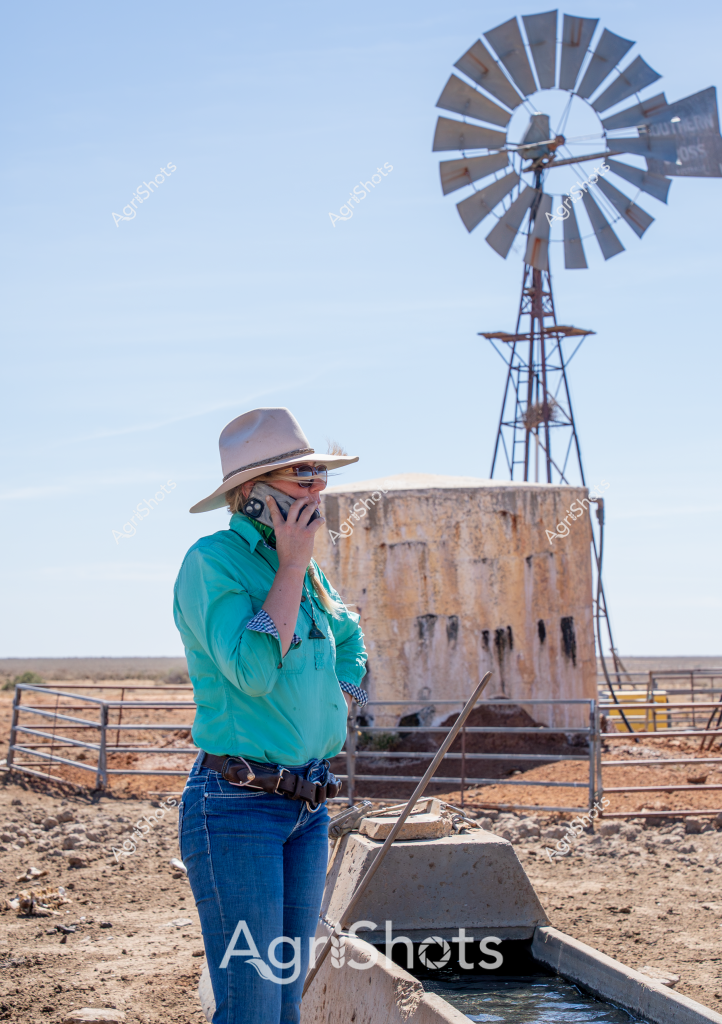
A woman farmer stands in a sun-bleached rural landscape, talking on a mobile phone beside a classic Australian windmill and water tank. Wearing a cream Akubra hat, turquoise long-sleeved shirt, and blue jeans, she appears to be managing a remote pastoral property. The metal windmill towers above a concrete water trough, with a rusted water storage tank visible in the background. The surrounding terrain is arid and rocky, typical of Australia's inland agricultural regions, with a clear blue sky suggesting a hot, dry day. Her stance and communication suggest she is coordinating farm operations or checking on livestock in this challenging outback environment.

The scene captures the essence of contemporary rural Australian agriculture - a blend of traditional infrastructure like the windmill and modern communication technology, with a resilient farmer adapting to the demands of managing agricultural land in a harsh landscape. Image

A woman farmer stands in a sun-bleached rural landscape, talking on a mobile phone beside a classic Australian windmill and water tank. Wearing a cream Akubra hat, turquoise long-sleeved shirt, and blue jeans, she appears to be managing a remote pastoral property. The metal windmill towers above a concrete water trough, with a rusted water storage tank visible in the background. The surrounding terrain is arid and rocky, typical of Australia's inland agricultural regions, with a clear blue sky suggesting a hot, dry day. Her stance and communication suggest she is coordinating farm operations or checking on livestock in this challenging outback environment. The scene captures the essence of contemporary rural Australian agriculture - a blend of traditional infrastructure like the windmill and modern communication technology, with a resilient farmer adapting to the demands of managing agricultural land in a harsh landscape.
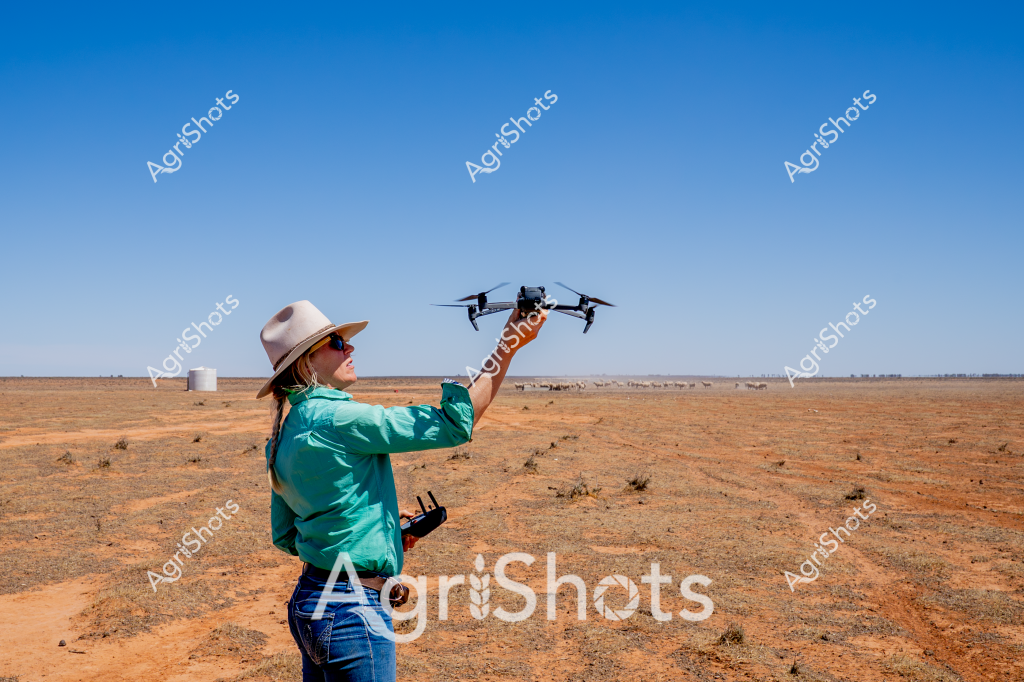
A woman in a teal shirt and wide-brimmed hat stands in a dry, expansive outback landscape, operating a drone for agricultural monitoring. The reddish-orange terrain stretches to a distant horizon, punctuated by sparse vegetation and a few water tanks in the background. She holds a drone controller while launching a quadcopter drone into the clear blue sky, demonstrating modern precision agriculture techniques. The arid environment suggests this is likely a remote cattle station or agricultural property in inland Australia, where technological solutions help farmers manage vast, challenging landscapes. Her professional stance and equipment highlight the innovative approaches used in contemporary Australian agricultural practices, bridging traditional farming with cutting-edge aerial surveying technology. Image

A woman in a teal shirt and wide-brimmed hat stands in a dry, expansive outback landscape, operating a drone for agricultural monitoring. The reddish-orange terrain stretches to a distant horizon, punctuated by sparse vegetation and a few water tanks in the background. She holds a drone controller while launching a quadcopter drone into the clear blue sky, demonstrating modern precision agriculture techniques. The arid environment suggests this is likely a remote cattle station or agricultural property in inland Australia, where technological solutions help farmers manage vast, challenging landscapes. Her professional stance and equipment highlight the innovative approaches used in contemporary Australian agricultural practices, bridging traditional farming with cutting-edge aerial surveying technology.
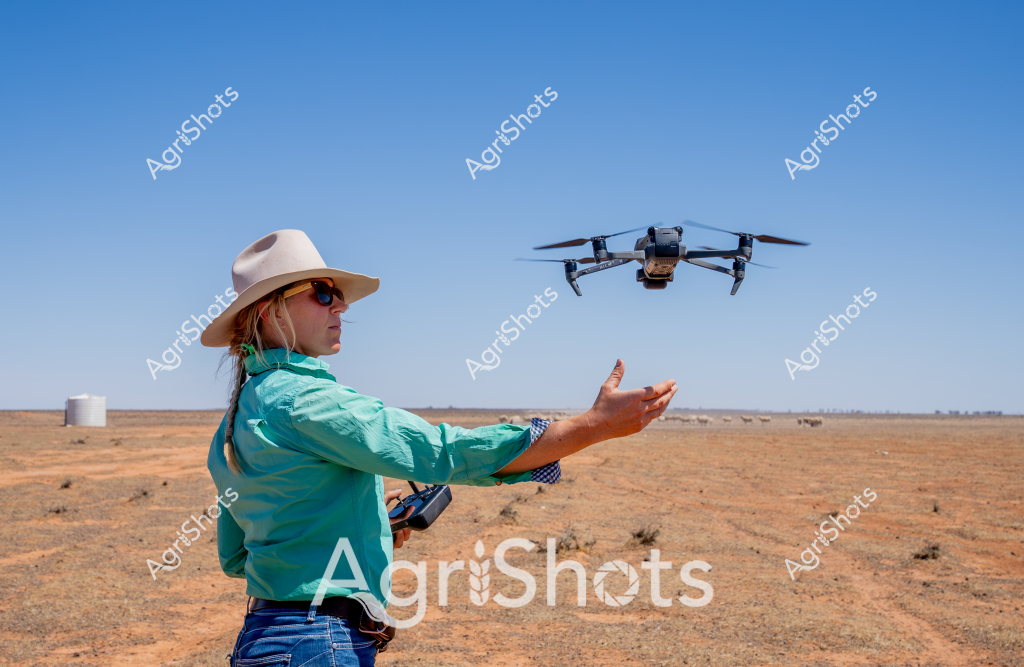
A woman in a turquoise long-sleeved shirt and wide-brimmed sun hat operates a drone in a stark, arid Australian landscape. Standing amid reddish-brown earth and sparse saltbush, she extends her hand to launch or guide a quadcopter drone, likely conducting agricultural surveying or monitoring. Wearing sunglasses to protect against the intense outback sunlight, she holds a remote control, demonstrating modern precision agricultural technology in a remote, dry environment. A white water tank is visible in the distant background, suggesting this is a rural station or farm property. The clear blue sky and open terrain highlight the expansive nature of Australian agricultural landscapes, where technological solutions are increasingly used to manage and understand challenging environmental conditions. Image

A woman in a turquoise long-sleeved shirt and wide-brimmed sun hat operates a drone in a stark, arid Australian landscape. Standing amid reddish-brown earth and sparse saltbush, she extends her hand to launch or guide a quadcopter drone, likely conducting agricultural surveying or monitoring. Wearing sunglasses to protect against the intense outback sunlight, she holds a remote control, demonstrating modern precision agricultural technology in a remote, dry environment. A white water tank is visible in the distant background, suggesting this is a rural station or farm property. The clear blue sky and open terrain highlight the expansive nature of Australian agricultural landscapes, where technological solutions are increasingly used to manage and understand challenging environmental conditions.
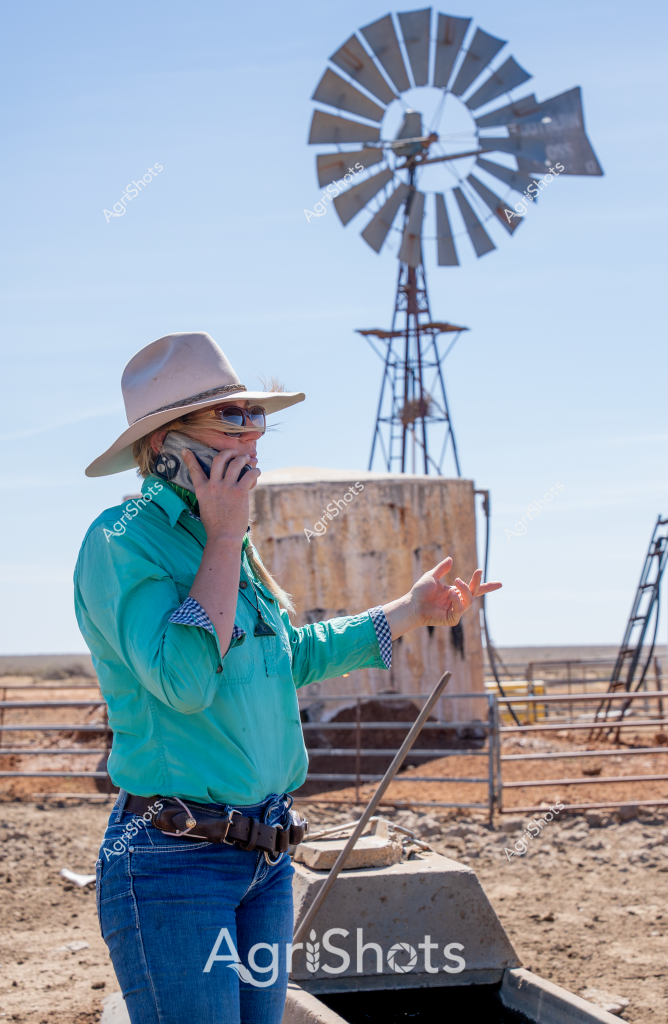
A woman wearing a broad-brimmed hat and teal work shirt stands in a dry, arid landscape beside a classic windmill and water tank. She is talking on a mobile phone while gesturing with her other hand, her stance conveying a sense of focused communication amid the stark rural setting. The windmill's metal blades stand silhouetted against a clear blue sky, while a concrete water tank and sparse fencing suggest this is a remote agricultural property. Her outfit - a crisp turquoise shirt, blue jeans, and a neutral-toned hat - reflects typical Australian rural workwear, highlighting the resilience and practical nature of farmers working in challenging outback conditions. The scene captures the essence of modern agricultural communication, where technology meets traditional farming landscapes. Image

A woman wearing a broad-brimmed hat and teal work shirt stands in a dry, arid landscape beside a classic windmill and water tank. She is talking on a mobile phone while gesturing with her other hand, her stance conveying a sense of focused communication amid the stark rural setting. The windmill's metal blades stand silhouetted against a clear blue sky, while a concrete water tank and sparse fencing suggest this is a remote agricultural property. Her outfit - a crisp turquoise shirt, blue jeans, and a neutral-toned hat - reflects typical Australian rural workwear, highlighting the resilience and practical nature of farmers working in challenging outback conditions. The scene captures the essence of modern agricultural communication, where technology meets traditional farming landscapes.
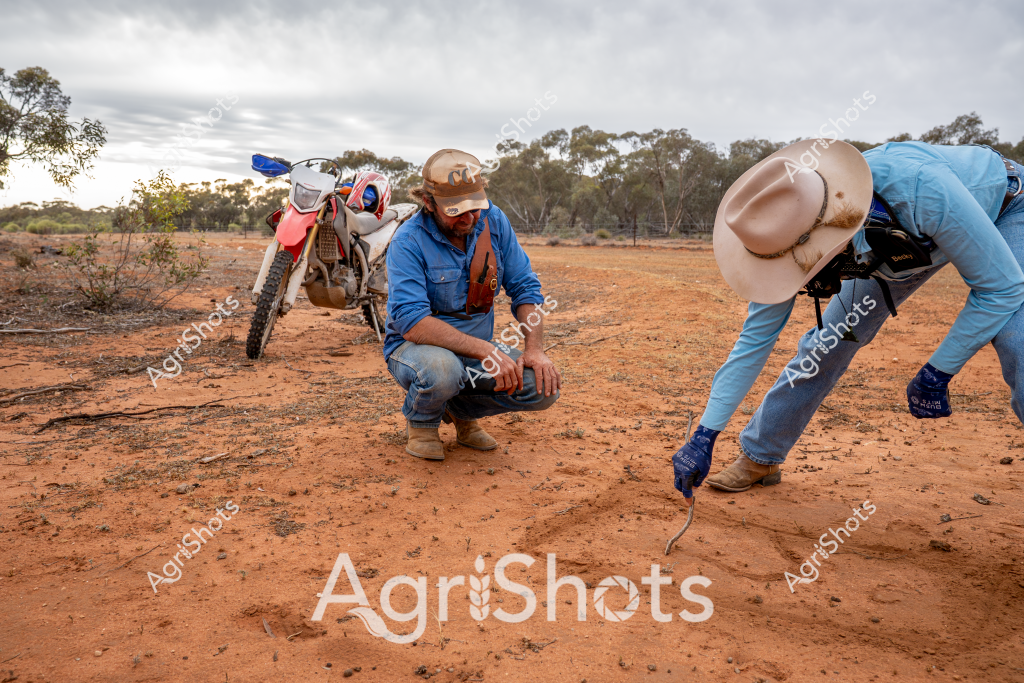
In the arid Australian outback, two men inspect the ground near a dirt bike, their clothing and posture revealing a deep connection to the rugged landscape. A man in a blue work shirt and tan hat crouches carefully, while another in light blue clothing and a broad-brimmed hat bends down, examining something on the red earth. A white and red dirt bike stands nearby, suggesting they've traveled some distance across this remote terrain. 

The scene captures the quintessential Australian rural working environment - a sparse landscape of reddish soil, scattered eucalyptus trees in the background, and an overcast sky creating a muted, atmospheric light. Their careful inspection could be related to soil conditions, tracking, or some agricultural assessment typical of station or farm work. The motorcycle indicates the vast distances that must be traversed in such remote regions, where traditional transportation methods meet modern rural technology.

The men's attire - robust work shirts, protective hats, and sturdy boots - speaks to the practical necessities of working in harsh environmental conditions. Their focused postures suggest expertise and a methodical approach to understanding the landscape, embodying the resilience and problem-solving spirit characteristic of Australian rural workers. Image

In the arid Australian outback, two men inspect the ground near a dirt bike, their clothing and posture revealing a deep connection to the rugged landscape. A man in a blue work shirt and tan hat crouches carefully, while another in light blue clothing and a broad-brimmed hat bends down, examining something on the red earth. A white and red dirt bike stands nearby, suggesting they've traveled some distance across this remote terrain. The scene captures the quintessential Australian rural working environment - a sparse landscape of reddish soil, scattered eucalyptus trees in the background, and an overcast sky creating a muted, atmospheric light. Their careful inspection could be related to soil conditions, tracking, or some agricultural assessment typical of station or farm work. The motorcycle indicates the vast distances that must be traversed in such remote regions, where traditional transportation methods meet modern rural technology. The men's attire - robust work shirts, protective hats, and sturdy boots - speaks to the practical necessities of working in harsh environmental conditions. Their focused postures suggest expertise and a methodical approach to understanding the landscape, embodying the resilience and problem-solving spirit characteristic of Australian rural workers.
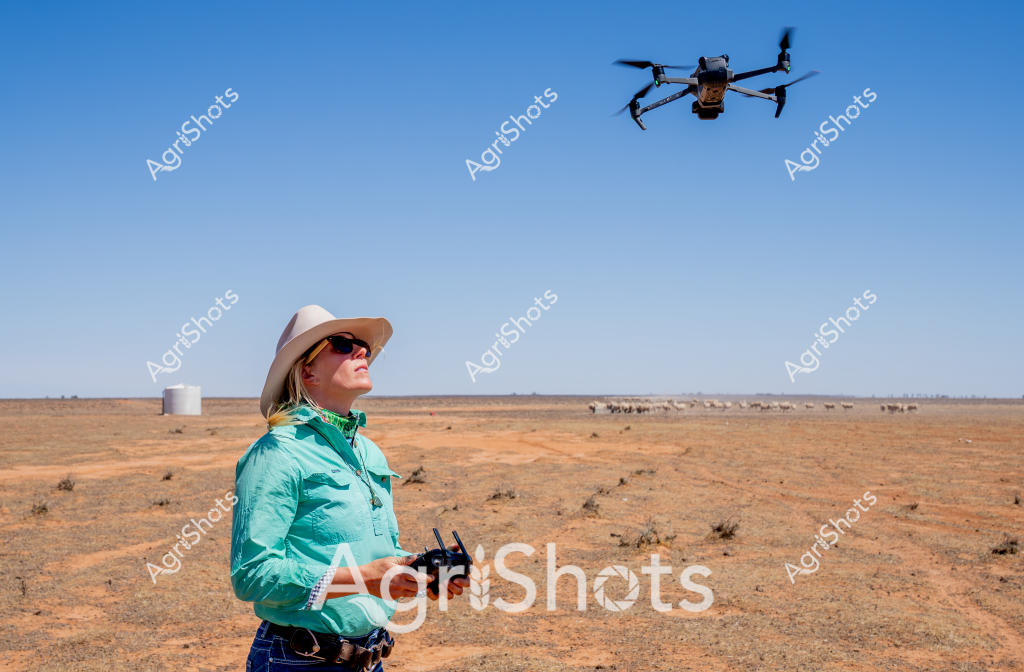
A woman in a turquoise long-sleeved shirt and a wide-brimmed sun hat stands in a dry, expansive outback landscape, operating a drone with precision. The arid terrain stretches to the horizon, dotted with sparse vegetation and a distant water tank, while a herd of cattle grazes in the far background. A professional-grade drone hovers overhead, capturing aerial imagery of the remote pastoral property. The clear blue sky and reddish-orange soil create a stark, quintessential Australian agricultural scene that highlights the modern technological approaches used in contemporary farm management. The woman's focused stance and professional equipment demonstrate the increasing integration of drone technology in monitoring livestock, assessing land conditions, and managing large-scale agricultural properties across Australia's challenging rural landscapes. Image

A woman in a turquoise long-sleeved shirt and a wide-brimmed sun hat stands in a dry, expansive outback landscape, operating a drone with precision. The arid terrain stretches to the horizon, dotted with sparse vegetation and a distant water tank, while a herd of cattle grazes in the far background. A professional-grade drone hovers overhead, capturing aerial imagery of the remote pastoral property. The clear blue sky and reddish-orange soil create a stark, quintessential Australian agricultural scene that highlights the modern technological approaches used in contemporary farm management. The woman's focused stance and professional equipment demonstrate the increasing integration of drone technology in monitoring livestock, assessing land conditions, and managing large-scale agricultural properties across Australia's challenging rural landscapes.
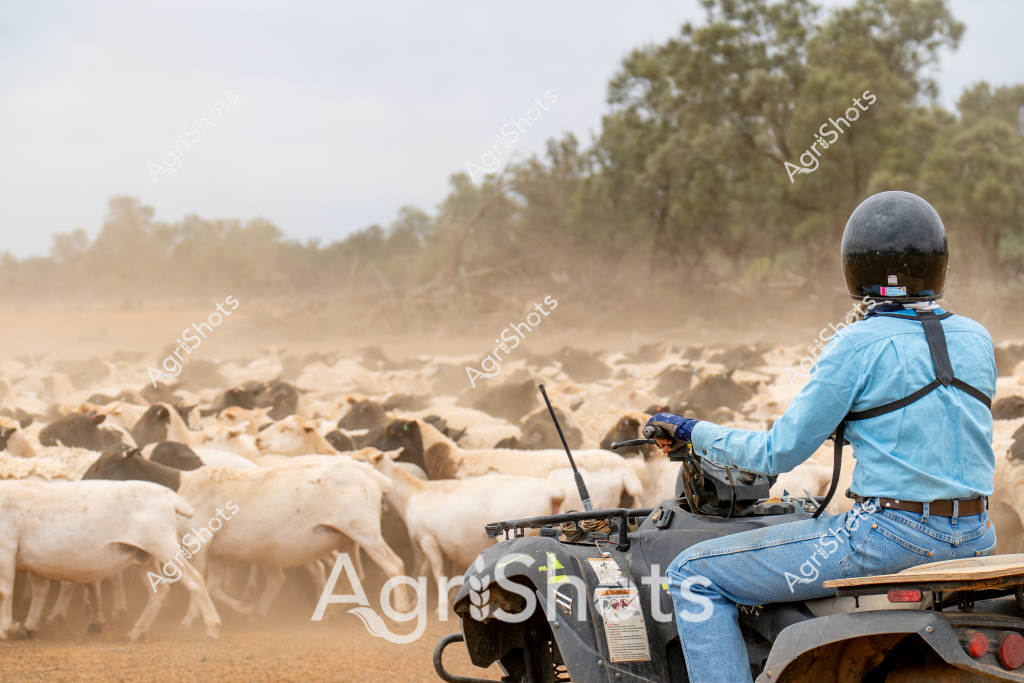
A man stockman seated on an all-terrain vehicle (ATV) manages a large herd of white and light-colored cattle in a dusty, tree-lined paddock. Wearing a blue shirt, jeans, and a protective helmet, he navigates the vehicle carefully among the densely packed livestock, raising a cloud of fine Australian dust. The cattle appear to be moving as a tight, cohesive group, suggesting an organized muster or stock movement typical of extensive pastoral operations.

Trees line the distant horizon, creating a classic Australian rural landscape backdrop, while the dusty conditions hint at the dry, challenging environmental conditions often encountered in agricultural regions. The stockman's positioning on the ATV demonstrates modern livestock management techniques, replacing traditional horseback mustering with more efficient mechanized approaches.

The scene captures the essence of Australian cattle farming - a blend of skill, technology, and adaptation to harsh rural environments. The dust, the dense herd, and the careful management by the stockman illustrate the demanding nature of livestock production in Australia's expansive agricultural landscapes. Image

A man stockman seated on an all-terrain vehicle (ATV) manages a large herd of white and light-colored cattle in a dusty, tree-lined paddock. Wearing a blue shirt, jeans, and a protective helmet, he navigates the vehicle carefully among the densely packed livestock, raising a cloud of fine Australian dust. The cattle appear to be moving as a tight, cohesive group, suggesting an organized muster or stock movement typical of extensive pastoral operations. Trees line the distant horizon, creating a classic Australian rural landscape backdrop, while the dusty conditions hint at the dry, challenging environmental conditions often encountered in agricultural regions. The stockman's positioning on the ATV demonstrates modern livestock management techniques, replacing traditional horseback mustering with more efficient mechanized approaches. The scene captures the essence of Australian cattle farming - a blend of skill, technology, and adaptation to harsh rural environments. The dust, the dense herd, and the careful management by the stockman illustrate the demanding nature of livestock production in Australia's expansive agricultural landscapes.
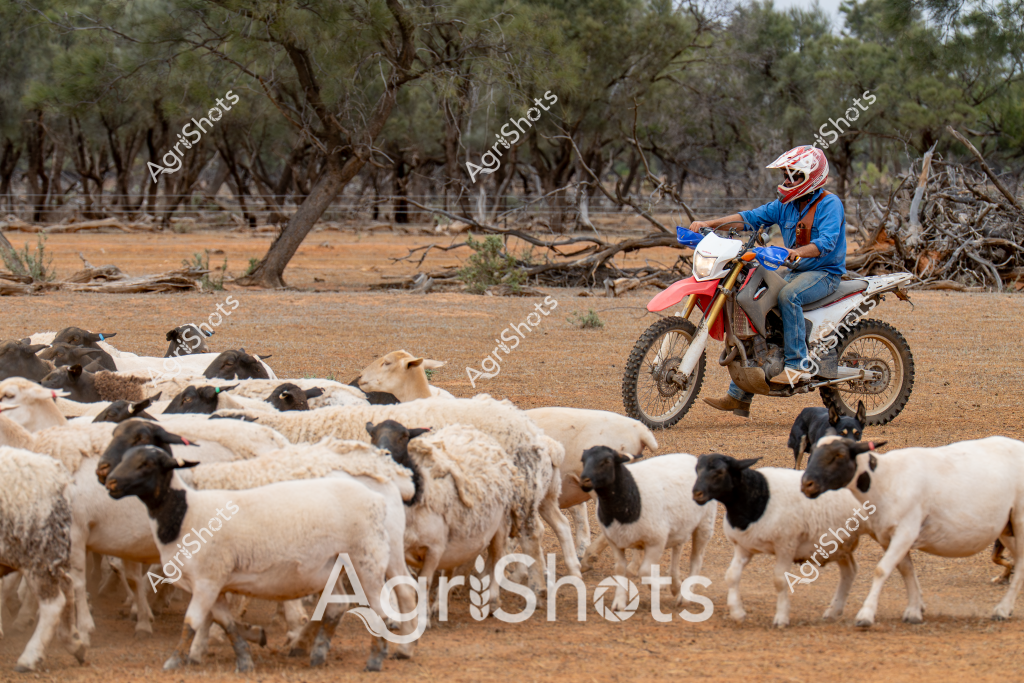
A man on a dirt bike carefully herds a flock of white and black-faced sheep across a dry, sparse landscape with scattered eucalyptus trees. Wearing a blue jacket, red and white helmet, and riding a red trail motorcycle, the rider navigates through the sheep, using the motorcycle as a herding tool in this rugged Australian rural setting. The sheep - which appear to be a breed like Dorper or Suffolk cross - are clustered together, creating a tight mob as they move across the dusty, tree-lined paddock. A small black dog can be seen near the motorcycle, potentially assisting with the livestock movement. The scene captures the adaptability of modern Australian farming, where motorcycles have become an efficient alternative to horses for mustering livestock across challenging terrain. The dry ground, sparse vegetation, and scattered fallen timber suggest this is likely in an inland region experiencing dry seasonal conditions. Image

A man on a dirt bike carefully herds a flock of white and black-faced sheep across a dry, sparse landscape with scattered eucalyptus trees. Wearing a blue jacket, red and white helmet, and riding a red trail motorcycle, the rider navigates through the sheep, using the motorcycle as a herding tool in this rugged Australian rural setting. The sheep - which appear to be a breed like Dorper or Suffolk cross - are clustered together, creating a tight mob as they move across the dusty, tree-lined paddock. A small black dog can be seen near the motorcycle, potentially assisting with the livestock movement. The scene captures the adaptability of modern Australian farming, where motorcycles have become an efficient alternative to horses for mustering livestock across challenging terrain. The dry ground, sparse vegetation, and scattered fallen timber suggest this is likely in an inland region experiencing dry seasonal conditions.
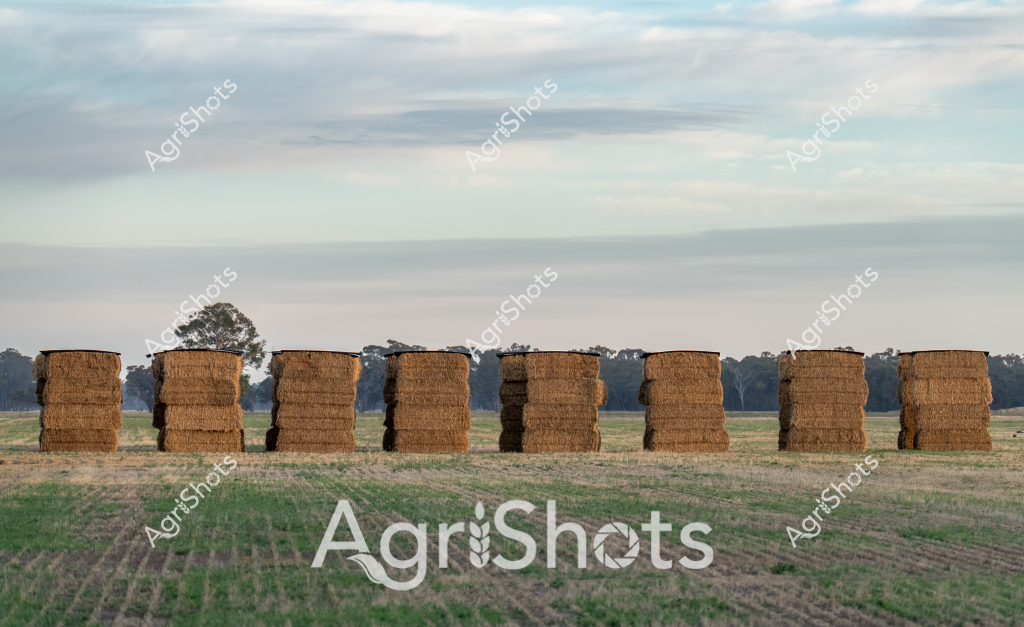
A series of golden hay bales stands neatly arranged in a linear formation across a rural agricultural landscape, creating a rhythmic pattern against the soft, overcast sky. The rectangular straw bales, tightly compressed and stacked vertically, represent the result of careful harvesting and storage techniques used by Australian farmers. Muted green and brown grasses of the harvested paddock stretch out before the hay stacks, with distant eucalyptus trees marking the horizon line. The uniform arrangement of the bales suggests systematic agricultural practice, highlighting the precision and efficiency of modern farming methods. A subtle gradient of soft blues and grays in the sky provides a gentle backdrop to the golden-brown tones of the hay, creating a classic Australian rural scene that captures the essence of broadacre farming and hay production. Image

A series of golden hay bales stands neatly arranged in a linear formation across a rural agricultural landscape, creating a rhythmic pattern against the soft, overcast sky. The rectangular straw bales, tightly compressed and stacked vertically, represent the result of careful harvesting and storage techniques used by Australian farmers. Muted green and brown grasses of the harvested paddock stretch out before the hay stacks, with distant eucalyptus trees marking the horizon line. The uniform arrangement of the bales suggests systematic agricultural practice, highlighting the precision and efficiency of modern farming methods. A subtle gradient of soft blues and grays in the sky provides a gentle backdrop to the golden-brown tones of the hay, creating a classic Australian rural scene that captures the essence of broadacre farming and hay production.
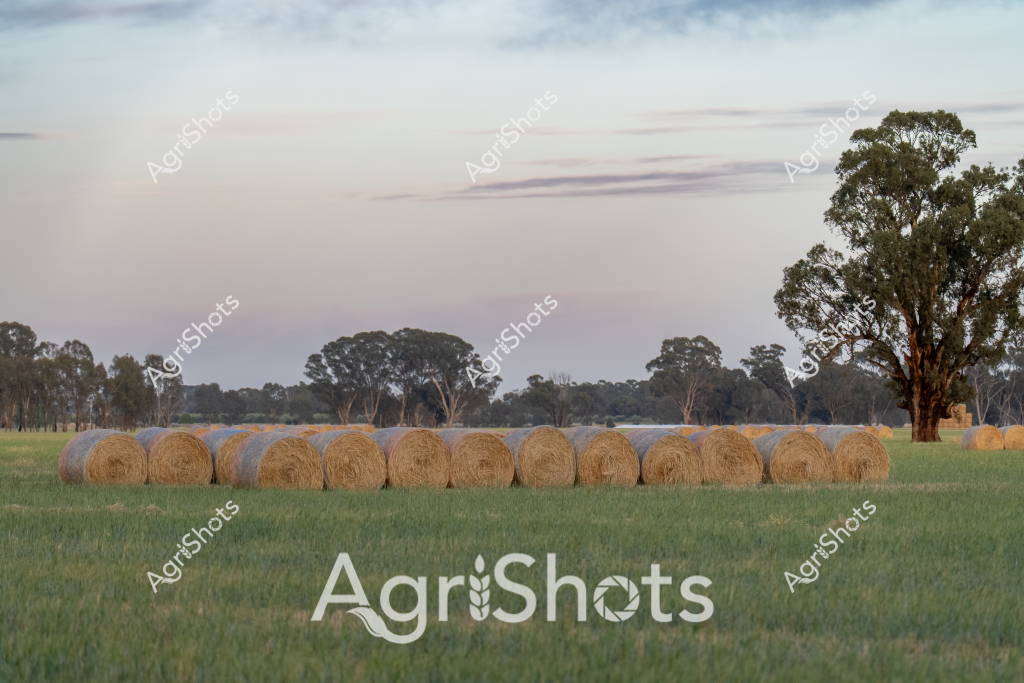
A picturesque rural landscape showcases a neat row of golden hay bales lined up in a verdant green field, capturing the essence of Australian agricultural harvest. The round bales, tightly wrapped and uniform in size, represent the successful collection of hay during what appears to be a late summer or early autumn season. Mature eucalyptus trees frame the background, creating a classic Australian rural vista with soft, muted tones in the sky suggesting early morning or evening light. The landscape stretches out with a sense of quiet productivity, with trees dotting the horizon and the neatly arranged hay bales demonstrating the precision and efficiency of modern farming practices. The soft pastel sky and lush green grass create a tranquil atmosphere that speaks to the rhythms of agricultural life in rural Australia. This scene epitomizes the careful land management and harvesting techniques used by farmers to prepare feed for livestock during drier seasons. Image

A picturesque rural landscape showcases a neat row of golden hay bales lined up in a verdant green field, capturing the essence of Australian agricultural harvest. The round bales, tightly wrapped and uniform in size, represent the successful collection of hay during what appears to be a late summer or early autumn season. Mature eucalyptus trees frame the background, creating a classic Australian rural vista with soft, muted tones in the sky suggesting early morning or evening light. The landscape stretches out with a sense of quiet productivity, with trees dotting the horizon and the neatly arranged hay bales demonstrating the precision and efficiency of modern farming practices. The soft pastel sky and lush green grass create a tranquil atmosphere that speaks to the rhythms of agricultural life in rural Australia. This scene epitomizes the careful land management and harvesting techniques used by farmers to prepare feed for livestock during drier seasons.
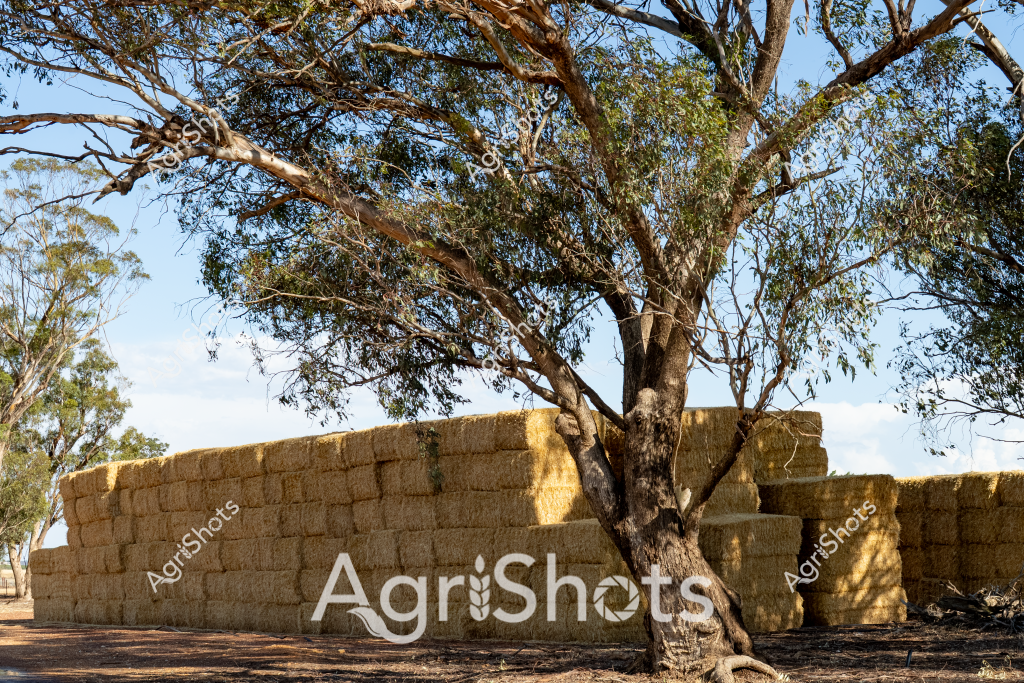
A large stack of golden hay bales stands stacked methodically beside a mature eucalyptus tree, casting deep shadows in the bright Australian rural landscape. The rectangular hay bales are neatly arranged in multiple layers, creating a substantial storage wall of compressed crop residue typical of broadacre farming practices. Sunlight highlights the textured straw, revealing varying golden and tan hues that speak to the quality of the harvested hay. The surrounding landscape includes additional gum trees and an expansive blue sky, suggesting this is likely a scene from a wheat or mixed farming region in rural Australia. The carefully constructed hay stack represents an important agricultural storage strategy, protecting valuable livestock feed and demonstrating the precision of modern farming techniques. The tree provides natural shade and visual contrast to the geometric hay bale structure, emphasizing the harmonious relationship between natural and cultivated elements in the agricultural landscape. Image

A large stack of golden hay bales stands stacked methodically beside a mature eucalyptus tree, casting deep shadows in the bright Australian rural landscape. The rectangular hay bales are neatly arranged in multiple layers, creating a substantial storage wall of compressed crop residue typical of broadacre farming practices. Sunlight highlights the textured straw, revealing varying golden and tan hues that speak to the quality of the harvested hay. The surrounding landscape includes additional gum trees and an expansive blue sky, suggesting this is likely a scene from a wheat or mixed farming region in rural Australia. The carefully constructed hay stack represents an important agricultural storage strategy, protecting valuable livestock feed and demonstrating the precision of modern farming techniques. The tree provides natural shade and visual contrast to the geometric hay bale structure, emphasizing the harmonious relationship between natural and cultivated elements in the agricultural landscape.
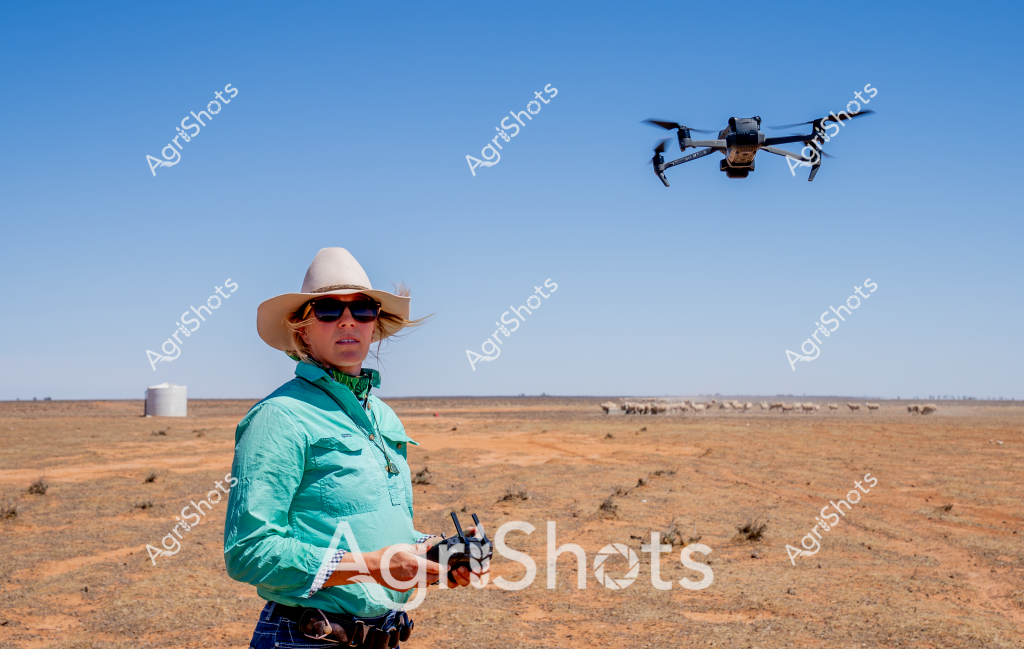
A woman agricultural worker operates a drone in a dry, expansive outback landscape, surveying livestock and monitoring farm conditions. Wearing a light turquoise long-sleeved shirt, a wide-brimmed sun hat, and sunglasses, she stands confidently in the arid terrain, controlling a quadcopter drone hovering above the reddish-brown earth. In the distant background, a small white water tank and a scattered herd of cattle can be seen, highlighting the remote and challenging agricultural environment. The clear blue sky and sparse, scrubby vegetation emphasize the harsh conditions of this rural Australian setting. The drone provides a critical tool for modern farm management, allowing for aerial surveillance and data collection across vast, hard-to-access properties. Image

A woman agricultural worker operates a drone in a dry, expansive outback landscape, surveying livestock and monitoring farm conditions. Wearing a light turquoise long-sleeved shirt, a wide-brimmed sun hat, and sunglasses, she stands confidently in the arid terrain, controlling a quadcopter drone hovering above the reddish-brown earth. In the distant background, a small white water tank and a scattered herd of cattle can be seen, highlighting the remote and challenging agricultural environment. The clear blue sky and sparse, scrubby vegetation emphasize the harsh conditions of this rural Australian setting. The drone provides a critical tool for modern farm management, allowing for aerial surveillance and data collection across vast, hard-to-access properties.
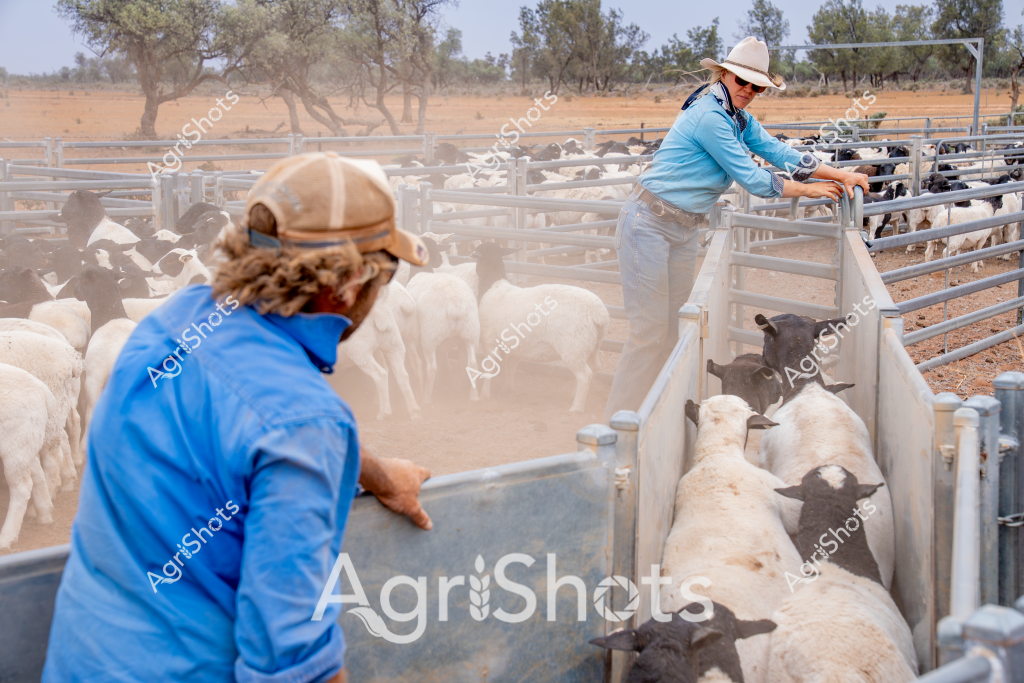
Two women livestock managers work together in a dusty sheep yard, carefully guiding a mob of white and black sheep through metal livestock gates and narrow race. Wearing blue long-sleeved shirts and wide-brimmed hats for sun protection, they move deliberately and professionally, managing the flow of animals in a dry, arid paddock with scattered eucalyptus trees in the background. The intense cloud of dust kicked up by the sheep's movement suggests a hot, dry day typical of Australian rural agricultural conditions. Metal livestock handling infrastructure allows precise movement and control of the flock, highlighting the skill and expertise required in modern sheep management. The rugged landscape and methodical work illustrate the challenging yet essential nature of livestock production in Australia's demanding rural environments. Image

Two women livestock managers work together in a dusty sheep yard, carefully guiding a mob of white and black sheep through metal livestock gates and narrow race. Wearing blue long-sleeved shirts and wide-brimmed hats for sun protection, they move deliberately and professionally, managing the flow of animals in a dry, arid paddock with scattered eucalyptus trees in the background. The intense cloud of dust kicked up by the sheep's movement suggests a hot, dry day typical of Australian rural agricultural conditions. Metal livestock handling infrastructure allows precise movement and control of the flock, highlighting the skill and expertise required in modern sheep management. The rugged landscape and methodical work illustrate the challenging yet essential nature of livestock production in Australia's demanding rural environments.
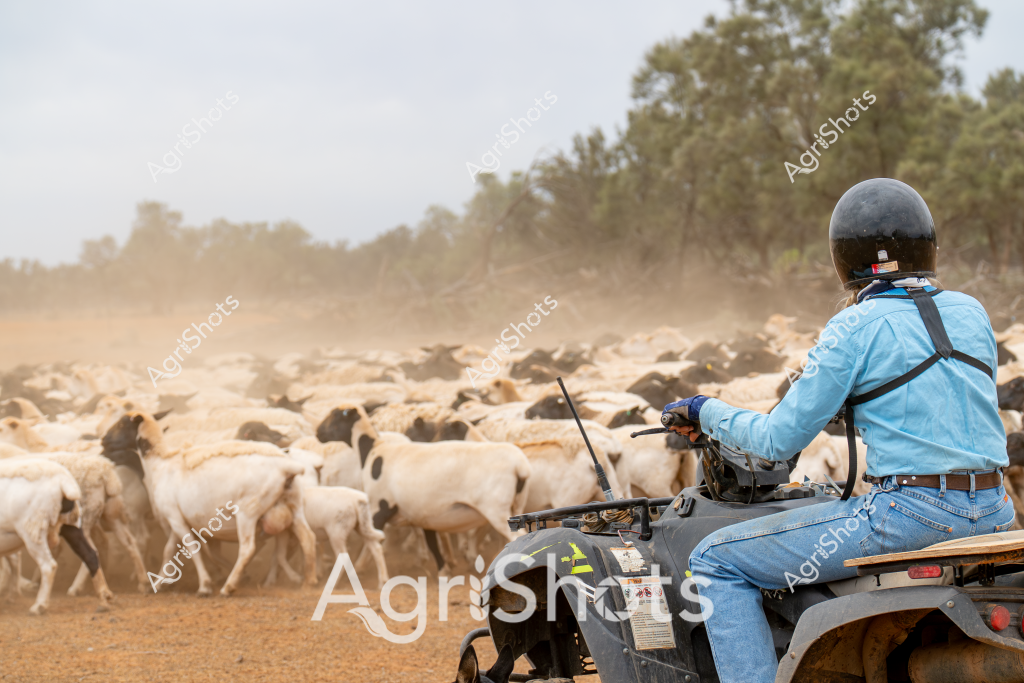
A man on an all-terrain vehicle (ATV) guides a large flock of white and mixed-colored goats across a dry, dusty paddock in rural Australia. Wearing a blue shirt, helmet, and carrying a radio, the livestock manager carefully steers the ATV through the herd, raising a cloud of fine dirt behind him. The landscape is characterized by sparse ground vegetation and distant eucalyptus trees, suggesting a dry pastoral region typical of Australia's inland areas. Dozens of goats move together in a tight cluster, their varied coat colors of white, tan, and brown creating a mottled appearance against the brown earth. The scene captures the challenging yet essential work of livestock management in an arid agricultural setting, highlighting the skill required to muster and control a large herd across open terrain. The dust and movement convey the dynamic nature of pastoral farming, with the ATV serving as a critical tool for modern livestock handling. Image

A man on an all-terrain vehicle (ATV) guides a large flock of white and mixed-colored goats across a dry, dusty paddock in rural Australia. Wearing a blue shirt, helmet, and carrying a radio, the livestock manager carefully steers the ATV through the herd, raising a cloud of fine dirt behind him. The landscape is characterized by sparse ground vegetation and distant eucalyptus trees, suggesting a dry pastoral region typical of Australia's inland areas. Dozens of goats move together in a tight cluster, their varied coat colors of white, tan, and brown creating a mottled appearance against the brown earth. The scene captures the challenging yet essential work of livestock management in an arid agricultural setting, highlighting the skill required to muster and control a large herd across open terrain. The dust and movement convey the dynamic nature of pastoral farming, with the ATV serving as a critical tool for modern livestock handling.
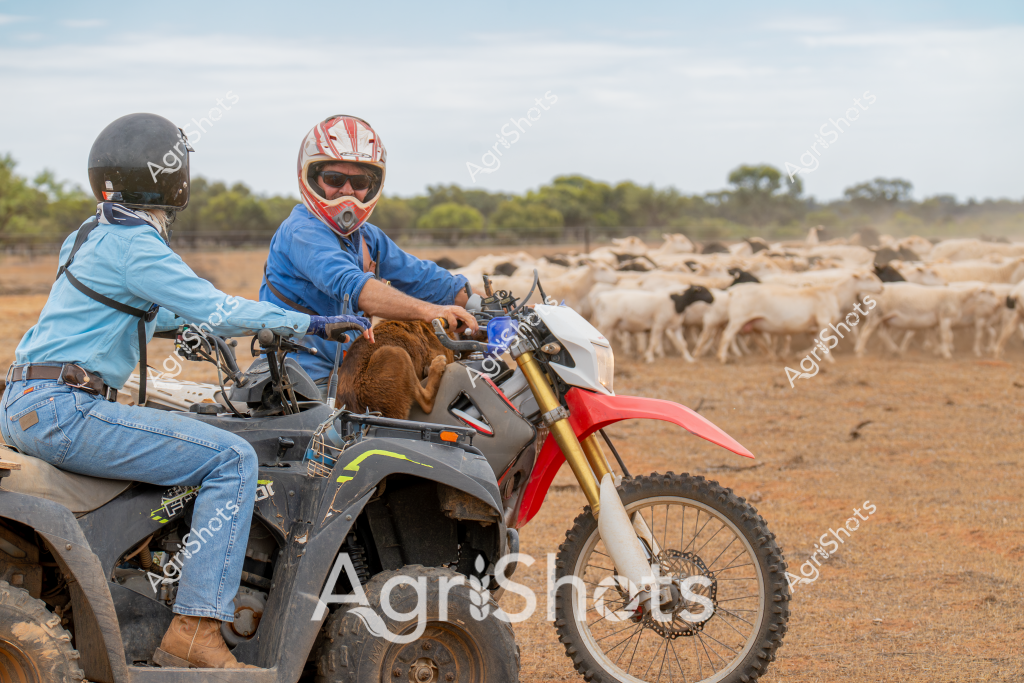
Two riders on off-road motorcycles guide a flock of white sheep across a dry, golden paddock in rural Australia. A woman in a light blue shirt and denim jeans sits on a quad bike, while a man in a blue shirt and red-and-white motocross helmet rides a dirt bike beside her. The landscape is typical of the Australian interior - sparse, dusty ground with scattered trees on the horizon and a herd of woolly sheep clustered in the background. 

The motorcycles appear well-equipped for farm work, with the dirt bike featuring a striking red and white color scheme and the quad bike looking robust and functional. Both riders are wearing protective gear, including helmets and sturdy clothing, suggesting they are actively mustering or moving the livestock across the property. 

The scene captures the essence of modern Australian livestock management, where motorized vehicles have replaced traditional horse-based mustering, demonstrating the evolving techniques of farm work in the contemporary agricultural landscape. The dry terrain and sparse vegetation hint at challenging environmental conditions typical of many Australian grazing regions. Image

Two riders on off-road motorcycles guide a flock of white sheep across a dry, golden paddock in rural Australia. A woman in a light blue shirt and denim jeans sits on a quad bike, while a man in a blue shirt and red-and-white motocross helmet rides a dirt bike beside her. The landscape is typical of the Australian interior - sparse, dusty ground with scattered trees on the horizon and a herd of woolly sheep clustered in the background. The motorcycles appear well-equipped for farm work, with the dirt bike featuring a striking red and white color scheme and the quad bike looking robust and functional. Both riders are wearing protective gear, including helmets and sturdy clothing, suggesting they are actively mustering or moving the livestock across the property. The scene captures the essence of modern Australian livestock management, where motorized vehicles have replaced traditional horse-based mustering, demonstrating the evolving techniques of farm work in the contemporary agricultural landscape. The dry terrain and sparse vegetation hint at challenging environmental conditions typical of many Australian grazing regions.