Results for “industrial”
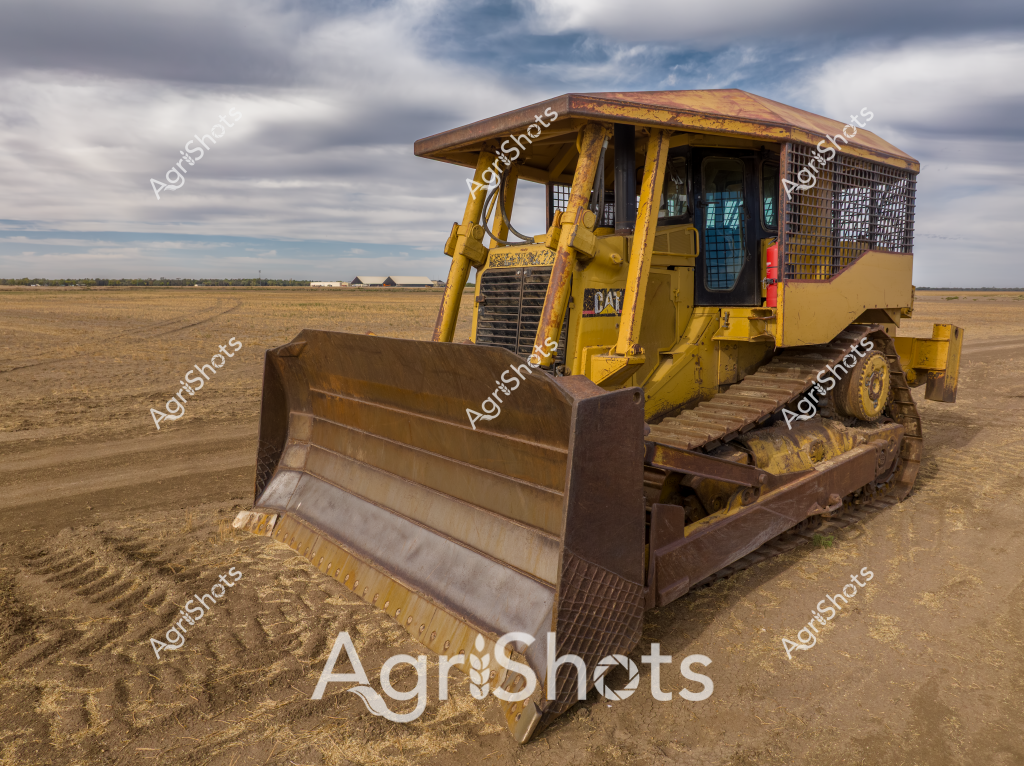
A yellow Caterpillar bulldozer sits positioned on a dry, expansive agricultural landscape under a cloudy, dramatic sky. The heavy-duty construction equipment, painted in its distinctive bright yellow color, features protective metal mesh guards on the operator's cabin and a large, sturdy blade for earthmoving and land preparation. Mounted on robust tracked wheels, the bulldozer appears ready for agricultural or construction work, with its blade leaving distinct tread marks in the dusty, light brown soil. The surrounding landscape is a broad, flat terrain with distant farm structures visible on the horizon, suggesting this is likely a rural farming or agricultural development site. The machine's weathered appearance - with some rust and wear on the blade and body - indicates it has seen significant use in challenging outdoor conditions. The overcast sky with layers of gray and white clouds adds a moody atmospheric backdrop to this powerful piece of agricultural and construction equipment. Image

A yellow Caterpillar bulldozer sits positioned on a dry, expansive agricultural landscape under a cloudy, dramatic sky. The heavy-duty construction equipment, painted in its distinctive bright yellow color, features protective metal mesh guards on the operator's cabin and a large, sturdy blade for earthmoving and land preparation. Mounted on robust tracked wheels, the bulldozer appears ready for agricultural or construction work, with its blade leaving distinct tread marks in the dusty, light brown soil. The surrounding landscape is a broad, flat terrain with distant farm structures visible on the horizon, suggesting this is likely a rural farming or agricultural development site. The machine's weathered appearance - with some rust and wear on the blade and body - indicates it has seen significant use in challenging outdoor conditions. The overcast sky with layers of gray and white clouds adds a moody atmospheric backdrop to this powerful piece of agricultural and construction equipment.
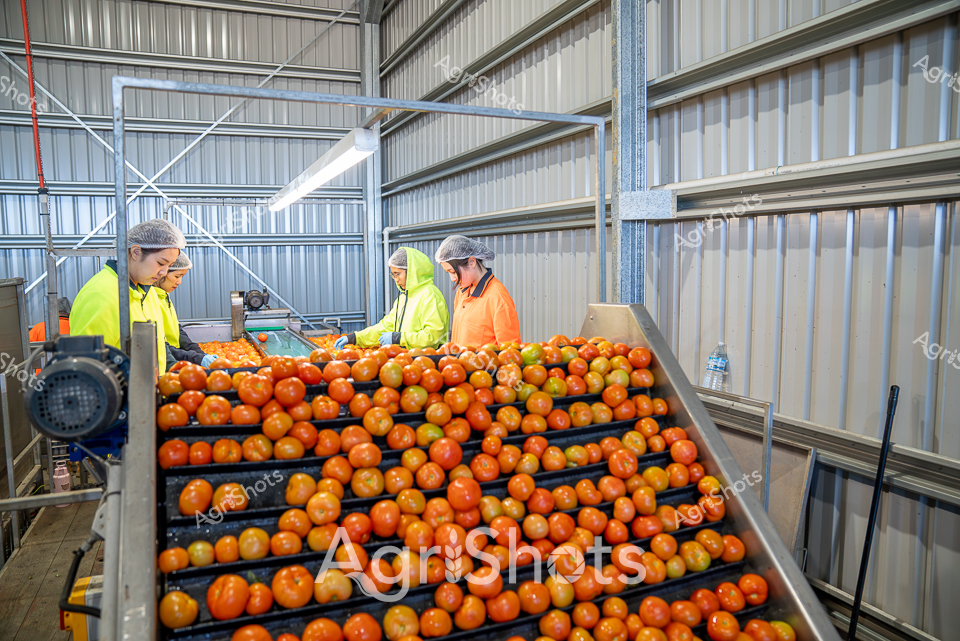
Rows of ripe, vibrant tomatoes cascade across sorting conveyor belts in a modern packing shed. Workers wearing high-visibility safety gear and protective hairnets meticulously grade and process the fresh produce, their careful movements ensuring only the highest quality tomatoes move forward. The gleaming metal infrastructure and precise industrial setup highlight the precision of modern agricultural processing in Queensland's renowned Queensland growing region. Image

Rows of ripe, vibrant tomatoes cascade across sorting conveyor belts in a modern packing shed. Workers wearing high-visibility safety gear and protective hairnets meticulously grade and process the fresh produce, their careful movements ensuring only the highest quality tomatoes move forward. The gleaming metal infrastructure and precise industrial setup highlight the precision of modern agricultural processing in Queensland's renowned Queensland growing region.
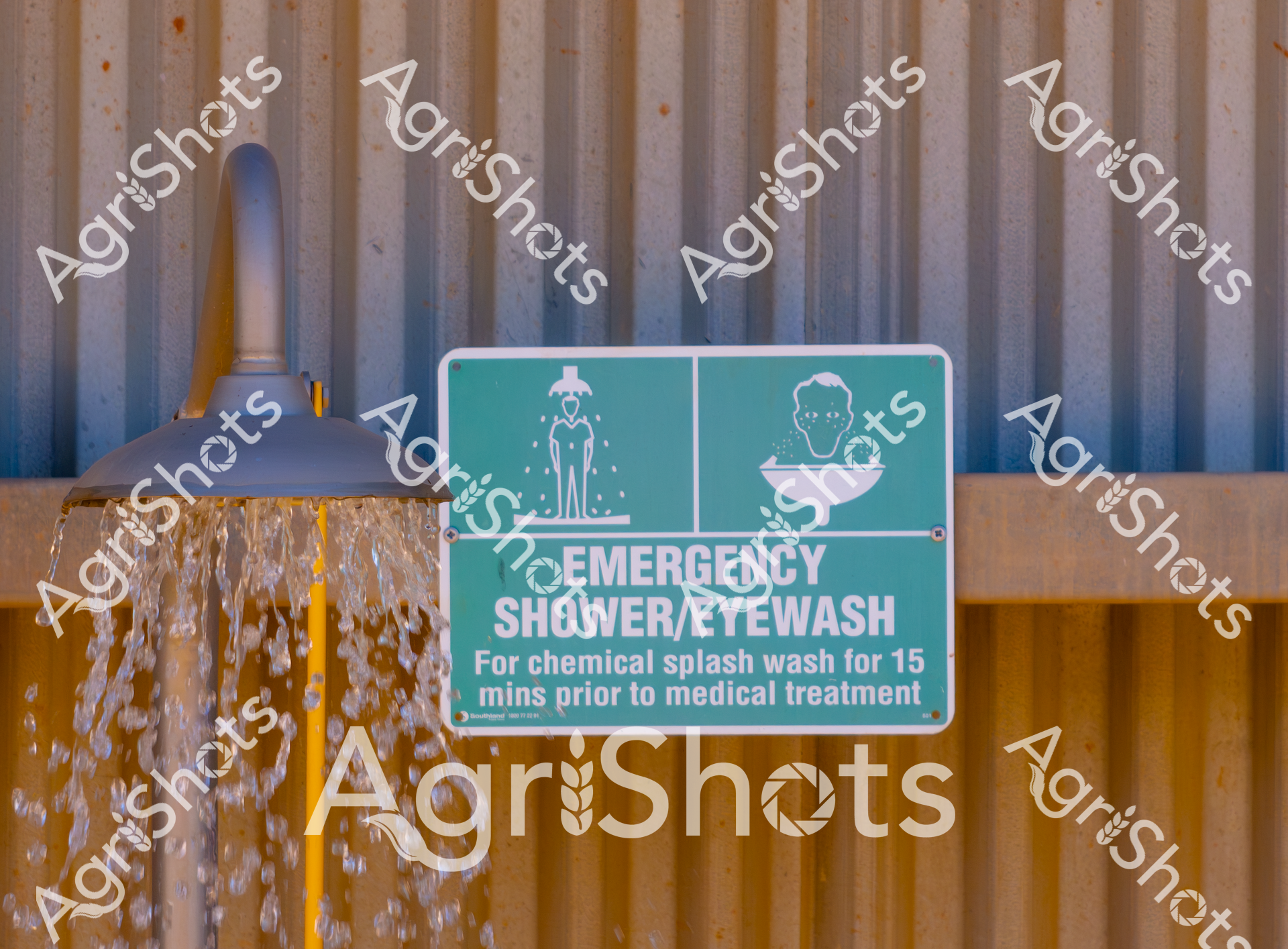
Safety protocol comes into sharp focus in this industrial workplace emergency preparedness scene. A teal-colored emergency shower and eyewash station sign stands prominently against a corrugated metal background, with an active safety shower streaming water dramatically in the foreground. The signage provides critical instructions for chemical splash decontamination, specifying a 15-minute wash protocol prior to medical treatment. Iconographic figures demonstrate the proper use of the emergency shower and eyewash station, emphasizing worker safety procedures in potentially hazardous environments. Water droplets cascade from the shower head, highlighting the immediate response mechanism for chemical exposure, with the metallic industrial backdrop underscoring the importance of safety infrastructure in agricultural and industrial workplace settings. Image

Safety protocol comes into sharp focus in this industrial workplace emergency preparedness scene. A teal-colored emergency shower and eyewash station sign stands prominently against a corrugated metal background, with an active safety shower streaming water dramatically in the foreground. The signage provides critical instructions for chemical splash decontamination, specifying a 15-minute wash protocol prior to medical treatment. Iconographic figures demonstrate the proper use of the emergency shower and eyewash station, emphasizing worker safety procedures in potentially hazardous environments. Water droplets cascade from the shower head, highlighting the immediate response mechanism for chemical exposure, with the metallic industrial backdrop underscoring the importance of safety infrastructure in agricultural and industrial workplace settings.
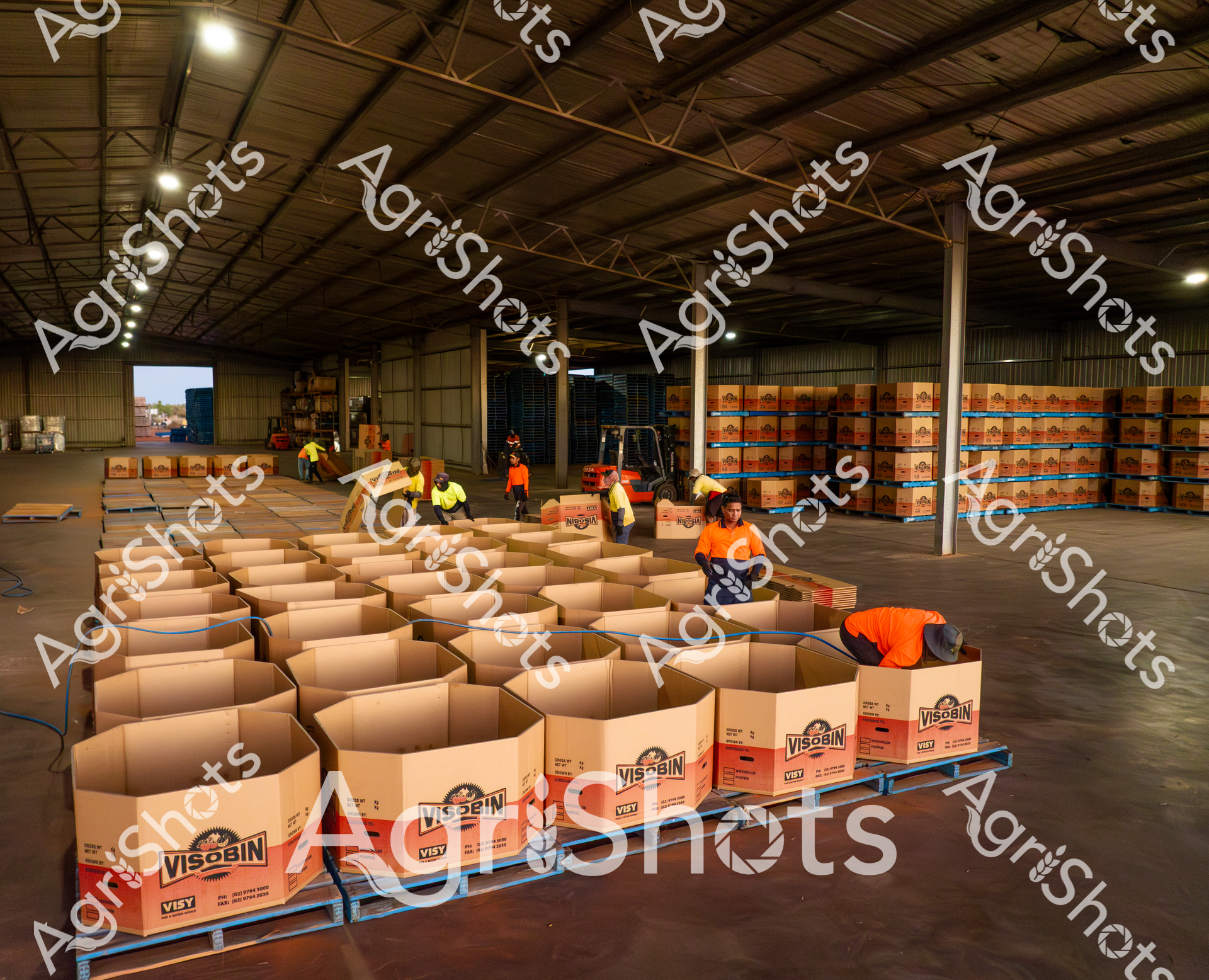
In a large warehouse, workers in bright orange safety vests are busy sorting and stacking Visbin-branded produce boxes, likely filled with watermelons. The industrial space features high ceilings, metal shelving, and a forklift in the background, showcasing a typical packing and distribution scene in the Northern Territory's Barkly Region during the winter harvest season. Image

In a large warehouse, workers in bright orange safety vests are busy sorting and stacking Visbin-branded produce boxes, likely filled with watermelons. The industrial space features high ceilings, metal shelving, and a forklift in the background, showcasing a typical packing and distribution scene in the Northern Territory's Barkly Region during the winter harvest season.
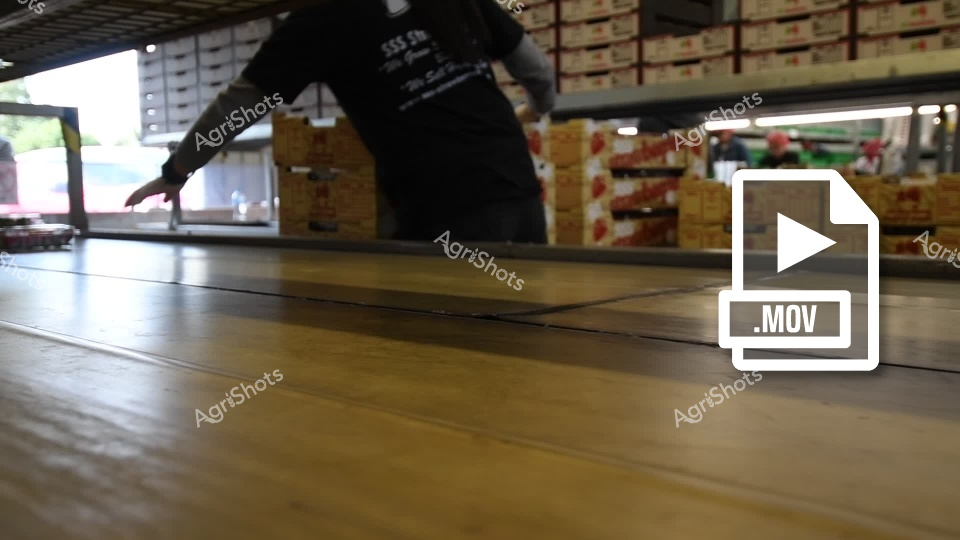
A woman in dark clothing bends forward to carefully pick fresh strawberries in a commercial fruit growing operation in Queensland's Queensland. Her hands work methodically through the strawberry plants during harvest time, selecting ripe berries in the covered growing facility. The systematic harvesting process showcases the precision required in horticultural produce collection, with neat rows of strawberry plants extending across the greenhouse floor. ▶ Video

A woman in dark clothing bends forward to carefully pick fresh strawberries in a commercial fruit growing operation in Queensland's Queensland. Her hands work methodically through the strawberry plants during harvest time, selecting ripe berries in the covered growing facility. The systematic harvesting process showcases the precision required in horticultural produce collection, with neat rows of strawberry plants extending across the greenhouse floor.
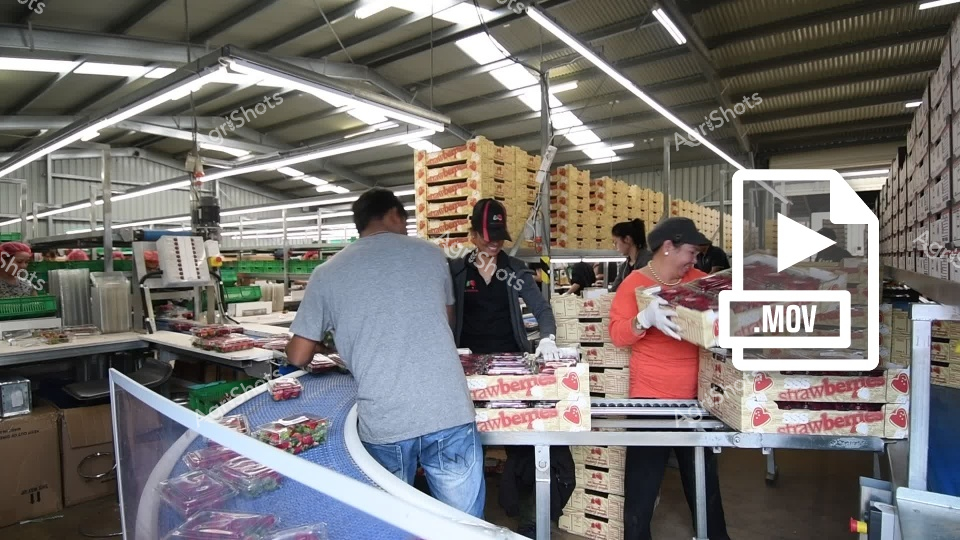
Workers sort and pack fresh strawberries at an indoor processing facility in Queensland's Queensland during harvest season. A man farm worker in a gray shirt and woman farm hand in a red top carefully handle the delicate fruit on white tables, surrounded by stacked strawberry boxes in this bustling horticulture operation. The warehouse setting with fluorescent lighting showcases the professional produce handling that transforms freshly picked strawberries from field to market-ready product. ▶ Video

Workers sort and pack fresh strawberries at an indoor processing facility in Queensland's Queensland during harvest season. A man farm worker in a gray shirt and woman farm hand in a red top carefully handle the delicate fruit on white tables, surrounded by stacked strawberry boxes in this bustling horticulture operation. The warehouse setting with fluorescent lighting showcases the professional produce handling that transforms freshly picked strawberries from field to market-ready product.
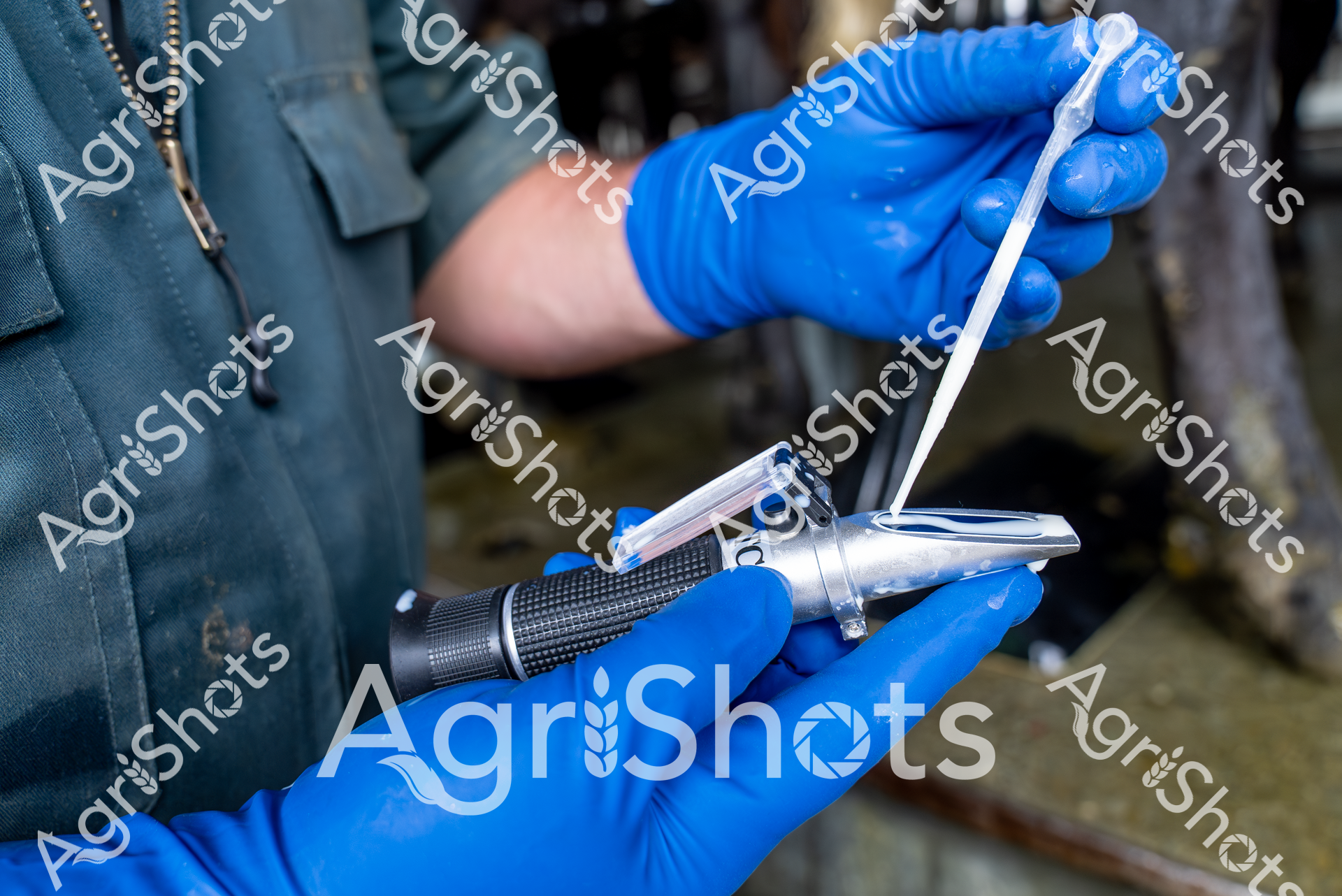
Blue-gloved hands carefully handle a precise agricultural testing instrument in a dairy environment. The stainless steel refractometer gleams under controlled lighting, its calibrated surface reflecting professional scientific methodology. These blue nitrile safety gloves - standard in livestock management and dairy testing - grip the optical instrument with careful precision, suggesting a meticulous approach to milk quality assessment. The close-up perspective emphasizes the technical skill required in modern agricultural testing, highlighting the intersection of scientific measurement and animal husbandry. Subtle textures of the gloves and metallic instrument suggest the rigorous standards of South Canterbury's dairy industry, where technological precision supports agricultural productivity. The scene communicates a moment of professional data collection, critical to maintaining high-quality dairy production standards. Image

Blue-gloved hands carefully handle a precise agricultural testing instrument in a dairy environment. The stainless steel refractometer gleams under controlled lighting, its calibrated surface reflecting professional scientific methodology. These blue nitrile safety gloves - standard in livestock management and dairy testing - grip the optical instrument with careful precision, suggesting a meticulous approach to milk quality assessment. The close-up perspective emphasizes the technical skill required in modern agricultural testing, highlighting the intersection of scientific measurement and animal husbandry. Subtle textures of the gloves and metallic instrument suggest the rigorous standards of South Canterbury's dairy industry, where technological precision supports agricultural productivity. The scene communicates a moment of professional data collection, critical to maintaining high-quality dairy production standards.
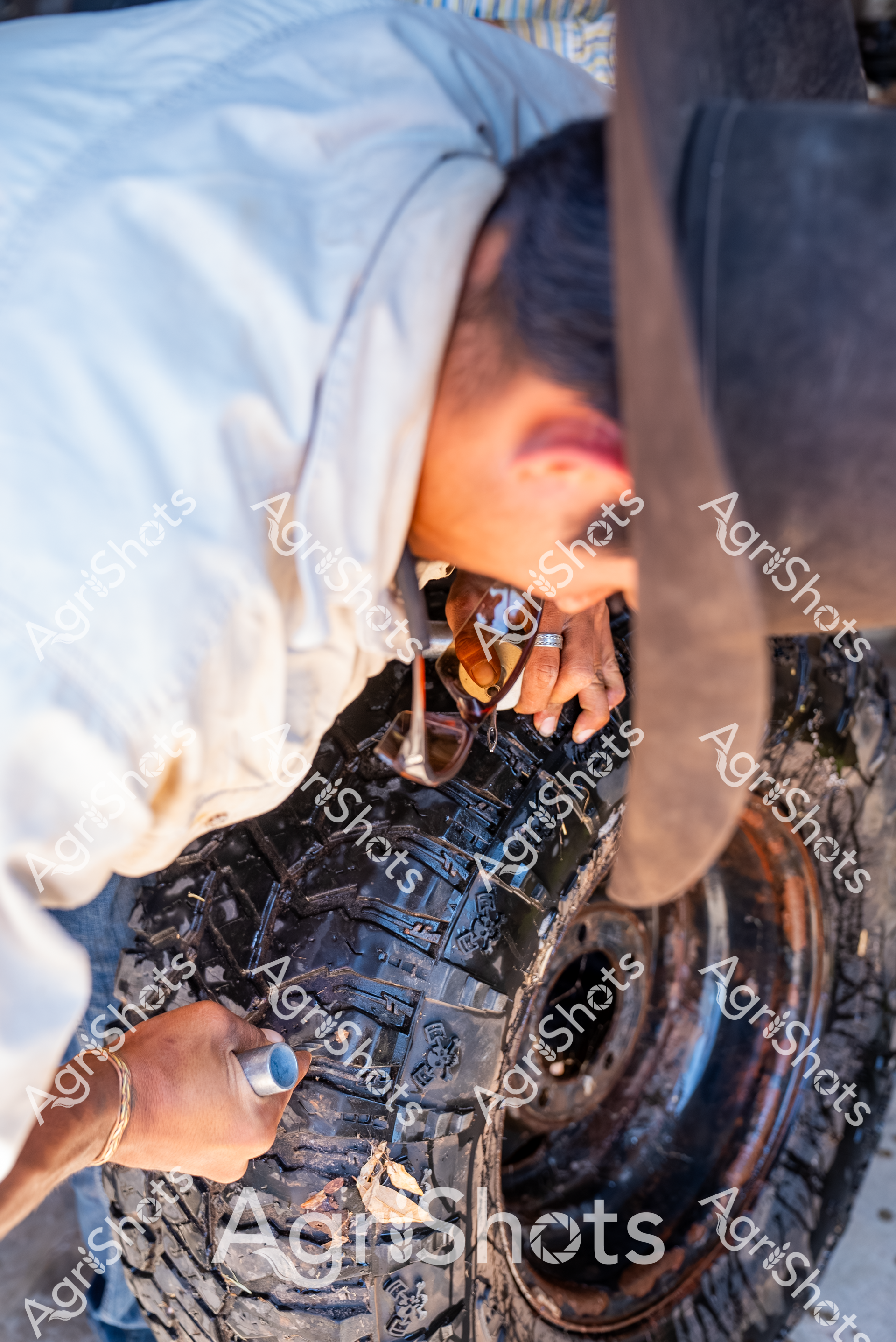
A person repairs a severely damaged tire in the Kimberley region of Western Australia. Wearing light-colored clothing, they carefully work on the worn and torn wheel, likely at a remote station during springtime. The image captures the challenging task of vehicle maintenance in a rugged outback landscape. Image

A person repairs a severely damaged tire in the Kimberley region of Western Australia. Wearing light-colored clothing, they carefully work on the worn and torn wheel, likely at a remote station during springtime. The image captures the challenging task of vehicle maintenance in a rugged outback landscape.
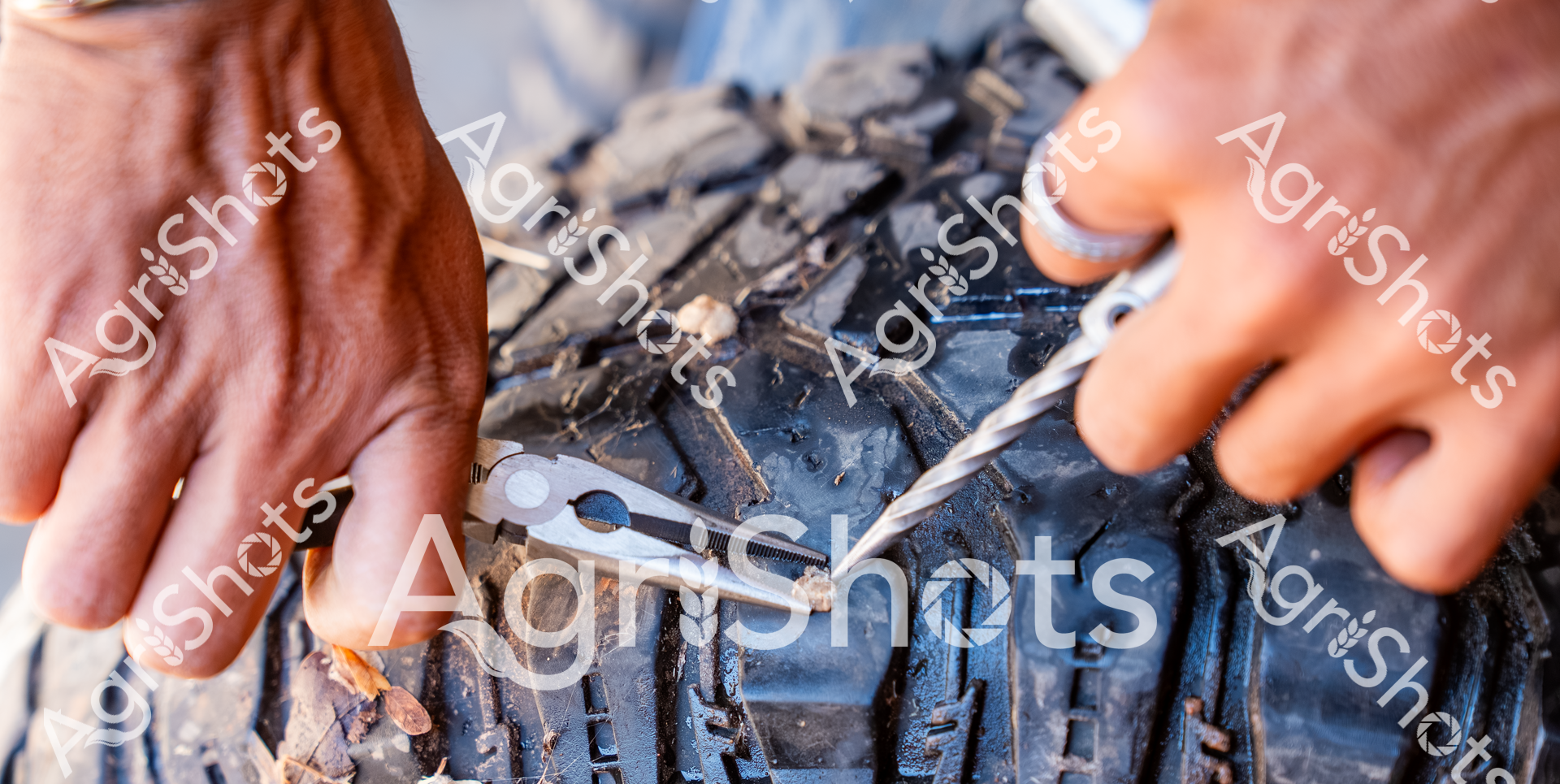
A close-up view of hands repairing a damaged tire, likely in the rugged Kimberley region of Western Australia. Pliers and a repair tool are being used to fix a punctured tire, suggesting this is a common scene of outback maintenance at a remote station during springtime. Image

A close-up view of hands repairing a damaged tire, likely in the rugged Kimberley region of Western Australia. Pliers and a repair tool are being used to fix a punctured tire, suggesting this is a common scene of outback maintenance at a remote station during springtime.

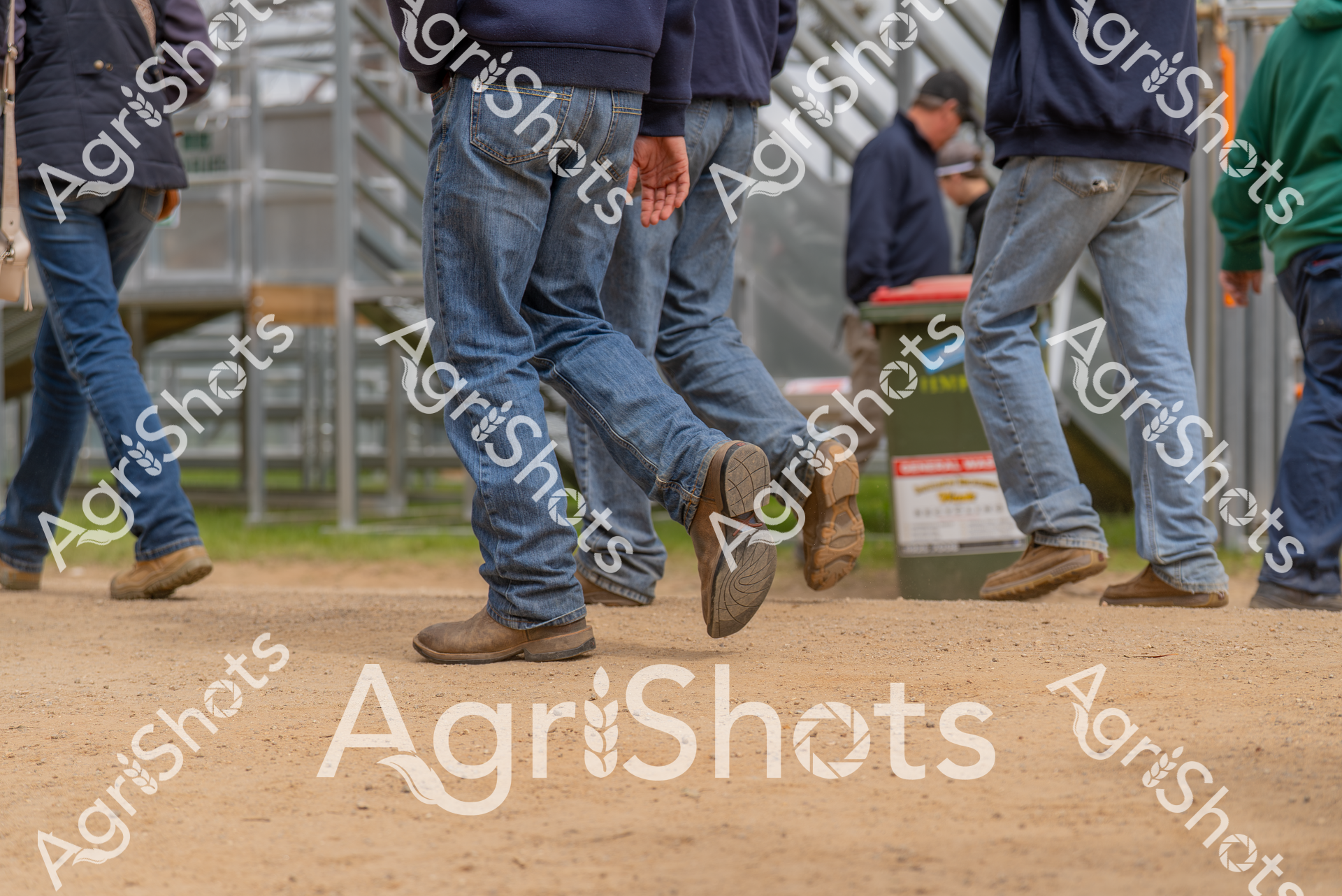
A group of people wearing blue jeans and work boots stand together at an agricultural event, likely the Henty Field Days in New South Wales. The image focuses on their legs and footwear, capturing the casual, practical attire typical of rural agricultural gatherings in the Riverina region during springtime. Image

A group of people wearing blue jeans and work boots stand together at an agricultural event, likely the Henty Field Days in New South Wales. The image focuses on their legs and footwear, capturing the casual, practical attire typical of rural agricultural gatherings in the Riverina region during springtime.
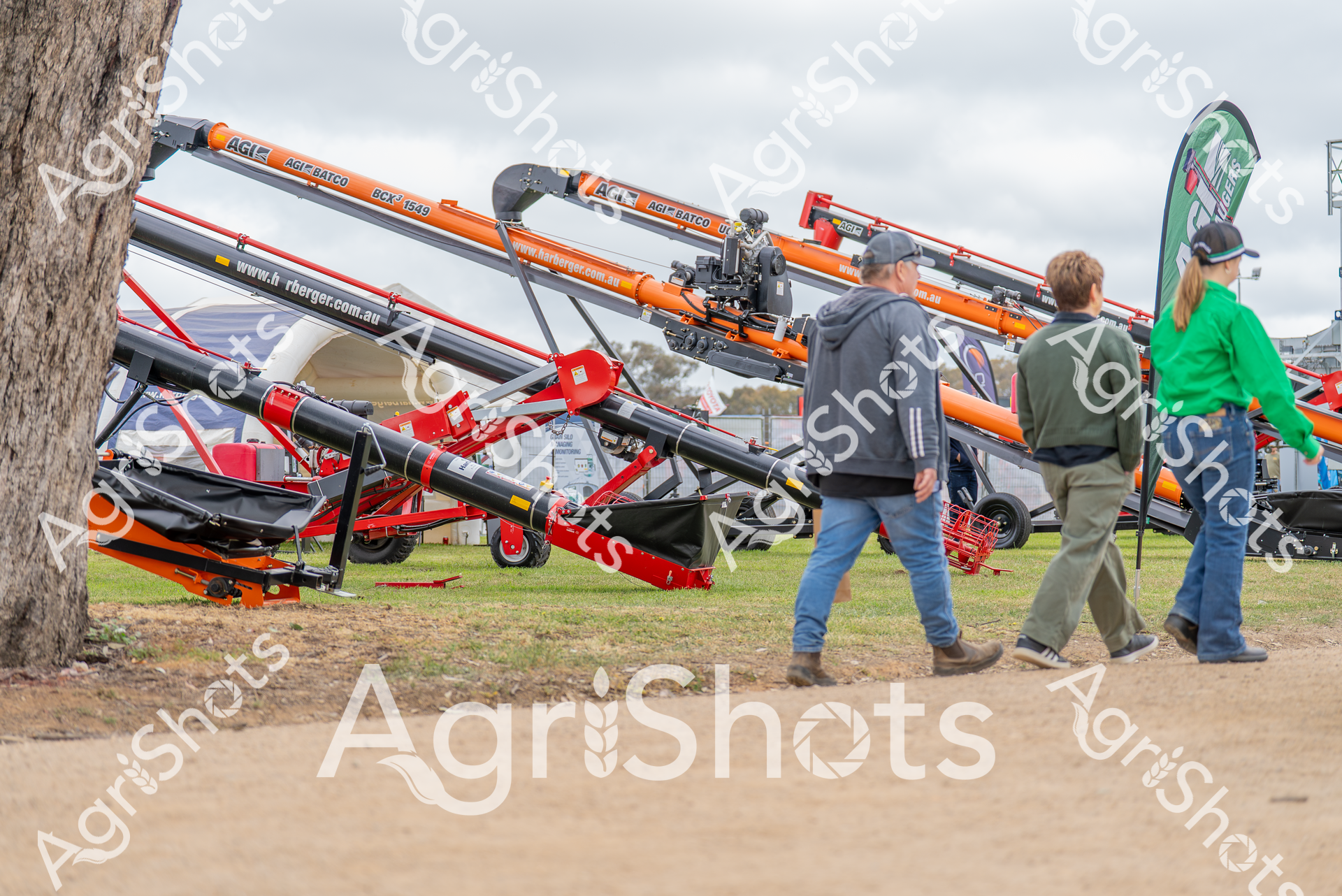
At the Henty Field Days in New South Wales, agricultural machinery enthusiasts explore a display of impressive orange and red AGI-BATCO grain augers. Two people walk among the towering conveyor systems, examining the latest agricultural equipment at this important Riverina region spring event showcasing innovative farming technology. Image

At the Henty Field Days in New South Wales, agricultural machinery enthusiasts explore a display of impressive orange and red AGI-BATCO grain augers. Two people walk among the towering conveyor systems, examining the latest agricultural equipment at this important Riverina region spring event showcasing innovative farming technology.
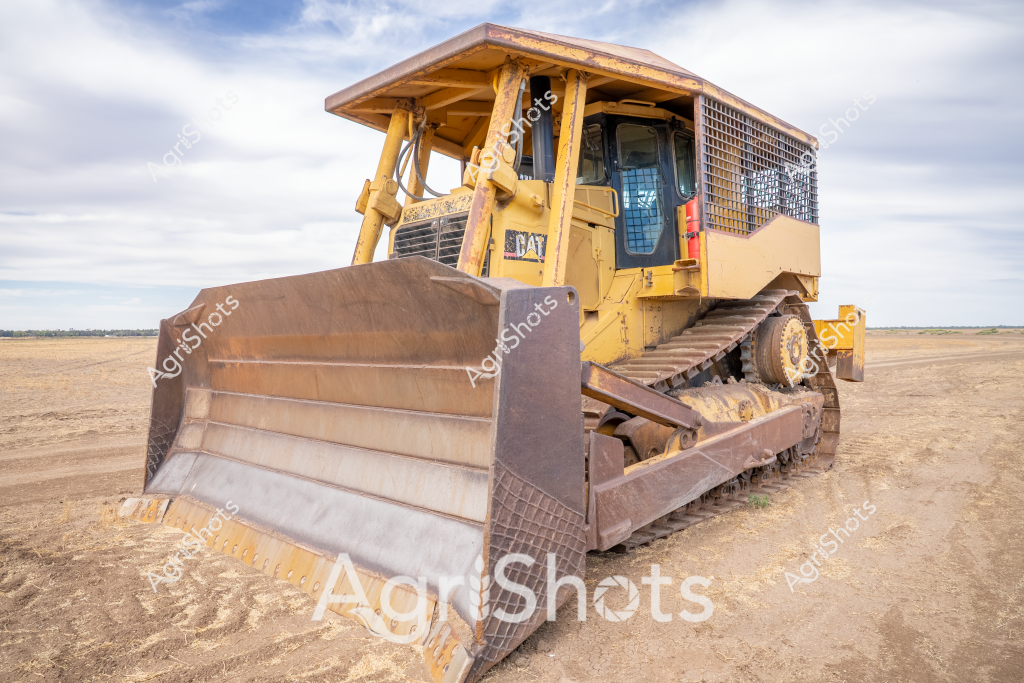
A yellow Caterpillar (CAT) bulldozer sits on a dry, dusty landscape, showcasing the robust machinery used in Australian agricultural and construction operations. The heavy-duty tracked vehicle features a large metal blade at the front, designed for earth-moving, land clearing, and site preparation tasks. Its weathered yellow paint and sturdy construction reflect the demanding conditions of rural and industrial environments. The expansive flat terrain stretches to the horizon, with a cloudy sky providing a muted backdrop that emphasizes the machine's significant presence. The bulldozer's protective cabin and mesh safety guards highlight the engineering considerations for operator protection in challenging work settings. This powerful piece of equipment represents the critical role of heavy machinery in developing and maintaining agricultural and construction landscapes across Australia. Image

A yellow Caterpillar (CAT) bulldozer sits on a dry, dusty landscape, showcasing the robust machinery used in Australian agricultural and construction operations. The heavy-duty tracked vehicle features a large metal blade at the front, designed for earth-moving, land clearing, and site preparation tasks. Its weathered yellow paint and sturdy construction reflect the demanding conditions of rural and industrial environments. The expansive flat terrain stretches to the horizon, with a cloudy sky providing a muted backdrop that emphasizes the machine's significant presence. The bulldozer's protective cabin and mesh safety guards highlight the engineering considerations for operator protection in challenging work settings. This powerful piece of equipment represents the critical role of heavy machinery in developing and maintaining agricultural and construction landscapes across Australia.
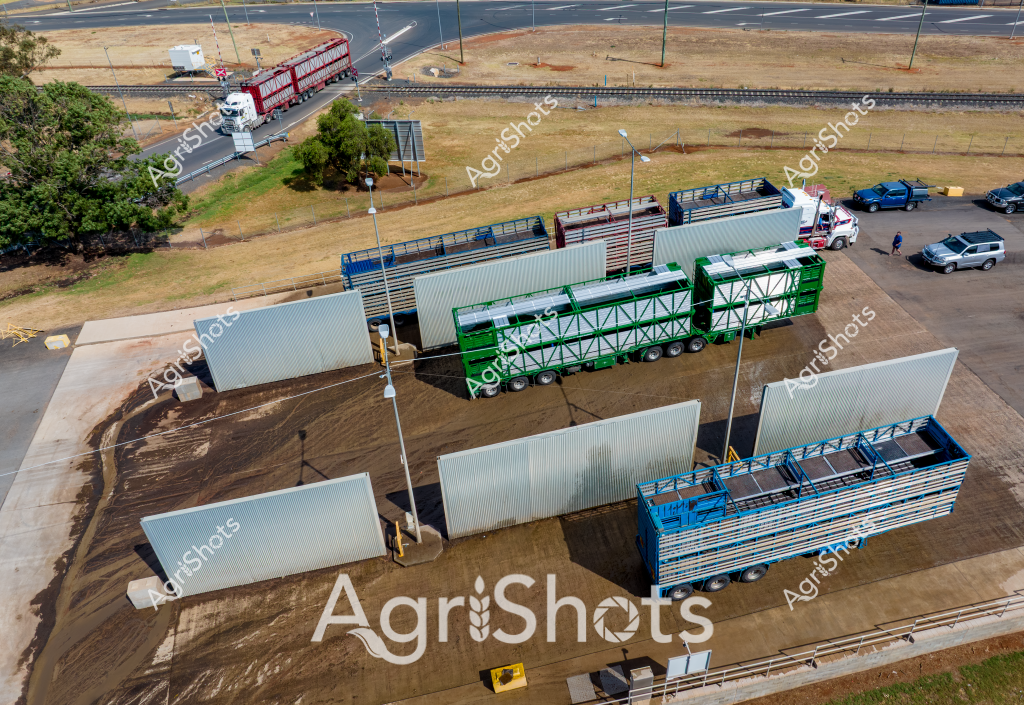
An aerial view of a transport and logistics hub showcases specialized livestock trailers designed for cattle transportation. Multiple multi-axle trucks with green, blue, and white animal transport containers are strategically positioned on a concrete hardstand area adjacent to railway lines. The scene reveals heavy-duty commercial vehicles with intricate steel framing and multiple decks, engineered to safely move livestock across Australian agricultural regions. Surrounding infrastructure includes grassy verges, bitumen roads, and railway tracks, indicating this is a professional livestock transportation staging area. Parked vehicles in the background suggest ongoing logistics operations, with the entire facility demonstrating the sophisticated infrastructure supporting Australia's cattle transport networks.

The trailers feature robust steel construction with multiple levels, ventilation gaps, and secure railings - critical design elements for animal welfare during long-distance transportation. The green and blue color schemes of the trailers provide visual contrast against the dusty brown ground and gray infrastructure, highlighting the specialized nature of agricultural transport equipment. Image

An aerial view of a transport and logistics hub showcases specialized livestock trailers designed for cattle transportation. Multiple multi-axle trucks with green, blue, and white animal transport containers are strategically positioned on a concrete hardstand area adjacent to railway lines. The scene reveals heavy-duty commercial vehicles with intricate steel framing and multiple decks, engineered to safely move livestock across Australian agricultural regions. Surrounding infrastructure includes grassy verges, bitumen roads, and railway tracks, indicating this is a professional livestock transportation staging area. Parked vehicles in the background suggest ongoing logistics operations, with the entire facility demonstrating the sophisticated infrastructure supporting Australia's cattle transport networks. The trailers feature robust steel construction with multiple levels, ventilation gaps, and secure railings - critical design elements for animal welfare during long-distance transportation. The green and blue color schemes of the trailers provide visual contrast against the dusty brown ground and gray infrastructure, highlighting the specialized nature of agricultural transport equipment.
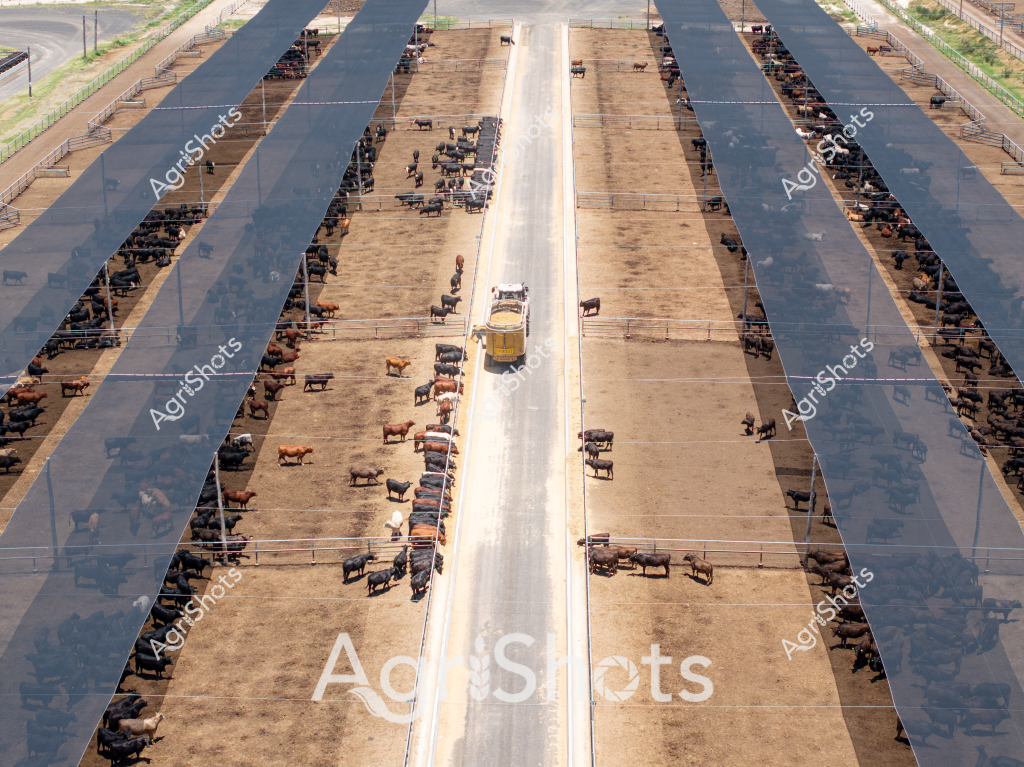
An expansive cattle cattle yards stretches across the landscape, revealing a meticulously organized system of parallel yards filled with black and brown beef cattle. A central concrete roadway bisects the facility, allowing a yellow utility vehicle to traverse between densely populated livestock pens. Hundreds of cattle are strategically grouped along the dusty earthen surfaces, with sturdy metal fencing creating precise boundaries and movement channels. The aerial perspective highlights the industrial scale of modern beef production, where carefully managed herds are prepared for market in a highly structured agricultural environment. Warm earth tones of tan and brown dominate the scene, with the cattle creating a living, moving texture across the systematically designed yards. The infrastructure demonstrates sophisticated livestock management techniques, where animal density, movement, and feeding can be precisely controlled. Image

An expansive cattle cattle yards stretches across the landscape, revealing a meticulously organized system of parallel yards filled with black and brown beef cattle. A central concrete roadway bisects the facility, allowing a yellow utility vehicle to traverse between densely populated livestock pens. Hundreds of cattle are strategically grouped along the dusty earthen surfaces, with sturdy metal fencing creating precise boundaries and movement channels. The aerial perspective highlights the industrial scale of modern beef production, where carefully managed herds are prepared for market in a highly structured agricultural environment. Warm earth tones of tan and brown dominate the scene, with the cattle creating a living, moving texture across the systematically designed yards. The infrastructure demonstrates sophisticated livestock management techniques, where animal density, movement, and feeding can be precisely controlled.
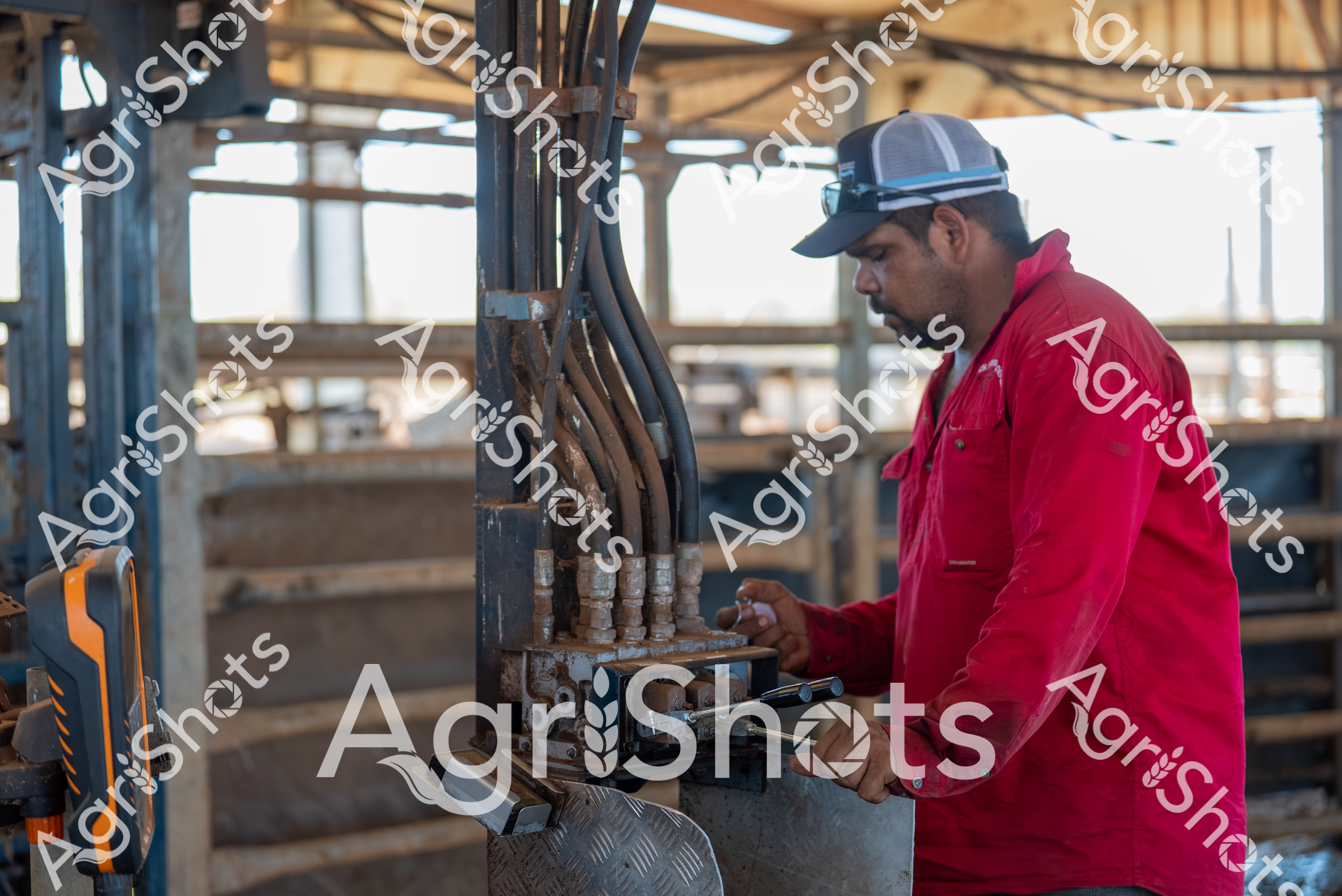
A worker in a bright red shirt and hard hat carefully inspects equipment in a cattle export facility, surrounded by metal infrastructure and processing infrastructure in the Kimberley region of Western Australia. The industrial setting suggests this is part of a routine veterinary check and quarantine process for livestock preparation prior to export. Image

A worker in a bright red shirt and hard hat carefully inspects equipment in a cattle export facility, surrounded by metal infrastructure and processing infrastructure in the Kimberley region of Western Australia. The industrial setting suggests this is part of a routine veterinary check and quarantine process for livestock preparation prior to export.
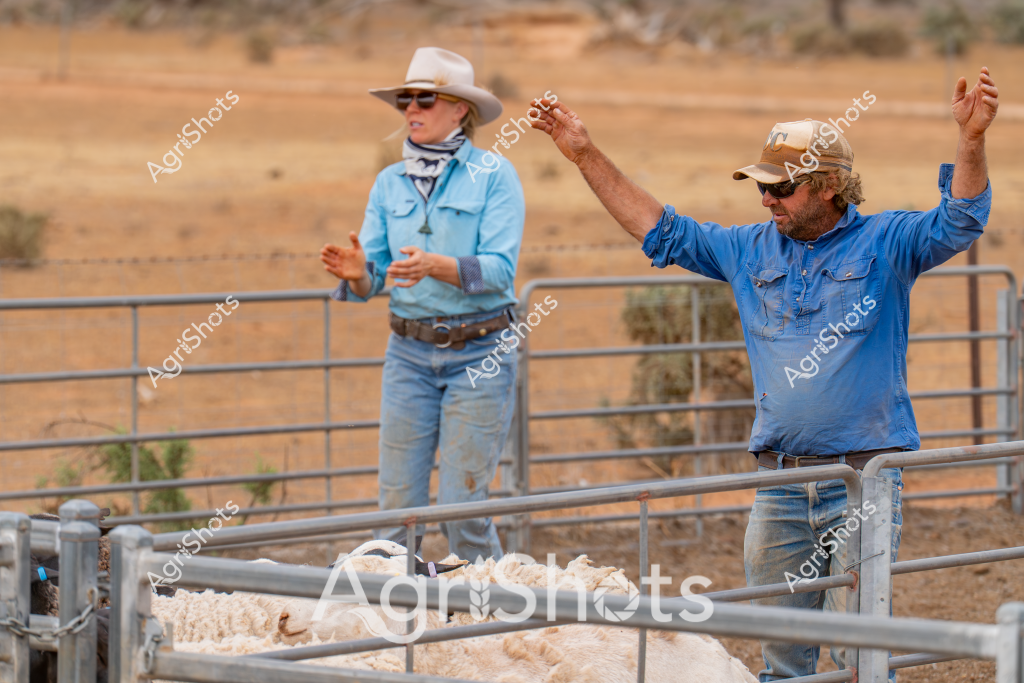
Two farm workers stand in a livestock yard during a dry, arid landscape setting. A woman wearing a light blue shirt, white cowboy hat, and neck scarf stands near a metal livestock pen, while a man in a blue work shirt and cap raises his arm in a gesture, seemingly directing or communicating about the sheep in the pen below. The background reveals a sparse, golden-brown landscape typical of Australian rural regions, with scattered scrub and desert-like terrain stretching to the horizon. The metal livestock yards provide a structured industrial element against the rugged natural environment, highlighting the challenging conditions of agricultural work in remote Australian settings. Their coordinated movements and attentive postures suggest they are managing a routine livestock handling operation, with the woolly sheep clustered within the sturdy metal pen railings. Image

Two farm workers stand in a livestock yard during a dry, arid landscape setting. A woman wearing a light blue shirt, white cowboy hat, and neck scarf stands near a metal livestock pen, while a man in a blue work shirt and cap raises his arm in a gesture, seemingly directing or communicating about the sheep in the pen below. The background reveals a sparse, golden-brown landscape typical of Australian rural regions, with scattered scrub and desert-like terrain stretching to the horizon. The metal livestock yards provide a structured industrial element against the rugged natural environment, highlighting the challenging conditions of agricultural work in remote Australian settings. Their coordinated movements and attentive postures suggest they are managing a routine livestock handling operation, with the woolly sheep clustered within the sturdy metal pen railings.
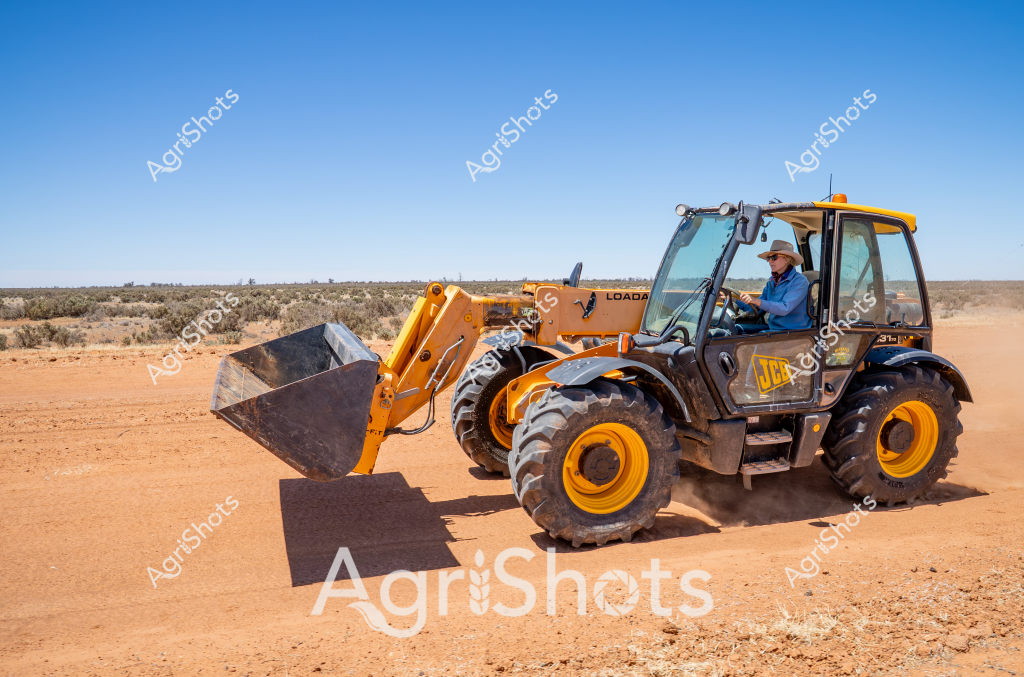
A yellow JCB telehandler operates on a dusty, arid landscape with sparse vegetation in the background. A man wearing a blue shirt and white hard hat carefully maneuvers the heavy machinery across the reddish-brown earth. The telehandler's large front bucket is raised, ready for loading or moving materials, with bright yellow and black paintwork standing out starkly against the clear blue sky. The rugged terrain suggests this is likely a remote agricultural or construction site in the Australian outback, where robust machinery is essential for working in challenging environmental conditions. The JCB's large tires are designed to handle uneven ground, demonstrating the specialized equipment needed to operate in such demanding landscapes. The scene captures the resilience and technological capability required for agricultural and industrial work in Australia's most challenging regions. Image

A yellow JCB telehandler operates on a dusty, arid landscape with sparse vegetation in the background. A man wearing a blue shirt and white hard hat carefully maneuvers the heavy machinery across the reddish-brown earth. The telehandler's large front bucket is raised, ready for loading or moving materials, with bright yellow and black paintwork standing out starkly against the clear blue sky. The rugged terrain suggests this is likely a remote agricultural or construction site in the Australian outback, where robust machinery is essential for working in challenging environmental conditions. The JCB's large tires are designed to handle uneven ground, demonstrating the specialized equipment needed to operate in such demanding landscapes. The scene captures the resilience and technological capability required for agricultural and industrial work in Australia's most challenging regions.
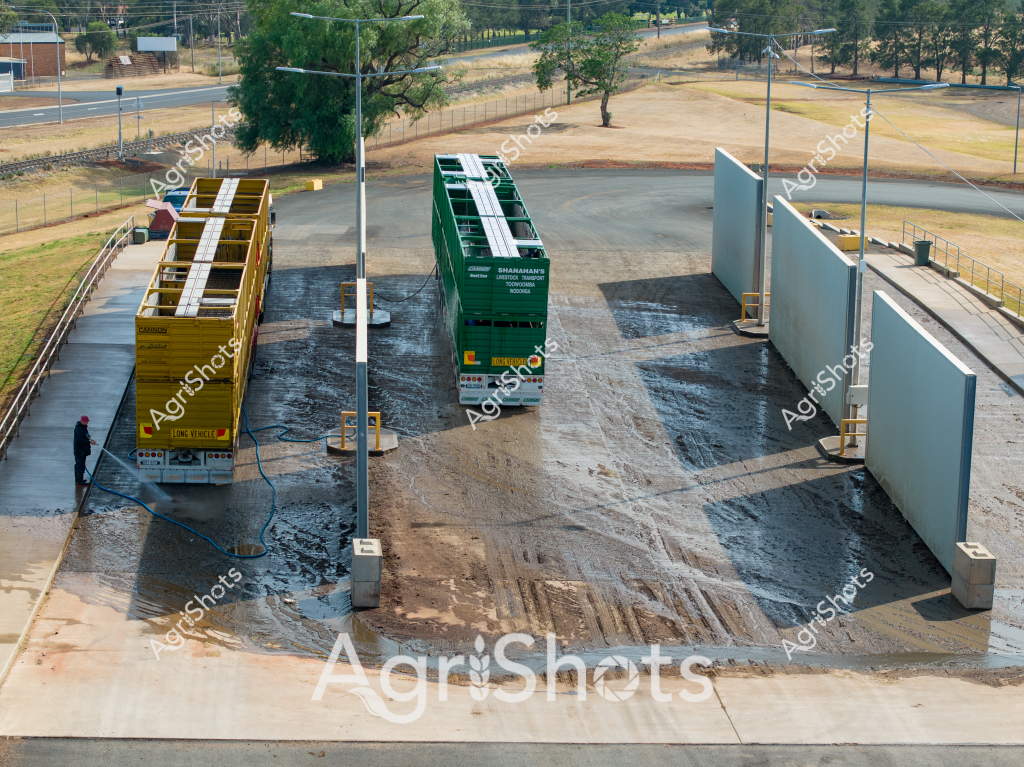
A detailed industrial scene captures a truck washing station with two large transport trailers positioned on a concrete wash pad. A person stands near one of the trucks, operating a high-pressure water hose to clean the vehicle's exterior. The yellow and green trailers are positioned precisely between concrete barriers and metal support structures, suggesting a systematic approach to vehicle maintenance and sanitation.

The environment appears to be a rural or industrial setting, with dry grass and scattered trees visible in the background. The concrete wash pad shows evidence of extensive water use, with wet and muddy areas surrounding the trailers. Overhead lighting poles and a fence line indicate this is a purpose-built facility for truck cleaning and maintenance.

The wash station demonstrates the meticulous care taken in maintaining commercial transport vehicles, with careful positioning and dedicated infrastructure for thorough cleaning. The scene captures the intersection of agricultural logistics and maintenance, highlighting the professional approach to vehicle upkeep in rural transportation operations.

The surrounding landscape is typical of a dry agricultural area, with sparse vegetation and open space, suggesting this is likely in an Australian rural or semi-rural location. The careful design of the wash station reflects the importance of vehicle maintenance in agricultural and transport industries. Image

A detailed industrial scene captures a truck washing station with two large transport trailers positioned on a concrete wash pad. A person stands near one of the trucks, operating a high-pressure water hose to clean the vehicle's exterior. The yellow and green trailers are positioned precisely between concrete barriers and metal support structures, suggesting a systematic approach to vehicle maintenance and sanitation. The environment appears to be a rural or industrial setting, with dry grass and scattered trees visible in the background. The concrete wash pad shows evidence of extensive water use, with wet and muddy areas surrounding the trailers. Overhead lighting poles and a fence line indicate this is a purpose-built facility for truck cleaning and maintenance. The wash station demonstrates the meticulous care taken in maintaining commercial transport vehicles, with careful positioning and dedicated infrastructure for thorough cleaning. The scene captures the intersection of agricultural logistics and maintenance, highlighting the professional approach to vehicle upkeep in rural transportation operations. The surrounding landscape is typical of a dry agricultural area, with sparse vegetation and open space, suggesting this is likely in an Australian rural or semi-rural location. The careful design of the wash station reflects the importance of vehicle maintenance in agricultural and transport industries.
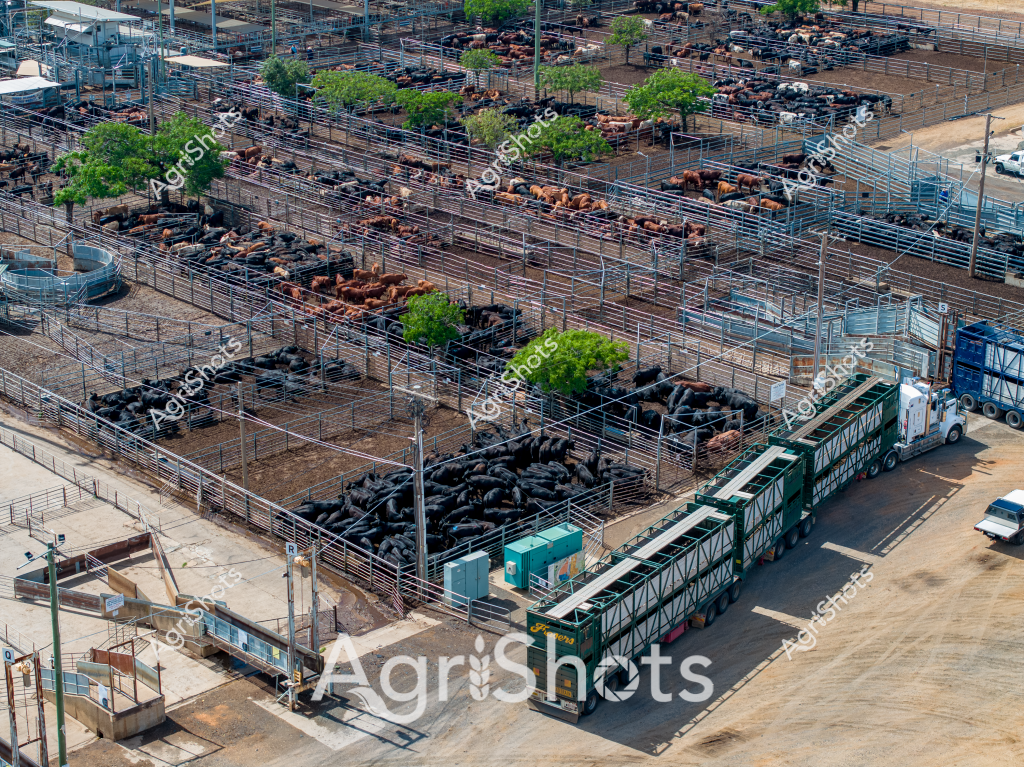
An expansive aerial view of a modern cattle saleyard reveals multiple interconnected metal-fenced paddocks densely populated with beef cattle. Rows of dark and reddish-brown cattle are strategically distributed across the compound, with small green trees and shade structures interspersed between the pens to provide relief from the harsh environment. A large green livestock transport trailer is positioned at the edge of the facility, ready for loading or unloading cattle, while industrial infrastructure including water tanks and processing equipment are visible throughout the site. The ground appears dry and compacted, typical of large-scale livestock management systems, with precise metal fencing creating a geometric pattern of controlled movement and segregation. The aerial perspective highlights the scale and industrial efficiency of modern beef cattle production, where large numbers of animals can be systematically managed, monitored, and prepared for market. Dusty earth tones and the structured layout emphasize the calculated approach to livestock farming in what appears to be an arid or semi-arid agricultural region. Image

An expansive aerial view of a modern cattle saleyard reveals multiple interconnected metal-fenced paddocks densely populated with beef cattle. Rows of dark and reddish-brown cattle are strategically distributed across the compound, with small green trees and shade structures interspersed between the pens to provide relief from the harsh environment. A large green livestock transport trailer is positioned at the edge of the facility, ready for loading or unloading cattle, while industrial infrastructure including water tanks and processing equipment are visible throughout the site. The ground appears dry and compacted, typical of large-scale livestock management systems, with precise metal fencing creating a geometric pattern of controlled movement and segregation. The aerial perspective highlights the scale and industrial efficiency of modern beef cattle production, where large numbers of animals can be systematically managed, monitored, and prepared for market. Dusty earth tones and the structured layout emphasize the calculated approach to livestock farming in what appears to be an arid or semi-arid agricultural region.
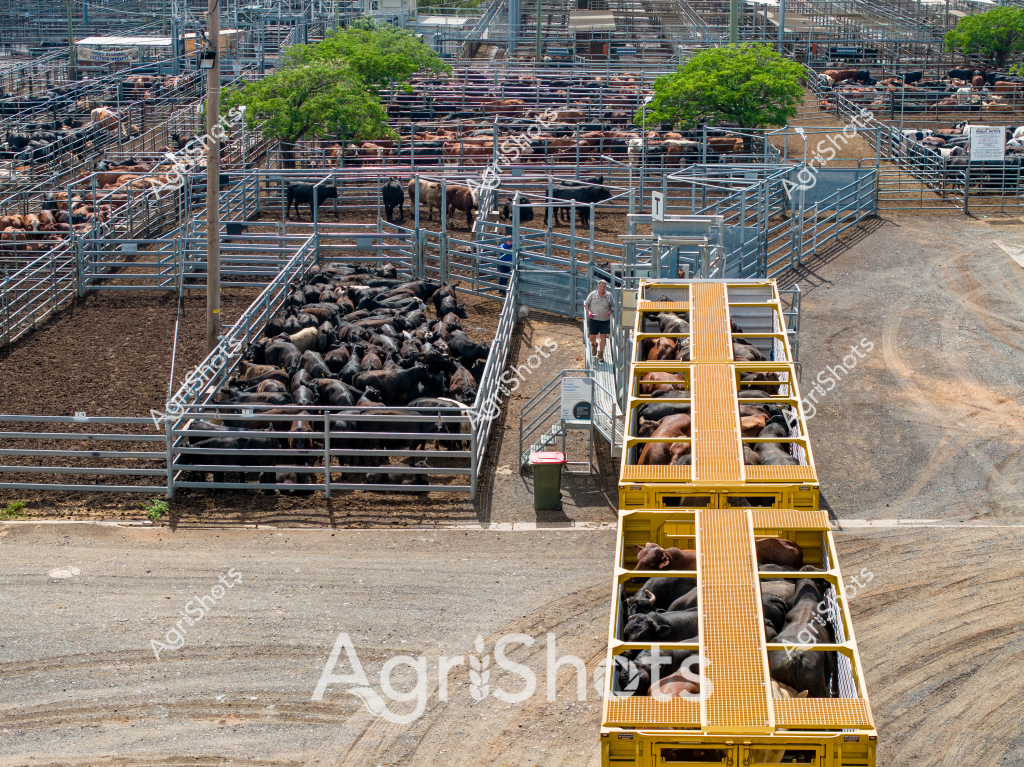
A bustling livestock processing facility showcases multiple pens of black cattle in a complex metal yard system. A series of bright yellow multi-level loading decks stand ready for animal transportation, with cattle carefully sorted and positioned on different compartment levels. A person wearing light-colored clothing can be seen standing on one of the elevated walkways, monitoring the livestock movement and sorting process. The facility appears meticulously organized, with multiple interconnected metal pen sections allowing efficient animal management and movement. Green trees punctuate the background, providing some natural contrast to the industrial agricultural infrastructure. The ground is dusty and compact, typical of a high-traffic livestock handling area, with precise metal fencing defining each processing zone.

The scene represents a professional cattle handling operation, demonstrating the sophisticated infrastructure required for modern livestock transportation and management. The yellow transport decks and intricate metal pen system highlight the technical precision involved in moving and sorting livestock, showcasing Australia's advanced agricultural logistics and animal handling practices. Image

A bustling livestock processing facility showcases multiple pens of black cattle in a complex metal yard system. A series of bright yellow multi-level loading decks stand ready for animal transportation, with cattle carefully sorted and positioned on different compartment levels. A person wearing light-colored clothing can be seen standing on one of the elevated walkways, monitoring the livestock movement and sorting process. The facility appears meticulously organized, with multiple interconnected metal pen sections allowing efficient animal management and movement. Green trees punctuate the background, providing some natural contrast to the industrial agricultural infrastructure. The ground is dusty and compact, typical of a high-traffic livestock handling area, with precise metal fencing defining each processing zone. The scene represents a professional cattle handling operation, demonstrating the sophisticated infrastructure required for modern livestock transportation and management. The yellow transport decks and intricate metal pen system highlight the technical precision involved in moving and sorting livestock, showcasing Australia's advanced agricultural logistics and animal handling practices.
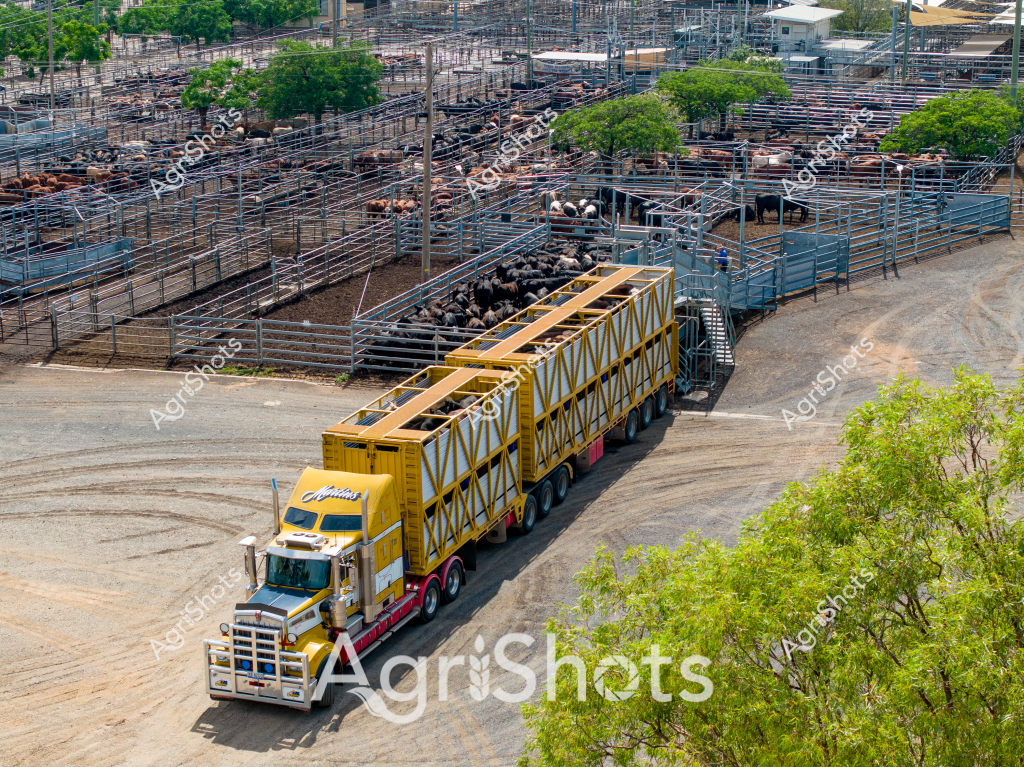
A sprawling cattle yard in the Australian outback features a striking yellow and white multi-axle livestock transport truck positioned amid numerous metal cattle pens. Numerous black beef cattle are densely grouped within the blue-gray metal holding yards, surrounded by trees and gravel roadways. The heavy-duty truck, likely a Kenworth or Western Star model designed for long-haul cattle transportation, has an extensive multi-level trailer configuration specifically engineered for moving large herds across vast distances. The industrial agricultural setting reveals the intricate infrastructure required for transporting livestock, with precisely engineered fencing, multiple interconnected yards, and specialized heavy transport vehicles purpose-built for the challenging Australian rural landscape. Mature green trees provide some natural backdrop to the intense industrial agricultural scene, highlighting the intersection of rugged terrain and sophisticated livestock management techniques. The yellow truck stands out dramatically against the earthy tones of the cattle yard, symbolizing the critical role of transportation in Australia's massive beef production industry. Image

A sprawling cattle yard in the Australian outback features a striking yellow and white multi-axle livestock transport truck positioned amid numerous metal cattle pens. Numerous black beef cattle are densely grouped within the blue-gray metal holding yards, surrounded by trees and gravel roadways. The heavy-duty truck, likely a Kenworth or Western Star model designed for long-haul cattle transportation, has an extensive multi-level trailer configuration specifically engineered for moving large herds across vast distances. The industrial agricultural setting reveals the intricate infrastructure required for transporting livestock, with precisely engineered fencing, multiple interconnected yards, and specialized heavy transport vehicles purpose-built for the challenging Australian rural landscape. Mature green trees provide some natural backdrop to the intense industrial agricultural scene, highlighting the intersection of rugged terrain and sophisticated livestock management techniques. The yellow truck stands out dramatically against the earthy tones of the cattle yard, symbolizing the critical role of transportation in Australia's massive beef production industry.
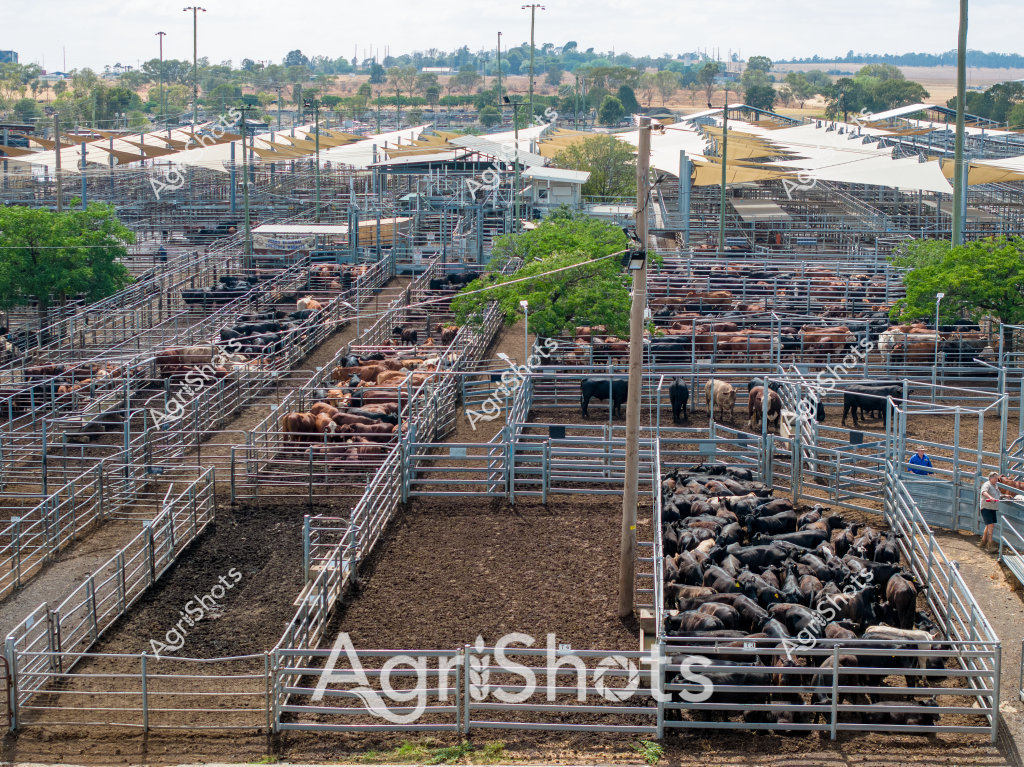
A vast cattle saleyard extends across the landscape, with multiple metal pen enclosures housing hundreds of black and brown cattle. The expansive facility features galvanized steel fencing dividing the pens, with shade structures in tan and white providing cover for the livestock. Densely packed groups of cattle occupy different sections, standing on bare dirt areas between green vegetation patches. Tall light poles and infrastructure buildings are visible in the background, indicating this is a large-scale commercial beef production facility. The scene captures the industrial scale of modern cattle farming, with precise grid-like pen arrangements and systematic livestock management. Multiple breeds and colors of cattle can be seen, suggesting a mixed herd being prepared for market. Image

A vast cattle saleyard extends across the landscape, with multiple metal pen enclosures housing hundreds of black and brown cattle. The expansive facility features galvanized steel fencing dividing the pens, with shade structures in tan and white providing cover for the livestock. Densely packed groups of cattle occupy different sections, standing on bare dirt areas between green vegetation patches. Tall light poles and infrastructure buildings are visible in the background, indicating this is a large-scale commercial beef production facility. The scene captures the industrial scale of modern cattle farming, with precise grid-like pen arrangements and systematic livestock management. Multiple breeds and colors of cattle can be seen, suggesting a mixed herd being prepared for market.
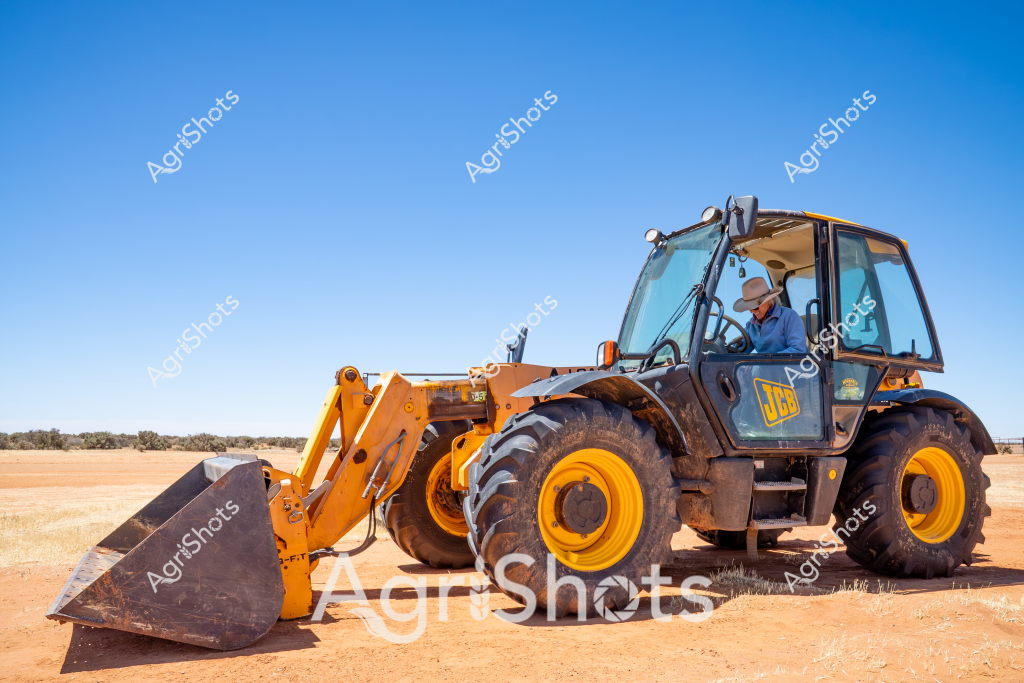
A powerful yellow JCB telehandler sits poised on a dry, dusty agricultural landscape under a brilliant blue sky. The robust machine, with its large distinctive yellow wheels and front-mounted bucket, represents modern agricultural and construction equipment used across Australian rural properties. A man operator sits inside the enclosed cabin, positioned to manage heavy lifting and materials handling tasks typical of farming, construction, and rural infrastructure work. The surrounding environment appears to be an arid or semi-arid region, with sparse vegetation and a wide-open terrain that speaks to the challenging landscapes where such versatile machinery is essential. The telehandler's pristine yellow color contrasts sharply with the terracotta-colored ground, highlighting the machine's industrial strength and purpose in agricultural and rural development settings. Image

A powerful yellow JCB telehandler sits poised on a dry, dusty agricultural landscape under a brilliant blue sky. The robust machine, with its large distinctive yellow wheels and front-mounted bucket, represents modern agricultural and construction equipment used across Australian rural properties. A man operator sits inside the enclosed cabin, positioned to manage heavy lifting and materials handling tasks typical of farming, construction, and rural infrastructure work. The surrounding environment appears to be an arid or semi-arid region, with sparse vegetation and a wide-open terrain that speaks to the challenging landscapes where such versatile machinery is essential. The telehandler's pristine yellow color contrasts sharply with the terracotta-colored ground, highlighting the machine's industrial strength and purpose in agricultural and rural development settings.
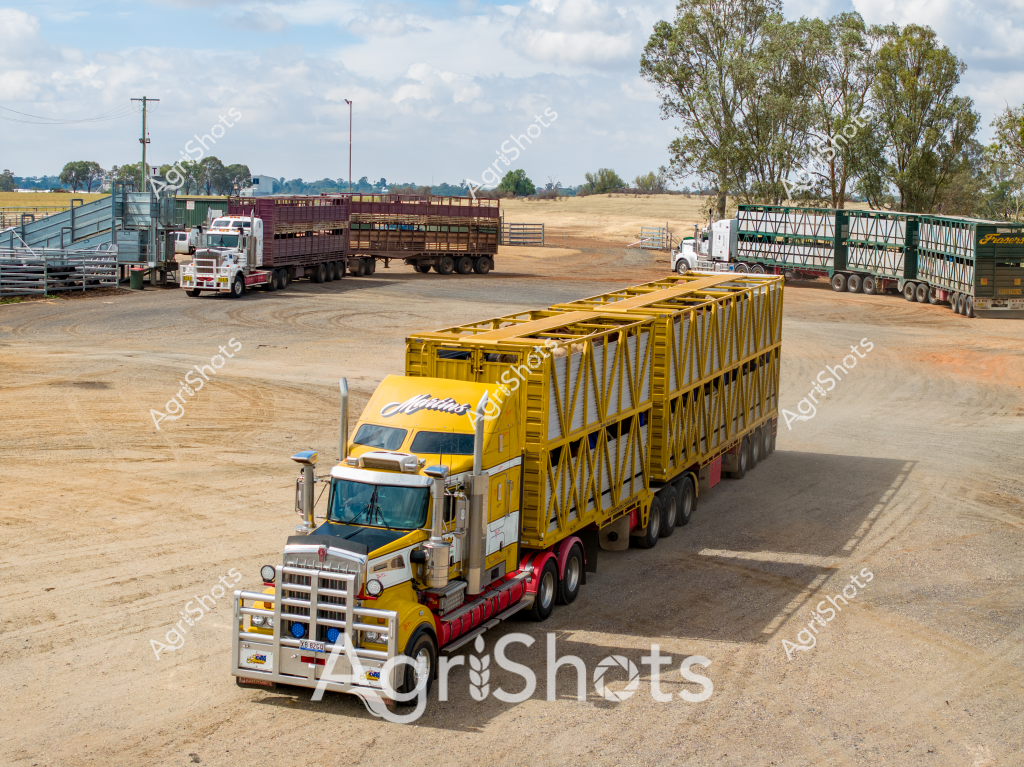
A bright yellow Roadtrain truck with an impressive multi-trailer livestock configuration dominates this rural transport yard in what appears to be an Australian agricultural setting. The heavy-duty truck, featuring a distinctive yellow cabin and robust bullbar, is hauling multiple yellow-framed stock crates designed for transporting livestock across long distances. Surrounding the truck are other similar livestock transport vehicles parked on a dusty, compacted earth yard, with eucalyptus trees and rural landscape visible in the background. Industrial livestock transportation infrastructure is evident, with loading ramps and gates positioned around the yard, highlighting the critical role of specialized trucks in moving cattle, sheep, or other farm animals across vast Australian agricultural regions. The scene captures the robust and essential nature of livestock logistics, showcasing the heavy-duty equipment required to support Australia's extensive agricultural supply chain. Image

A bright yellow Roadtrain truck with an impressive multi-trailer livestock configuration dominates this rural transport yard in what appears to be an Australian agricultural setting. The heavy-duty truck, featuring a distinctive yellow cabin and robust bullbar, is hauling multiple yellow-framed stock crates designed for transporting livestock across long distances. Surrounding the truck are other similar livestock transport vehicles parked on a dusty, compacted earth yard, with eucalyptus trees and rural landscape visible in the background. Industrial livestock transportation infrastructure is evident, with loading ramps and gates positioned around the yard, highlighting the critical role of specialized trucks in moving cattle, sheep, or other farm animals across vast Australian agricultural regions. The scene captures the robust and essential nature of livestock logistics, showcasing the heavy-duty equipment required to support Australia's extensive agricultural supply chain.