Browse the collection
 Image
White Leghorn chickens cluster tightly beneath yellow drinking nipples in a modern Jansen poultry equipment installation, representing large-scale egg production systems. Crisp white feathered birds with distinctive red combs press against galvanized steel feeding bars, demonstrating high-density commercial livestock management. The clean, uniform appearance of the chickens highlights precision breeding and controlled environmental conditions typical of contemporary Australian agricultural practices. Metallic greys, bright whites, and vivid red accents create a stark, clinical visual composition that speaks to efficiency and technological advancement in livestock production. This image captures the systematic approach of modern poultry farming, where animal husbandry meets technological innovation to maximize agricultural output.
 Image
White leghorn chickens cluster tightly in a modern intensive layer facility, each bird suspended beneath gleaming yellow-capped drinking nipples. Precision-engineered metal flooring supports the uniform flock, their pristine white feathers creating a stark visual against the industrial infrastructure. Each chicken stands in carefully regulated proximity, representing the pinnacle of agricultural efficiency in contemporary egg production systems. The metallic infrastructure, with its strategic yellow water dispensers, demonstrates sophisticated poultry management technology typical of advanced Australian agricultural practices. Crisp lighting illuminates the birds' bright red combs and pale plumage, highlighting the clinical environment of contemporary livestock production.
 Image
A white leghorn rooster stands alert, its vibrant crimson comb and wattle contrasting sharply against its pristine white plumage, held firmly by a worker's weathered hand in a dimly lit poultry shed. The bird's muscular form represents the pinnacle of large-scale agricultural breeding, showcasing the precision of modern chicken genetics developed for maximum efficiency. In the background, a dense cluster of similarly white feathered birds fills the industrial-style shed, revealing the scale of contemporary Australian poultry production. The handler's dark skin and strong grip suggest experienced livestock management, demonstrating the critical human element in large-scale agricultural operations. Soft shadows and the controlled indoor environment highlight the carefully managed conditions of commercial chicken farming, where every aspect of the birds' environment is meticulously regulated for optimal productivity. This powerful image captures the intersection of biological engineering, agricultural technology, and human labor that characterizes Australia's sophisticated poultry industry.
 Image
White Leghorn chickens densely packed in a battery cage system, illuminated by industrial lighting that casts stark shadows across their feathered bodies. The birds are tightly confined on a grid-like metal floor, their pale plumage creating a uniform blanket of white punctuated by pink combs and wattles. A vertical metal support bisects the frame, emphasizing the systematic, grid-like nature of industrial poultry production. These chickens represent the intense efficiency of modern agricultural practices, where maximizing production takes precedence over individual animal welfare. The cramped conditions and uniform appearance of the birds speak to the industrial scale of contemporary egg production in Australia.
 Image
White Leghorn chickens crowd a dense industrial poultry shed, their bright red combs standing out vividly against pristine white feathers. Tightly packed on wire mesh flooring, these commercially bred layers represent the intense efficiency of modern egg production. Overhead metal support structures and feeding lines underscore the systematic, mechanized environment of large-scale agricultural operations. The chickens appear uniform in breed and coloration, a testament to selective breeding for maximum productivity. Stark fluorescent lighting illuminates the compact space, highlighting the birds' uniform appearance and the clinical precision of contemporary agricultural practices.
 Image
White Leghorn broiler chickens crowd a multi-tier battery cage system in this large-scale poultry farming documentation. Uniformly white feathered birds with bright red combs cluster tightly across wire mesh platforms, supported by yellow feeding mechanisms. The industrial agricultural environment reveals precise, systematic livestock management - each chicken positioned within a calculated spatial grid that maximizes production efficiency. Overhead lighting casts sharp shadows across the metallic infrastructure, highlighting the mechanical precision of modern commercial egg and meat production. The dense population of birds suggests a high-density farming approach common in Australian agricultural practices, where maximizing output is a primary economic strategy.
 Image
Dusty golden light filters through the corrugated iron roof of the Gostwyck woolshed, illuminating massive wool bales marked with the distinctive 'DK' brand. A seasoned wool handler in a soft grey jacket and work cap carefully manages freshly pressed Ultra XXX grade Merino wool bales, each compressed and labeled with precise identification numbers. The weathered interior tells a story of generations of Australian wool production, with a historical production chart hanging behind revealing decades of agricultural heritage. Sturdy work boots planted firmly on the wooden floor, the worker embodies the quiet concentration and skill integral to rural wool processing. The crisp white wool bales contrast against the rustic shed's warm timber and metal surfaces, representing the pinnacle of Australian fine wool production - a testament to the meticulous craft of transforming fleece into a globally renowned textile commodity. This scene captures the intersection of traditional agricultural practice and precision manufacturing, highlighting the Merino sheep industry's crucial role in Australia's economic and cultural landscape.
 Image
Skilled shearers work methodically in a traditional woolshed, harvesting fine Merino wool with practiced precision. A worker in a soft yellow shirt and green work pants carefully maneuvers a sheep, positioning it for shearing against the white-paneled interior of the shed. Wooden structural beams and hanging equipment frame the scene, highlighting the industrial yet timeless nature of Australian wool production. Another shearer in a striped shirt works nearby, their movements deliberate and efficient as fleece falls to the concrete floor. The lighting casts sharp shadows, revealing the textural contrast between the woolly sheep and the smooth, worn surfaces of the shearing station. This image captures the raw essence of rural agricultural labor - a testament to the generations of expertise embedded in Australia's wool industry, where human skill and animal husbandry combine in a dance of economic necessity and traditional craft.
 Image
Inside a weathered corrugated iron woolshed, a skilled shearer pauses during the rhythmic work of seasonal wool harvesting. Wearing a hand-knitted brown beanie and draped with a deep blue towel, the worker stands near a crowded pen of Merino sheep, their dense, silvery-white fleece tightly packed and waiting to be shorn. Wooden framing and slatted light filtering through the shed create a textured, atmospheric scene that captures the traditional craft of sheep farming. The close proximity of the shearer to the flock reveals the intimate, physical nature of wool production - a cornerstone of Australian agricultural heritage. Soft morning light highlights the intricate curls of the sheep's wool and the concentrated expression of the worker, embodying the quiet dedication of rural laborers. This image represents the timeless connection between farmer and livestock, a fundamental rhythm of pastoral life that has shaped Australia's economic and cultural landscape.
 Image
Al Marin's wool processing facility pulses with quiet concentration as an experienced woolworker meticulously examines a massive fleece. Pristine white merino wool, shorn with precision, forms substantial mounds across the sorting table, each fleece bearing yellow classification tags that denote quality and grade. The elder worker, dressed in a deep forest green jacket, peers closely through wire-rimmed glasses, his weathered hands moving carefully over the dense, curling wool fibers. Overhead industrial lighting illuminates the expansive woolshed, with its robust steel infrastructure and systematic processing conveyor revealing the technical sophistication of modern Australian wool production. Structural steel trusses and industrial green metalwork frame the scene, reflecting decades of agricultural expertise and technological refinement in wool processing. This image captures the nuanced intersection of traditional craftsmanship and contemporary agricultural technology, where generations of knowledge are woven into every carefully assessed merino fleece.
 Image
Pure white wool cascades like billowing clouds, suspended mid-motion across the rustic interior of a traditional Australian woolshed. A skilled worker in a blue and white top stands amid the dynamic flow of freshly shorn fleece, her focused expression revealing the precision and artistry of the shearing process. The raw timber framework and corrugated iron roof create a classic rural industrial backdrop, highlighting the generations of agricultural expertise embedded in this quintessential Australian wool production scene. Soft natural light filters through high windows, illuminating the textural landscape of wool - crisp, dense, and brilliantly white - as it is expertly separated and prepared for processing. The metallic sorting table anchors the foreground, a practical workspace where each fleece is meticulously evaluated for quality and consistency. This image captures the intricate dance of human skill and natural fiber, embodying the meticulous craftsmanship of Australia's renowned wool industry.
 Image
Australian wool production in full swing, captured within a classic woolshed's pristine white-paneled shearing stations. Skilled shearers in a rhythmic dance of labor, each worker bent intently over a Merino sheep, systematically removing its dense fleece. The workers wear a palette of earthy work attire - soft yellow, striped, green, and blue shirts - reflecting the practical uniform of rural agricultural professionals. Overhead industrial machinery and hanging equipment frame the scene, while the polished wooden floor bears witness to generations of similar manual craft. Precise movements and physical strength define this critical stage of wool harvesting, where each fleece represents both economic value and a centuries-old agricultural tradition. The controlled environment of the shearing shed contrasts with the raw, organic nature of the task, highlighting the intersection of technique, skill, and pastoral heritage that defines Australian wool production.
 Image
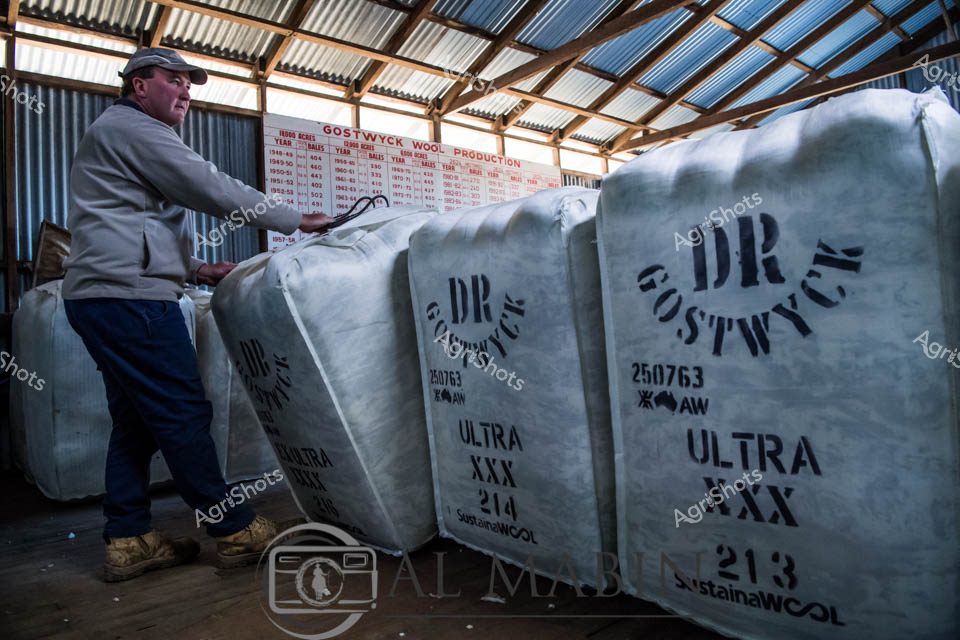
Stacked meticulously within a rugged corrugated iron woolshed, pristine white wool bales bear the distinctive "DR Gostwyck" brand, revealing the provenance of this premium Australian merino wool harvest. Each compressed bale represents the culmination of careful sheep husbandry, with detailed markings indicating quality grades like "ULTRA XXX" and tracking numbers that speak to the precision of rural agricultural processing. The wooden floor and industrial shed infrastructure frame these substantial wool bales, capturing the essence of Australia's renowned wool production - a testament to generations of agricultural expertise and sustainable farming practices. Soft, dense bales stand uniformly aligned, their crisp white surfaces contrasting against the weathered timber and metal surroundings, embodying the remarkable transformation from fleece to valuable textile commodity. The structured arrangement and professional labeling underscore the sophisticated supply chain of Australian woolgrowing, highlighting the critical link between pastoral landscapes and global textile markets. These bales represent more than mere agricultural product - they are compressed stories of landscape, livestock, and the meticulous craft of wool production.
 Image
Weathered woolshed expertise converges as two seasoned shearers meticulously examine a pristine pile of freshly shorn Merino wool. Their hands, marked by decades of agricultural craftsmanship, gently assess the fleece's quality, checking fiber length, density, and cleanliness against generations of inherited knowledge. Dressed in classic navy and blue workwear, these skilled professionals stand against a steel-green shed backdrop, their reading glasses and focused expressions revealing the precision required in wool assessment. Soft white fleece billows around them, a testament to the intricate process of transforming raw wool into a global textile commodity. The subdued lighting and industrial setting capture the timeless rhythm of Australian wool production - a delicate dance of skill, experience, and respect for one of the nation's most significant agricultural exports. Their collaborative examination speaks to the deep understanding and quiet communication developed through years of shared work in the pastoral landscape.
 Image
Aerial view of a classic Australian sheep station nestled in the golden pastoral landscape of rural Australia. A weathered woolshed with its iconic red-rusted roof anchors the scene, surrounded by precisely divided livestock paddocks and yards. Merino sheep cluster in the carefully fenced enclosures, their white fleeces standing out against the dry, wheat-colored grasslands dotted with scattered eucalyptus trees. The shearing complex reveals a meticulously organized agricultural infrastructure - multiple holding paddocks, a central water tank, and auxiliary buildings that support the critical wool production process. Soft shadows stretch across the undulating terrain, suggesting mid-morning light revealing the intricate workings of a high-functioning sheep farming operation. The landscape speaks to generations of agricultural expertise, with carefully maintained fencing, strategic land management, and the enduring architecture of rural Australian farming traditions.
 Image
Sunrise casts long shadows across a quintessential Australian sheep station, revealing the architectural precision of a classic woolshed and intricate livestock yards. Weathered red-rusted corrugated iron crowns the expansive shearing shed, standing as a testament to generations of pastoral enterprise. Meticulously organized paddocks and wooden fencing create a geometric landscape, containing a flock of pristine white Merino sheep - their fleece a valuable agricultural commodity. The surrounding terrain speaks of resilient rural topography, with scattered eucalyptus trees punctuating golden grasslands and distant hills, capturing the essence of Australian agricultural landscape. Nearby farm buildings and utility vehicles suggest an active, working agricultural environment, where modern infrastructure meets traditional farming practices. The scene embodies the quiet industry of sheep farming, a cornerstone of Australia's rural economic and cultural heritage.
 Image
Sunlight cascades across the weathered woolshed, casting long shadows on the parched pastures of The rural landscape. The classic corrugated iron roof, faded to a rusty patina, sits atop sturdy white walls, nestled among silvery eucalyptus trees that define the quintessential Australian pastoral setting. Positioned in the heart of New South Wales sheep country, this shearing shed stands as a testament to generations of wool production, its sturdy timber yards and fencing suggesting decades of agricultural heritage. The brilliant azure sky and golden-brown grasslands speak to the harsh, beautiful conditions of the Australian countryside, where resilience is etched into every weathered timber post and sun-bleached landscape. Though no workers are visible in this moment, the shed resonates with the potential energy of shearing season - a place where Merino wool, prized globally for its exceptional quality, is harvested with skill and tradition. The scene captures the quiet dignity of rural infrastructure, a silent guardian of Australia's rich agricultural narrative.
 Image
Sprawling across the golden undulating paddocks of rural New South Wales, this state-of-the-art glasshouse complex represents the pinnacle of modern agricultural innovation. Gleaming silver-grey greenhouse structures dominate the landscape, their precise geometric grid meticulously engineered for maximum crop productivity. A substantial water reservoir flanks the facility, highlighting the critical role of water management in contemporary agricultural systems. The surrounding landscape reveals a classic Australian agricultural terrain - gently rolling wheat-colored fields punctuated by scattered eucalyptus trees, creating a timeless backdrop to this cutting-edge horticultural installation. Strategic perimeter fencing and well-maintained access roads demonstrate careful infrastructure planning, while the expansive glasshouse suggests advanced hydroponic cultivation techniques for high-yield vegetable production. The crisp blue sky and dry grasslands emphasize the challenging environmental conditions that modern agricultural technology can now successfully overcome, showcasing Australian agricultural prowess and technological sophistication.
 Image
A dedicated farm worker maneuvers a massive wool bale using a blue hand trolley in a classic corrugated iron woolshed. The large white rectangular bale, stamped with "DB EXTRA ULTRA ALASKA", represents the culmination of careful wool processing, waiting to be transported from the rustic storage area. Wooden structural beams and multiple stacked wool bales create a textured backdrop of agricultural infrastructure, highlighting the systematic nature of wool production. Dressed in a grey jacket and blue jeans, the worker leans into the task with focused determination, showcasing the physical labor required in rural agricultural operations. The soft, filtered light streaming through the shed's openings creates a sense of early morning industry, capturing the essence of Australian wool processing. This image epitomizes the precision and hard work integral to Australia's renowned wool export industry, revealing the critical human element behind every bale of premium wool.
 Image
Ripe clusters of tomatoes cascade from verdant vines within a meticulously organized hydroponic glasshouse. Vibrant red and emerging orange fruits sit alongside unripe green spheres, illustrating the progressive ripening stages of this carefully cultivated crop. Precise rows stretch into the distance, supported by white infrastructure and expertly managed growing systems typical of modern Australian agricultural production. The lush green stems and varying tomato hues create a compelling visual narrative of controlled agricultural innovation, showcasing the precision and technological sophistication of contemporary horticultural practices in New South Wales. Soft ambient light filters through the glasshouse, highlighting the smooth, glossy surfaces of the tomatoes and creating a sense of tranquil productivity. This image captures the intersection of nature and agricultural expertise, revealing the meticulous care and advanced techniques that bring fresh produce from specialized growing environments to Australian tables.
 Image
Ripening tomato clusters cascade in vibrant gradients of green, orange, and deep crimson against the pristine white infrastructure of a modern hydroponic greenhouse. Suspended on precisely engineered vine supports, each tomato cluster demonstrates the meticulous cultivation techniques of contemporary Australian agricultural production. The verdant green stems and varying fruit maturation stages reveal the carefully controlled environment, where temperature, humidity, and nutrient delivery are optimized for consistent, high-quality yield. Brilliant sunlight filters through the glasshouse, casting soft shadows and highlighting the smooth, glossy surfaces of tomatoes transitioning from unripe green to rich, saturated red-orange. This controlled agricultural setting represents the pinnacle of sustainable horticultural practice, where technology and botanical expertise converge to produce premium fresh produce for domestic and export markets. The geometric precision of the growing infrastructure - with its clean white surfaces and orderly plant arrangement - speaks to the advanced scientific approach of modern Australian agricultural enterprises.
 Image
Industrial-scale white leghorn chickens crowd a wire-mesh battery cage system, showcasing the large-scale poultry production methods prevalent in modern Australian agriculture. Tightly packed birds jostle for space, their pale feathers contrasting against the dark metal infrastructure of the industrial farming environment. Yellow water dispensers line the cage, providing hydration in this densely populated system. The chickens' red combs stand out starkly against their white plumage, indicating they are mature birds in peak production. This scene captures the challenging realities of large-scale commercial egg and meat production, where animal welfare and industrial efficiency intersect in complex and often controversial ways. The tightly confined space, uniform coloration, and mechanical infrastructure reveal the systematic approach of contemporary agricultural practices in managing livestock.
 Image
Rippling clusters of vine-ripened tomatoes surge with vibrant crimson brilliance against the soft-focused backdrop of a modern glasshouse environment. Each perfectly formed fruit gleams with a lustrous, saturated red, punctuated by verdant green stems and intricate branching structures that anchor the robust tomato bunch. The precision of hydroponic cultivation is evident in the uniform size and stunning color gradient, ranging from deep scarlet to warm orange-red, suggesting optimal growing conditions and meticulous agricultural management. Suspended from sturdy supporting lines within a controlled greenhouse setting, these tomatoes represent the pinnacle of contemporary Australian horticultural practice. The image captures the extraordinary detail of each tomato - smooth, taut skin revealing subtle variations in tone and luminosity, with delicate stems connecting each fruit in an elegant botanical architecture. Soft background hints of additional clusters suggest this is part of a larger, carefully maintained crop, showcasing New South Wales' advanced agricultural capabilities in protected cultivation. The close-up perspective invites viewers to appreciate the near-perfect symmetry and organic beauty of these vegetables, transforming a simple agricultural product into a compelling visual narrative of technological innovation and natural abundance.
 Image
Battery Cage White Leghorn Layers: Industrial Poultry Production Stark white Leghorn chickens crowd tightly within a steel-framed battery cage system, their pale feathers pressed against metal gridwork and yellow positioning markers. Packed shoulder-to-shoulder, the hens display the intense density of commercial egg production, their red combs and wattles creating stark crimson accents against their uniform white plumage. Each bird seems simultaneously compressed and alert, a living testament to agricultural efficiency and industrial livestock management. The metallic vertical divider bisecting the frame emphasizes the systematic, regimented nature of this controlled environment, where every square centimeter is optimized for maximum protein and egg output. Harsh lighting reveals every feather and physiological detail, presenting an unflinching view of modern agricultural practices that prioritize production metrics over individual animal comfort. This image captures the cold calculus of industrial farming - a world where living creatures are transformed into precisely managed biological systems.