Browse the collection
 Image
Aerial view of a sprawling cattle herd dispersed across the sun-baked, rust-colored landscape of a remote Queensland cattle station. Hundreds of mixed-breed cattle - a blend of white, black, and brown animals - dot the arid terrain, their bodies creating a living mosaic against the parched earth and sparse vegetation. The expansive pastoral scene captures the harsh beauty of Australian outback agriculture, where livestock management requires significant land and resilient animal breeds adapted to extreme conditions. Windswept grasses and scattered low scrub punctuate the ochre-toned ground, revealing the challenging environment these cattle navigate daily. The image speaks to the scale of Australian beef production, where herds roam across vast, seemingly endless stations that stretch to the distant horizon. This aerial perspective dramatically illustrates the extensive farming practices unique to Australia's interior, where cattle mustering and land management are intrinsically linked to survival in one of the world's most unforgiving landscapes.
 Image
Pale, sun-bleached cattle legs emerge from a rich terracotta-colored desert landscape, casting delicate shadows across the fine, rippled sand. The muscular limbs of stock animals stand resolute against the harsh Australian outback terrain, revealing the resilience of cattle bred for challenging station environments. Fine dust motes hover around the hooves, suggesting recent movement during a cattle muster across a remote Queensland pastoral property. The image captures the raw, unfiltered essence of cattle farming in Australia's arid interior - a world of extreme temperatures, minimal vegetation, and generational agricultural persistence. Each animal's leg bears subtle variations in coloration, from cream to russet, highlighting the individual character within the herd.
 Image
Dusty red earth and sparse golden grasses frame a classic Australian cattle muster across the expansive pastoral landscape. A dense mob of mixed breed cattle - predominantly Brahman crossbreeds with rich brown, white, and black coats - traverse a rugged outback hillside, their muscular bodies moving in a purposeful column. The harsh Central Queensland terrain tells a story of resilience, with sparse native trees and spinifex grasses punctuating the terracotta-hued landscape. These robust beef cattle, adapted to harsh arid conditions, demonstrate the skill of station workers in carefully directing the herd across challenging country. The bright, clear sunlight and cloudless sky suggest a mid-morning muster, with the warm tones of the landscape creating a quintessential Australian pastoral scene that speaks to generations of agricultural heritage. Each animal's distinct coloration and the undulating movement of the herd capture the raw energy and precision of large-scale cattle management in remote Australian rangelands.
 Image
A thundering herd of mixed-breed cattle traverses the burnt-orange desert landscape of a Queensland cattle station, kicking up billowing dust clouds against sparse grassland and weathered rocky terrain. Brahman-cross and white Shorthorn cattle, marked with distinctive yellow ear tags, move with purposeful momentum across the rich red earth, displaying the resilience of Australia's pastoral heritage. The herd reflects the diversity of northern Australian cattle breeding - ranging from creamy white to deep chocolate brown animals, their muscular frames testament to generations of selective breeding for heat tolerance and rugged environmental adaptation. Early morning light casts long shadows, highlighting the textural contrast between the cattle's varied coat colors and the arid landscape's muted vegetation. This powerful scene captures the essence of Australian cattle mustering - a timeless ritual of movement, survival, and agricultural tradition that has defined the continent's inland economies for generations.
 Image
Brahman cattle herd traverses the ochre-red earth of a remote Queensland cattle station, kicking up fine dust against a pale blue winter sky. A tight mob of mixed-breed beef cattle - predominantly grey Brahman with some darker brown animals - move purposefully along a stark dirt track cutting through sparse grassland and low scrub. Weathered sandy soil banks rise on either side, creating a natural channel guiding the livestock forward. The herd displays the robust characteristics of northern Australian cattle breeding, adapted to harsh arid conditions with their distinctive humped shoulders and loose skin. Soft morning light emphasizes the textural landscape, highlighting the rich terracotta ground and the varied coat colors of the cattle.
 Image
Brahman and crossbred cattle advance purposefully across the rich red earth of a Queensland station, their muscular frames silhouetted against a pale expansive sky. The lead animals - a pale grey Brahman, a deep russet-brown mid-sized beast, and a mottled grey mature cow - stride with collective intent across the dusty terrain. Their varied coat colors and robust builds speak to careful breeding strategies developed for resilience in Australia's challenging pastoral landscapes. The tight grouping suggests an experienced muster, with the animals moving with disciplined coordination typical of well-managed cattle stations. Warm ochre ground contrasts dramatically with the earthy tones of the herd, creating a quintessential Australian agricultural tableau that captures the raw beauty of northern Queensland's cattle country.
 Image
Brahman cattle traverse the rust-red earth of a remote Queensland pastoral station, their pale hides contrasting against the golden spinifex and weathered landscape. A striking white Brahman cow leads the herd, her distinctive large ears and loose dewlap marking her as a breed perfectly adapted to Australia's harsh northern environments. Behind her, a mix of rich brown and grey cattle move through the sparse grasslands, their yellow ear tags indicating careful station management and livestock tracking. The scene captures the essence of Australian cattle farming - resilience, space, and connection to challenging terrain. Low-hanging clouds suggest the approaching dry season, with the compacted dirt and scattered vegetation revealing the unforgiving nature of this agricultural landscape. The herd moves with a quiet purposefulness, embodying generations of genetic adaptation and pastoral knowledge. In the foreground, the red dirt tells a geological story of mineral-rich earth, while sparse grass clusters demonstrate the delicate ecological balance of arid grazing lands.
 Image
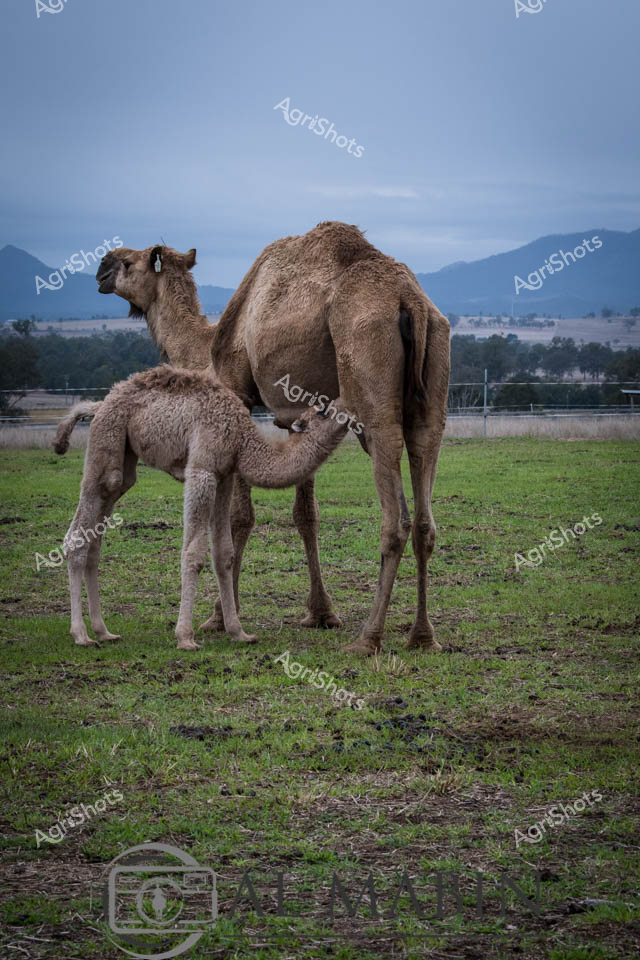
Bathed in the soft, misty light of an early morning, a tender moment unfolds between a dromedary camel and her young calf in a lush Queensland pasture. The mature camel stands stoically, her rich tan-brown fur textured and thick, while her offspring nestles close, nursing with the innocent dependency of youth. Mountain ranges blur softly in the background, creating a muted blue-grey horizon that frames the pastoral scene, highlighting the verdant green grasslands where the pair graze. The baby camel, slightly lighter in coloration, displays the gangly proportions of youth, its legs still gaining strength and coordination. This intimate portrait captures the nurturing bond between mother and offspring, a universal narrative of care and sustenance played out against the quintessential Australian rural landscape. The fence line and distant agricultural infrastructure suggest this is a managed agricultural environment, likely a specialized camel dairy or research facility exploring alternative livestock breeding. The image embodies the quiet resilience of Australian agricultural practices, showcasing how diverse livestock can thrive in challenging environments, with the misty mountains and green pastures serving as a testament to the adaptability of both animal and landscape.
 Image
Brahman cattle surge across a rust-red earth ridge under an expansive pale blue Queensland sky, their muscular frames and distinctive humped shoulders revealing their adaptation to harsh pastoral landscapes. The lead animals, varying from rich mahogany to soft fawn tones, move with deliberate purpose across the dusty terrain, their powerful legs traversing the unforgiving station country. Each beast bears the hallmarks of classic Brahman genetics - large pendulous ears, loose skin, and a robust constitution perfectly suited to Australia's challenging tropical and subtropical environments. The herd's tight formation suggests an organized muster, likely conducted by skilled stockmen guiding these resilient cattle across vast pastoral holdings. Soft clouds drift overhead, providing subtle contrast to the intense earthy tones of the landscape, while the cattle's textured hides catch the clear, bright light characteristic of inland Australian days. This image captures the essence of northern Australian cattle production - a testament to agricultural resilience, genetic adaptation, and the timeless rhythm of mustering on massive station properties.
 Image
Brahman cattle surge across deep crimson sand dunes, their varied coats of white, brown, and black creating a living canvas against the arid Central Queensland landscape. A classic cattle muster unfolds across this sun-baked terrain, with scattered spinifex and drought-resistant scrub punctuating the rich terracotta earth. The herd moves with collective purpose, their muscular bodies adapted to traversing challenging desert station country, demonstrating the resilience of both livestock and the pastoral workers guiding them. Dusty tracks wind behind the cattle, testament to their steady progression through this unforgiving environment where generations of Australian cattlemen have worked to manage herds across vast, remote stations. The image captures the raw essence of outback cattle management - a delicate dance of human skill and animal instinct playing out under an expansive sky. Each beast represents the robust Brahman breed, renowned for their heat tolerance and ability to thrive in Australia's harshest interior landscapes.
 Image
Brahman cattle surge across the rusty-red sand hills of a remote Queensland station, kicking up a billowing dust cloud that softens the arid landscape. The herd - a mix of white, grey, and black Brahman breeds - moves with purposeful momentum, their muscular bodies and distinctive humps adapted perfectly to Australia's harsh inland conditions. Sparse desert grasses and low scrub punctuate the rich terracotta soil, creating a striking backdrop that highlights the cattle's varied coat colors and textures. This dynamic mustering scene captures the essence of Australian pastoral life, where stockmen and cattle work in unison to navigate challenging terrain. The tightly packed mob demonstrates the resilience and strength required to manage livestock in one of the world's most demanding agricultural environments. The image pulses with movement, dust, and the raw energy of cattle being skillfully directed across the timeless Australian outback.
 Image
Wind-carved ripples of terracotta sand stretch across the vast Queensland desert landscape, capturing the raw, undulating texture of an arid station country. Soft, wavelike patterns create a mesmerizing topography of light and shadow, revealing the delicate sculptural forms shaped by persistent desert winds. The rich salmon-pink hues evoke the deep earth tones of Australia's central desert regions, highlighting the subtle variations in sand grain and wind-driven contours. Each ripple tells a story of geological patience, where invisible currents have meticulously carved intricate textures into the sandy terrain over countless seasons. The uniform coloration and smooth gradients suggest a moment of serene stillness, where the landscape breathes with a quiet, timeless energy characteristic of remote Australian outback environments. This textural canvas represents the harsh yet beautiful essence of Queensland's desert stations - a testament to the resilient and transformative power of natural landscape processes.
 Image
A dusty cattle muster unfolds across the arid Queensland landscape, with a herd of mixed white and brown Brahman-cross beef cattle traversing a rust-red earth track. Sparse golden grasslands and scattered grey-green trees punctuate the horizon under a soft, overcast sky, creating a quintessential Australian pastoral scene. The "White Puffs" signage hints at the station's cattle management, with yellow ear tags identifying individual animals moving together with a sense of purposeful direction. Hardy cattle, adapted to harsh inland conditions, demonstrate the resilience of Australian beef production - their varied coat colors ranging from pale ash to rich chocolate brown, reflecting genetic diversity bred for heat tolerance and survival in challenging environments. The photograph captures the raw essence of pastoral life - the quiet determination of livestock and landscape, where every element speaks to survival, adaptation, and the intricate relationship between land, animals, and agricultural enterprise. This image epitomizes the rugged beauty of Queensland's cattle country, where generations of farmers have carved out a living in unforgiving terrain.
 Image
Brahman cattle traverse the rusty-red earth of a remote Queensland cattle station, their distinctive pale hides contrasting against the arid landscape. A lead bull stands prominently in the foreground, his muscular frame and characteristic large, pendulous ears marking him as a classic Brahman breed - perfectly adapted to Australia's harsh inland conditions. The herd stretches behind him in a long, disciplined line across the rocky, ochre-colored terrain, each animal moving with purposeful determination through sparse scrubland and rocky outcrops. The harsh midday light casts sharp shadows, highlighting the texture of the weathered ground and the sleek, heat-resistant coats of the cattle. This is the quintessential Australian cattle muster - a timeless scene of pastoral management that speaks to generations of agricultural resilience. Yellow ear tags glint on the lead animals, a modern touch amid the timeless landscape that signals careful stock management and tracking.
 Image
Drover's Herd on Red Earth A powerful mob of mixed-breed beef cattle surge across the ochre-red dirt track, kicking up a swirling dust cloud that speaks to the harsh beauty of Queensland's interior. Brahman-cross and Santa Gertrudis cattle dominate the herd, their muscular bodies displaying the robust genetics developed for surviving Australia's unforgiving northern landscapes. Variations of rich brown, ash-grey, and cream coats blend together as the cattle move with purposeful momentum, suggesting an experienced muster across a remote station property. The burnt sienna earth contrasts sharply with the pale blue sky, creating a quintessential Australian pastoral scene that captures the raw energy of cattle management in the continent's arid regions. Each animal moves with a collective determination, their powerful frames and alert expressions revealing generations of breeding for resilience and strength. The image embodies the spirit of Australian cattle farming - a testament to human and animal adaptation in one of the world's most challenging agricultural environments.
 Image
Brahman-cross cattle drive thunders across the rust-red earth of a remote Queensland cattle station. A magnificent pale grey lead cow, her muscular Brahman features prominent, guides the herd along a dusty track through arid shrubland. Her yellow ear tag gleams against her silvery-white hide, marking her as part of a carefully managed breeding program. Behind her, a string of mixed-breed beef cattle - rich brown and pale cream - follow in tight formation, their disciplined movement reflecting generations of pastoral management. The landscape speaks of harsh Australian inland conditions: oxidized soil, sparse vegetation, and a harsh light that suggests mid-morning heat building across the expansive station country. This image captures the raw essence of northern Australian cattle production - where resilient livestock and skilled mustering techniques transform challenging terrain into productive agricultural landscapes.
 Image
A vast herd of Brahman and crossbred cattle traverses the rich red dirt landscape of a Queensland cattle station, kicking up billowing clouds of dust against the arid backdrop. White and brown bovines move in a dense, undulating mass up a rocky slope, their muscular bodies revealing the hardy genetics bred for surviving Australia's challenging pastoral environments. Sparse golden grasses and scattered green shrubs punctuate the terracotta earth, highlighting the rugged beauty of the inland pastoral region. The tight mob demonstrates expert mustering techniques, likely guided by stockmen just out of frame, showcasing the precision and skill of Australian cattle management. Each animal displays the distinctive characteristics of Brahman cattle - loose skin, prominent humps, and adaptable constitution perfectly suited to the harsh central Australian climate. The scene captures the raw essence of large-scale beef production, where thousands of head of cattle are moved across immense stations spanning hundreds of square kilometers, embodying the resilience and working culture of Australia's agricultural heartland.
 Image
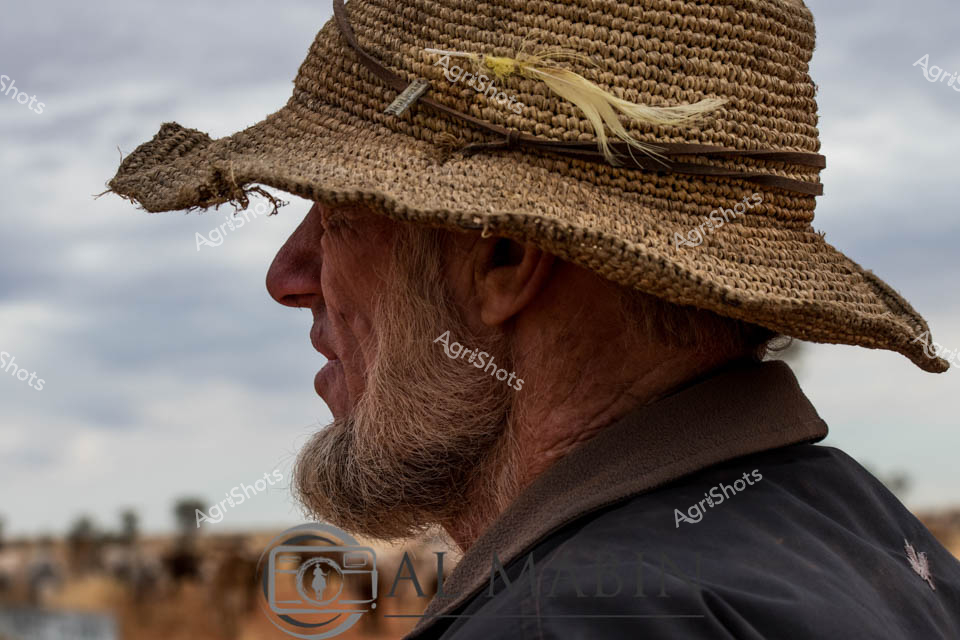
Weathered by decades of outback life, a seasoned stockman surveys the vast cattle station landscape. His deep-lined profile tells a story of resilience, framed by a meticulously hand-woven raffia sun hat adorned with a delicate feather - a subtle token of bush wisdom. Wearing a dark jacket that speaks to practical station attire, he stands with the quiet confidence of someone intimately connected to the harsh Queensland interior. The soft grey sky and distant terrain hint at the challenging environment of cattle mustering, where every detail of experience matters. A small insect rests casually on the hat's brim, a natural companion to this timeless scene of Australian pastoral life. The image captures the profound connection between a stockman and the unforgiving landscape, where survival depends on keen observation and generations of accumulated knowledge.
 Image
Weathered stockman guides a pale Brahman crossbred cow across the arid Central Queensland grasslands, navigating the rusty-red landscape on a robust red and black all-terrain vehicle. The sun-baked golden grasses stretch between scattered olive-green scrub trees, creating a quintessential Australian pastoral scene of remote cattle management. Wearing a protective wide-brimmed hat and dark jacket, the rider demonstrates the essential role of motorized transport in modern cattle mustering, bridging traditional pastoral skills with contemporary agricultural technology. The ATV, equipped with sturdy off-road tyres and practical cargo racks, becomes an extension of the stockman's working environment, enabling efficient movement across challenging terrain. Sparse woodland and reddish soil backdrop hint at the harsh, expansive nature of Australian cattle stations, where resilience and adaptability are crucial to agricultural survival. This image captures the enduring spirit of outback livestock management, where human ingenuity meets the demanding landscape.
 Image
A dusty pastoral landscape in outback Queensland unfolds as a herd of mixed Brahman and British-breed beef cattle graze on sun-scorched grasslands. Earthy red dirt tracks wind through sparse native grasses and scattered eucalyptus trees, with a weathered "White Puffs" sign marking the station location. The cattle - a blend of light grey Brahmans and rich brown beef breeds - cluster together, their muscular bodies resilient against the harsh arid environment. Yellow ear tags glint on several animals, marking their management and tracking. The overcast sky casts a soft, muted light across the scene, emphasizing the rugged textures of the landscape and the robust nature of cattle bred to survive in challenging Australian rangelands. This image captures the essence of northern Australian cattle station life - a testament to agricultural resilience, where livestock and landscape merge in a powerful narrative of survival and sustainable farming.
 Image
A sprawling herd of cattle traverses the arid Queensland landscape, kicking up clouds of russet dust against a backdrop of sparse woodland and rocky terrain. Brahman-cross cattle, their hides ranging from ash-white to deep chocolate brown, move with purposeful determination across the sun-baked station country. The tight mob represents the resilience of northern Australian cattle farming - weathered, tough animals adapted to survive in challenging environments where lesser breeds would perish. Each animal's muscular hindquarters and sturdy build tells a story of genetic selection for heat tolerance and robust movement across vast unfenced territories. Soft morning light casts long shadows across the dry grasslands, highlighting the subtle variations in coat color and the collective movement of hundreds of animals tracking in unison. This is the essence of Australian cattle production - a timeless dance of livestock and landscape, where generations of pastoral knowledge merge with the ancient rhythms of the continent's interior.
 Image
Central Australian cattle muster unfolds across a striking rust-red landscape, where a diverse herd of Brahman and crossbred cattle traverse a sweeping dirt track through sparse grasslands and scattered eucalyptus. The rugged terrain - characteristic of Queensland's interior - radiates with ochre-toned soil and weathered spinifex grasses, creating a dramatic backdrop for this quintessential pastoral scene. Cattle of varying colors - white, black, brown, and steel-blue - move purposefully in a long, sinuous line, kicking up fine dust clouds that softly diffuse the harsh sunlight. This image captures the raw essence of Australian cattle station life, where stockmen guide herds across vast, unforgiving landscapes using generations of accumulated skill and understanding of both animal and environment. The disciplined movement of the cattle suggests an experienced muster, with each animal tracking smoothly along the well-worn path, embodying the resilience and methodical nature of Australia's beef production industry.
 Image
Vast copper-red earth stretches beneath a soft pastel dawn sky, revealing a classic Queensland cattle station landscape. Scattered grey and white cattle graze across the arid terrain, punctuated by sparse eucalyptus and spinifex grasslands that define the harsh pastoral environment. A blue water tank and associated infrastructure sit quietly in the foreground, essential lifelines in this unforgiving landscape where cattle production demands resilience and strategic water management. The early morning light casts long shadows across the dusty ground, highlighting the intricate patterns of hoofprints and sparse vegetation that characterize these extensive grazing lands. Herds are loosely distributed, suggesting recent mustering or the natural grazing patterns of cattle adapted to survival in marginal rangelands. This aerial perspective captures the immense scale of Australian beef production, where thousands of hectares support relatively small cattle populations, showcasing the challenging yet productive nature of inland agricultural systems.
 Image
A thundering herd of Brahman and crossbreed cattle traverses the blazing red earth of a remote Queensland cattle station, kicking up plumes of ochre dust against a pale, cloudless sky. Rich browns, creamy whites, and burnished copper tones ripple through the muscular herd, their distinctive humped shoulders and loose skin revealing their adaptability to harsh Australian pastoral landscapes. Sparse mulga trees and spinifex grasses punctuate the arid backdrop, highlighting the rugged terrain these resilient cattle navigate during a traditional muster. The powerful movement captures the essence of Australian pastoral life - a carefully choreographed dance of livestock, stockmen, and unforgiving landscape, where generations of agricultural expertise converge in a timeless rhythm of survival and productivity. Yellow ear tags glint on some animals, a subtle marker of modern livestock management amidst this ancient, sunbaked environment.