Browse the collection
 Image
Two figures practice traditional stockwhip skills in silhouette against a dramatic South Australian sunset. The stockmen demonstrate their mastery of the long whips, creating flowing arcs through the dusky air as golden light filters across the rural landscape. This quintessential outback scene captures the enduring traditions of Australian pastoral life, where horsemanship and whip work remain essential skills for cattle mustering and station work.
 Image
Battery cage configuration for laying hens reveals the stark industrial precision of modern egg production. Tightly packed auburn-feathered chickens crowd around a metallic central structure with geometric red-and-grey mechanical extensions, creating a dense matrix of poultry infrastructure. The grid-like design demonstrates contemporary agricultural engineering, maximizing spatial efficiency for large-scale egg collection systems. Uniform brown hens with distinctive red combs huddle across perforated metal platforms, their bodies creating a living carpet surrounding the central mechanical axis. The intense proximity and systematic arrangement highlight the industrial scale of commercial egg production, where efficiency and standardized animal management define contemporary agricultural practices.
 Image
A figure holds a stockwhip silhouetted against a dramatic sunset sky in South Australia, with the sun's rays piercing between their legs as they stand in a grassy paddock. The purple and orange twilight colors create a striking backdrop as the person practices their whip work in the rural landscape. The scene captures the essence of traditional Australian stockwork against the golden hour lighting.
 Image
A bustling shearing shed captures the heart of wool production, with Merino sheep positioned on elevated wooden platforms while shearers work at their stations. The green wool press stands prominently in the center of the woolshed floor, surrounded by scattered wool and the organized chaos of shearing operations. Workers move efficiently throughout the shed, with wool bales stacked and ready for processing, showcasing the skilled craftsmanship and teamwork essential to South Australia's sheep industry. The industrial setting with its wooden partitions and practical layout reflects the functional design of traditional Australian shearing operations.
 Image
Inside a busy shearing shed, skilled shearers work with Merino sheep at individual stands along wooden platforms. The industrial woolshed features overhead equipment and pneumatic systems typical of large-scale sheep shearing operations. In the foreground, a green wool press compacts freshly shorn fleeces while a wool table displays the characteristic circular grading surface used for wool classing. Bales of pressed wool sit ready for transport, showcasing the efficient workflow from sheep to marketable wool product in this South Australian agricultural operation.
 Image
Thousands of Merino sheep crowd into expansive mustering yards in rural South Australia, their woolly forms creating a sea of cream and white across the dusty paddock. A farm worker on a motorbike patrols along the steel rail fencing, overseeing the organized chaos of the large-scale sheep operation. The sheep are densely packed within the structured yard system, likely gathered for shearing or sorting, demonstrating the impressive scale of Australian wool production. The arid landscape stretches beyond the yards, typical of South Australia's pastoral country where Merino sheep thrive in these challenging conditions.
 Image
Inside a bustling woolshed in South Australia, the sheep shearing operation is in full swing with Merino sheep being processed through wooden holding pens. A distinctive green wool press dominates the center of the shed floor, with white wool scattered around from the day's shearing activities. Farm workers can be seen moving between the timber-framed shearing stands where multiple shearers work simultaneously on the Merino flock. The industrial woolshed setting showcases the traditional yet efficient methods of wool harvesting, with the wool table and press equipment ready to bale the freshly shorn fleeces into compact wool bales for transport and processing.
 Image
Inside a bustling wool shed in South Australia, a farm worker operates a green wool press surrounded by towering stacks of wool bales labeled "KONETTA." The shearer works methodically at the wool table, compressing freshly shorn Merino fleece into compact bales while white wool fibers fill the air around the industrial pressing equipment. A large fan circulates air through the shed as hundreds of pressed wool bales create impressive walls of stored fleece, showcasing the scale of this sheep station's shearing operation. The scene captures the heart of Australia's wool industry, where skilled shearers transform raw fleece into market-ready bales.
 Image
Inside a bustling woolshed in South Australia, several shearers work efficiently at their positions along wooden shearing boards, handling Merino sheep with practiced skill. The industrial shed features exposed steel roof trusses and natural lighting, while wool bales and a wool press are visible in the background. Farm workers move between the shearing stations, maintaining the steady rhythm of this essential rural operation. White wool scattered across the wooden floors creates a textured carpet, highlighting the productive energy of shearing season at this sheep station.
 Image
Aerial view reveals thousands of Merino sheep densely packed in extensive sheep yards during mustering operations in rural South Australia. The weathered timber yards stretch across the dry paddock landscape, with sheep organized into multiple holding pens connected by race systems. A vehicle is visible near the yards, highlighting the scale of this wool-producing operation in the arid pastoral region.
 Image
Inside a bustling woolshed in South Australia, skilled shearers work efficiently in wooden shearing stands as they remove fleeces from Merino sheep. The industrial shed features exposed steel framework and concrete floors, with multiple shearing positions where men work as professional shearers handling the wool-heavy sheep. A wool table dominates the central area where fleeces are processed, while wool bales and pressing equipment are visible throughout the facility. This scene captures the intense pace and skilled craftsmanship of Australian sheep shearing operations during peak season.
 Image
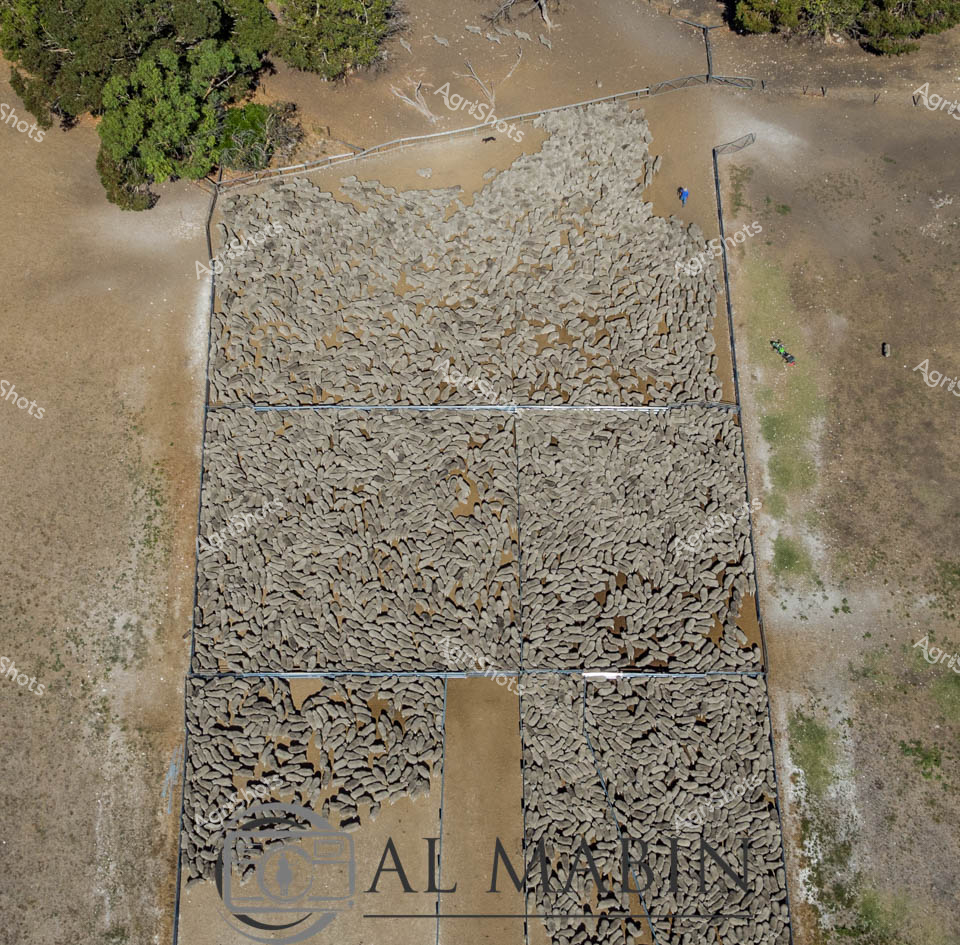
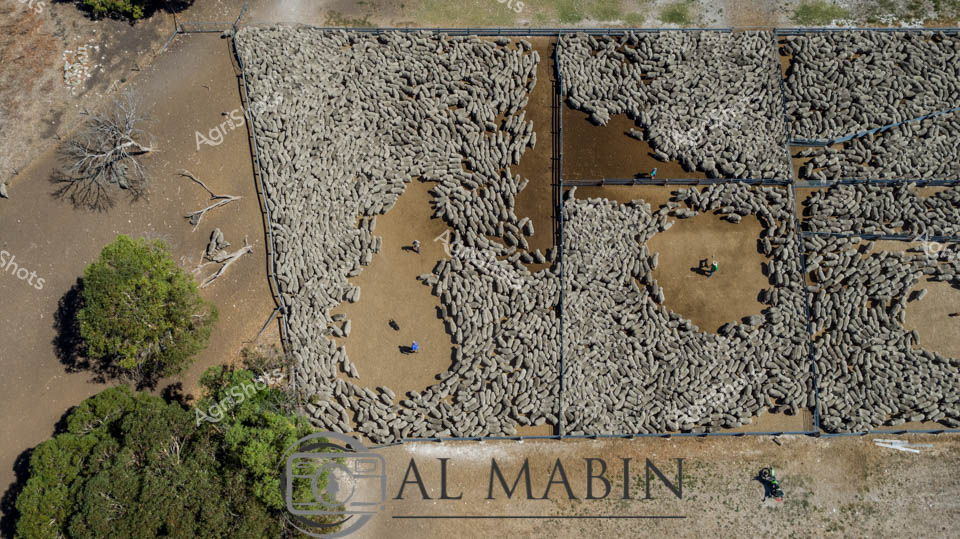
Aerial view of a meticulously organized Merino sheep yard in rural South Australia, revealing a dense flock clustered within geometrically precise metal-fenced paddocks. Soft grey-beige fleeces blend together, creating a textural landscape of woolly bodies pressed closely against one another, their subtle variations in tone suggesting individual sheep within the collective mass. Surrounding the yards, the landscape speaks of arid pastoral terrain - dusty earth tones of brown and tan, punctuated by sparse green vegetation and weathered trees, indicating a typical dry season in the agricultural heartland. The precise division of the yards suggests careful stock management, with each section strategically designed to control and direct the movement of these prized Merino sheep. The overhead perspective transforms the sheep from individual animals into a living, breathing textile - a moving carpet of wool that represents the backbone of Australian agricultural productivity.
 Image
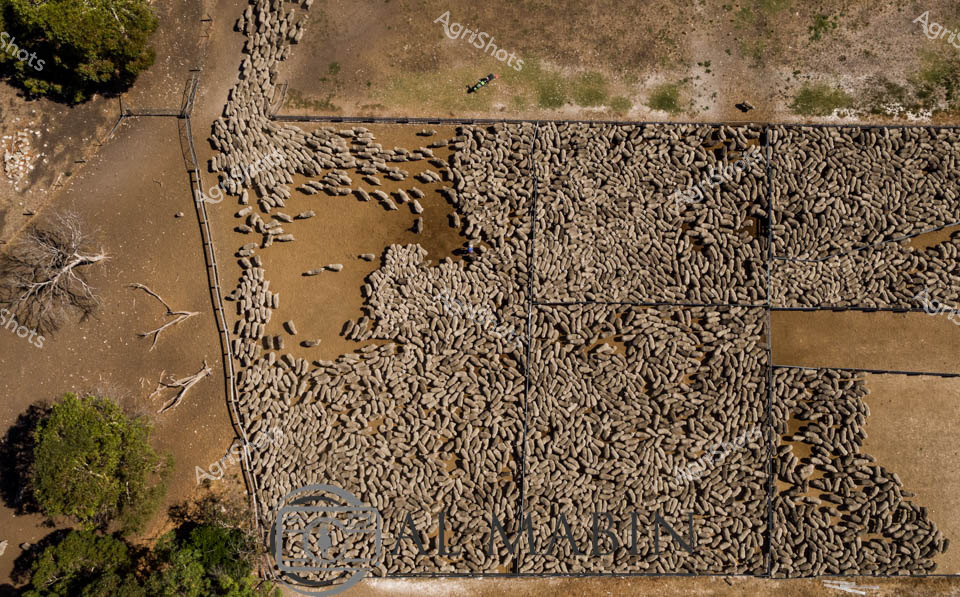
Aerial view of a densely packed Merino sheep yard in rural South Australia, capturing the intricate movement and clustering of hundreds of woolly bodies across segmented paddock sections. The sun-baked earth provides a rich ochre backdrop, contrasting with the uniform beige-grey fleece of the tightly grouped livestock. Fenced compartments create a geometric pattern, guiding the sheep's flow and movement between different yard sections, a testament to skilled agricultural management and mustering techniques. Scattered dry trees and sparse vegetation frame the edges of the yard, highlighting the arid landscape typical of South Australian sheep country. The overhead perspective reveals the remarkable density and organic, almost fluid-like formation of the flock, showcasing the remarkable precision of modern sheep farming practices. This image encapsulates the resilience of Australian agricultural systems, where livestock management is both an art and a science, adapting to challenging environmental conditions.
 Image
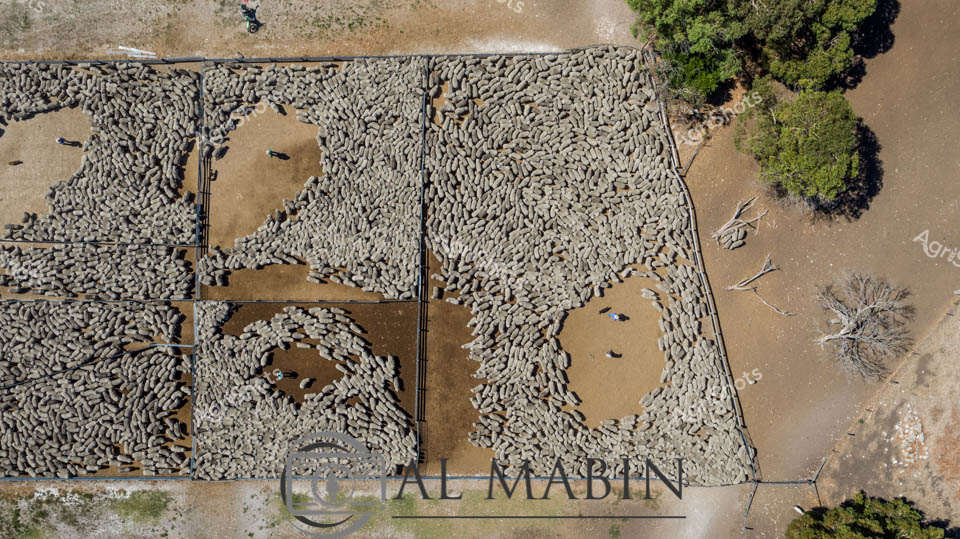
Aerial survey of a meticulously organized sheep holding yard, showcasing the precision of modern Australian agricultural livestock management. Dense flocks of merino sheep cluster across interconnected paddock sections, their pale woolly bodies creating a living carpet against the russet-brown earth. Carefully designed yard infrastructure divides the space into strategic segments, allowing controlled movement and sorting of the livestock. Surrounding the yards, sparse native vegetation and weathered trees punctuate the arid landscape, revealing the challenging environmental conditions of rural South Australia. The geometric pattern of the yards, viewed from above, demonstrates the sophisticated infrastructure required to manage large-scale sheep operations in challenging agricultural terrains.
 Image
Verdant vineyard rows cascade across the fertile banks of a winding river, capturing the quintessential agricultural landscape of South Australia. Meticulously planted grapevines create a geometric tapestry of emerald and olive green, their uniform lines stretching across gently undulating terrain. The surrounding landscape reveals a lush ecosystem of native bushland and river systems, with dense woodland framing the agricultural plot and a broad waterway meandering through the backdrop. Silvery-green foliage of the grapevines suggests a mature plantation, likely a well-established wine-growing region with ideal terroir for viticulture. Small agricultural buildings and access roads punctuate the scene, indicating a professionally managed agricultural enterprise with careful land use and strategic cultivation. The aerial perspective reveals the harmonious integration of agricultural production with the natural environment, showcasing the precision and beauty of Australian agricultural practices.
 Image
Verdant citrus orchards cascade down the gently sloping riverbank, creating a geometric mosaic of vibrant green plantations against the golden-brown earth of the Murray River region in South Australia. Meticulously planted rows of fruit trees stretch across the foreground, their uniform lines contrasting with the natural, winding blue waterway in the background. Dirt access roads separate the different crop sections, providing essential infrastructure for agricultural management and harvest operations. The landscape tells a story of careful agricultural planning, where modern farming techniques harmonize with the ancient riverine ecosystem, creating a productive and visually striking agricultural environment. Mature trees dot the peripheral zones, offering shelter and biodiversity to the cultivated landscape, while the expansive vista suggests the scale and importance of agricultural production in this part of South Australia.
 Image
An aerial view captures thousands of Merino sheep densely packed in concrete yards at a South Australian farming operation. The sheep appear as a textured sea of wool across multiple penned sections, with metal railings creating organized divisions for efficient mustering and handling. A farm worker in blue clothing stands among the livestock, providing scale that emphasizes the impressive size of this flock. The surrounding landscape shows typical Australian pastoral country with golden-brown paddocks stretching toward the horizon, while a solitary tree marks the edge of this large-scale sheep station.
 Image
An aerial view reveals the precise livestock management at The expansive sheep station, where meticulously designed containment yards demonstrate contemporary Australian agricultural precision. The drone perspective captures a complex network of paddocks, each densely populated with pale woolly sheep clustered in tight, organic formations against rich ochre earth. Large circular gathering points punctuate the geometric yard layout, allowing strategic mob movement and sorting. The gleaming white agricultural shed anchors the composition, a modern structural contrast to the organic movement of hundreds of merino sheep below. Dusty earthen tones dominate the landscape, suggesting the arid conditions of rural South Australia, where pastoral operations require sophisticated infrastructure to manage livestock efficiently. This image eloquently communicates the scale, mathematical planning, and environmental adaptation inherent in contemporary sheep farming - a testament to the agricultural expertise that underpins Australia's agricultural productivity.
 Image
An aerial view captures hundreds of Merino sheep densely packed within steel yard panels during mustering operations on a South Australian station. The sheep flow in organized streams through the handling facilities, with their cream and white woolly bodies creating distinctive patterns against the dusty ground. Metal gates and fencing structures divide the yards into sections, allowing efficient livestock movement and management. The scene showcases the scale of sheep operations in Australia's pastoral industry, with the flock's movement highlighting the systematic approach to livestock handling.
 Image
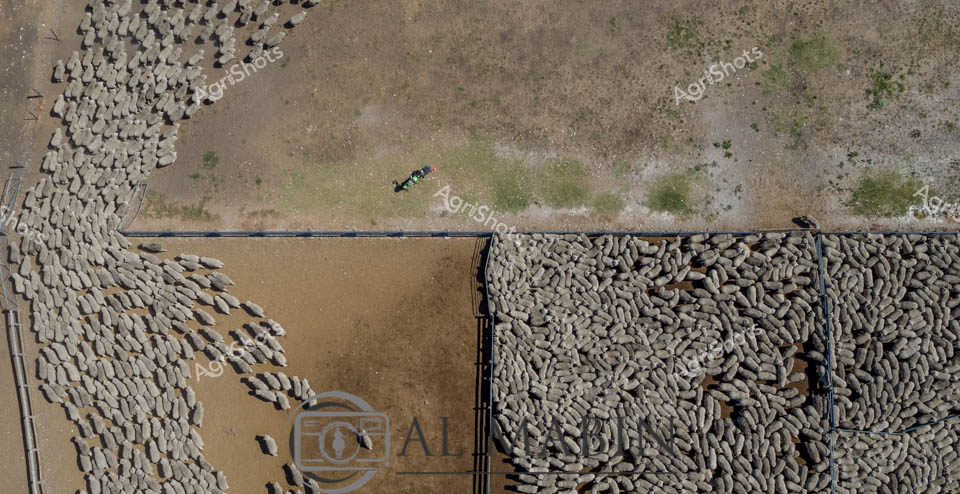
Aerial drone perspective of a precision livestock management scene in rural South Australia, capturing a vast Merino sheep flock densely clustered within geometrically defined steel-fenced yards. Golden-brown earth tones blend with the weathered landscape, revealing intricate patterns of sheep movement and strategic agricultural infrastructure. The flock's uniform silvery-grey fleece creates a mesmerizing textural mosaic, highlighting the disciplined herding techniques fundamental to Australian sheep farming. Subtle patches of sparse green vegetation punctuate the arid terrain, suggesting recent minimal rainfall in this challenging agricultural environment. The meticulously organized paddock layout demonstrates advanced farming practices, with carefully constructed yard sections allowing efficient stock management and movement. This image powerfully communicates the scale, precision, and environmental resilience inherent in modern Australian sheep production, where technological innovation meets traditional pastoral expertise.
 Image
Aerial view of thousands of Merino sheep densely packed in large rectangular sheep yards during mustering operations in South Australia. The well-organized yards feature multiple holding pens with earthen floors, designed to efficiently manage the substantial flock during processing. A few stockmen can be seen working among the sheep, demonstrating the scale of pastoral operations in this rural farming landscape.
 Image
Aerial view of a sprawling merino sheep holding yard in the arid landscapes of South Australia, capturing the intricate choreography of livestock management. Hundreds of dense, woolly merino sheep crowd the sectioned dirt paddocks, their pale fleece creating a living mosaic against the ochre earth. Strategically divided pens allow for careful sorting and movement, with small groups clustered in circular formations, demonstrating the precision of modern agricultural practices. The geometric lines of the yard contrast beautifully with the organic mass of sheep, revealing the careful balance between human infrastructure and animal husbandry. Brilliant overhead sunlight casts sharp shadows, highlighting the textural complexity of the fleece and the geometric precision of the yard's design. This image epitomizes the scale and sophistication of Australian sheep farming, where technology, landscape, and livestock merge in a dynamic agricultural ecosystem.
 Image
An aerial perspective reveals the intricate layout of a classic South Australian sheep station, with a pristine white woolshed anchoring the complex and surrounding paddocks dense with merino sheep. Dusty golden earth tones dominate the landscape, punctuated by weathered fencing and strategically designed livestock yards that guide sheep through systematic processing zones. The geometric precision of the corrals contrasts with the organic mass of woolly bodies clustered in different holding pens, showcasing the sophisticated infrastructure of modern Australian sheep farming. Multiple holding paddocks with circular water troughs demonstrate careful animal management, while the expansive shed provides critical shelter and workspace for shearing operations. The surrounding terrain speaks to the harsh, arid beauty of rural South Australia - sparse vegetation, compact dirt tracks, and a few scattered trees highlighting the challenging environment where pastoral agriculture thrives. This overhead view captures the engineering and ecological collaboration that defines Australia's world-renowned wool production industry, revealing the sophisticated systems behind one of the continent's most iconic agricultural practices.
 Image
Rural Heartland: Merino Woolshed Operations Kawasaki dirt bikes gleam electric green against the weathered corrugated iron of a classic South Australian woolshed, casting sharp shadows on the dusty yard. A vigilant working dog patrols the perimeter, alert to potential livestock movements within the sturdy sheep yards. Merino sheep cluster in the adjacent holding pen, their woolly forms a testament to generations of pastoral expertise. The brilliant blue sky and wispy cirrus clouds speak of a typical clear Adelaide Plains day, capturing the essence of Australian agricultural landscape. Modern agricultural technology meets traditional farming infrastructure - high-performance motorcycles providing rapid mobility across extensive pastoral properties. The scene epitomizes contemporary rural working life: efficient, pragmatic, deeply connected to landscape and livestock, where cutting-edge equipment supports time-honored farming practices.